What Writing Means To Me

I was just tagged by my friend and fellow author Jen Brubacher in a meme about what writing means to me.

She wrote that writing is truth and her elaborations are so perfect and true that I’m kind of jealous she wrote it, not me. It’s particularly worth reading for a certain drunken dwarf’s quote and her thoughts on said quote.

The person who tagged her, Icy Sedgwick, wrote that writing is escapism—and I wonder, really, if any writer lives who wouldn’t agree with her on some level at least.

And the “it” who got Icy? Tony Noland, who expressed that writing is freedom.

And just before him, Ruchira Mandal expounded on how writing is a journey.

Am I trying to cheat by giving the answers those other writers provided? Not at all. It’s just that their answers fit perfectly with what I want to say: writing is many things to me. The reasons I write, what I “get” from my writing, and how I feel about the process vary from day to day, even from hour to hour—yet I find there are always similar tendrils of desire as put my pen to paper or my fingers to my keyboard (to discover, to explore what’s “known,” to have fun).

Writing is a science—especially non-fiction, where I work from a hypothesis (thesis!) (articulated or not) and hone each phrase, insert each fact, and carefully draw each picture or stage I want to reveal to my reader, all the while deliberating on what I know and what I can reasonably infer about life.

The results can be surprising—sometime I realize I need to discard my initial premise because my experimenting (my writing) reveals a flaw in my thinking or logic—a new hypothesis is needed. Other times, the conclusion is exactly what I had hoped/envisioned/felt sure it would be—very affirming stuff. And, as in all science, while there are breakthroughs and massive epiphanies, there is never an arrival moment where all is known, all is suddenly clear.

And writing is magic—especially fiction. Us odd few called to the task, take strange ingredients, some commonplace, some only hinted at in polite company, some imagined, some completely undefined, only intuited, and throw them all together in simmering mess (or carefully measure out and weigh and add in at specific times, depending on our style).

It’s a shadowy art, unpredictable and dangerous even when it’s white. It’s often exhilarating, joyful and fun—but no words appear without some personal sacrifice (even if it’s just time that we worry could or should be better spent) and sometimes there is pain.

When the magic works, we conjure people long dead and still to come. We play with time, sending readers back and forward in both this world and others. A barrage of scents—good and gross—waft from our pages. People curl up, relax and smile—and freeze, sweat, flinch and flee—at what we smooth across their brow, glide along their chest—jab into their bellies. They grow embarrassed, become livid and enraged—weep, laugh, bite their lip and nod—with emotions evoked by lines of text.

We reveal strangers’ stories and end up showing the readers themselves. We hold up a mirror, but it’s our guts and innards that are reflected back at the reader with their lives, past and present, transposed over top.

When the magic doesn’t work—or, at least, doesn’t yield the results we were aiming for—we, sometimes weeping, bleeding, and beaten, return to our worktables to try different combinations, to explore different roots and weeds. We work, despite the pitying looks of naysayers and the laughter, even jeers, of those who doubt our ability or think we’re merely crazy for trying.

And why do people turn to science and/or magic? Because they are searching. They are longing. I am searching. I am longing. For connection, for understanding, for hope and to give hope . . . for many things actually. So for me, perhaps above all else, writing is a quest.

I don’t know why you write or what writing means to you—perhaps, like me, you find your thoughts on the subject toss and change like the ocean—but I’d like to find out and would love you to share thoughts here.

And to keep the meme-tag game going, I tag:

Laura Best
Jennifer Neri
Angela Dorsey
Kathy Chung
Vello Sork

Inklings, Procrastinators and . . . me

C.S. Lewis is one of my favourite writers. I love his Narnia creations, and his books on Christian faith (most notably, Mere Christianity and The Problem With Pain) were instrumental in bringing me to Christ. It was, however, his writing in A Grief Observed that most spoke to me. Though losing a wife and losing a mother are ultimately different; loss is ultimately the same and Lewis’s honest writings about sorrow helped me. And re-affirmed my conviction that books and story—fiction and non—are crucial helpers to us humans as we try to figure out how to live and what it mean to be, well, human. It’s not giving Lewis too much credit to say he’s one of the reasons* I started writing again.

But it’s not really C.S. Lewis I want to write about today. It’s his Inklings—a writing group that, from what I’ve gathered, consisted of twelve or so members (including J.R.R. Tolkien). I won’t embarrass myself with the romantic view I have of the bunch holed up in some pub, corner of a library, or ancient book and antique laden reading room. I won’t confess that thinking of them, I always feel the warmth of a crackling fire glowing from a grate and see it casting looming shadows of the literary greats along the walls—shadows that grow as their stories did, well into the night. And I won’t admit that I’m sure they always drank port—its scarlet red shimmering as firelight refracted off the crystal glasses containing it—cheers! And of course there’s cigar smoke. And equally of course, somehow said smoke is sweet and mellow and doesn’t make me gag or give me a headache just being in the same room with it.**

Oh, how jealous I was of his writing group! And then I got to be part of my own—a smaller group, though, I think, not lesser for being less. We try to meet in person once a year or so (and usually manage to, thanks in part to the huge pull of SiWC—but it’s tricky as we hail from different parts of B.C., and now, London, England), and we meet online regularly in a private forum called Procrastination (which makes us Procrastinators now, doesn’t it?). We drink lots of tea and coffee—and only occasionally port. I do have a wood fire that warms me—or at least the living room near me. We all have tonnes of books—or at least read tonnes of books. I don’t smoke cigars, but can’t speak for the others in the group.

I wish I lived in a place where we could all be together, at least monthly, but I can’t complain too much because I live in a time where despite huge geographical differences, we can still maintain very close relationships and share our words in real time, almost instantaneously.

It has been said that C.S. Lewis would’ve written and published all that he did without the Inklings (and the same has been said of Tolkien), and I suspect that may be true—at least partially. I think his writing community was a huge help to him, creatively and emotionally and practically.

The writing life can be a lonely, misunderstood and alienating (except when it’s the glorious opposite of all those things!). The writing craft is daunting—you only master one thing to notice six other problems you’d never even thought of dealing with. And the publishing world? Well, let’s just say it’s always been rife with tales of doom and gloom and the end of books and reading—not the happiest news when one’s trying to eke out a living with their words. Meeting with kindred spirits who like you, who like your stories, who are kind and funny and compassionate—even while they’ll straightforwardly tell you what is and isn’t working with your stories—keep you keeping on.

In James W. Miller’s review of Diana Pavlac Glyer’s The Company They Keep: C. S. Lewis and J. R. R. Tolkien as Writers in Community, *** he says that, “using a formula for determining influence created by another scholar, Karen Lefevre, Glyer analyzes the way the Inklings served as Resonators (encouraging voices), Opponents (thoughtful critics), Editors, and Collaborators (project teammates) for one another. She then adds her own fifth category, that they were Referents who wrote about one another and promoted one another’s books to publishers and the public.”

When I read that description, I thought, Egad—I’m so lucky! I have the good fortune of being part of a community like that too.

How about you? What is your writing community like? Are you part of a writing group? Does it have a name? Is it a face-to-face group or an online one? Do you feel there’s an advantage to either type of meeting?

– – – – – – – – – – – –

* Well, him, Stephen King, and Julia Cameron—bwahahahaha, what a combination! I wonder what on earth they’d think of being grouped together?)

** I don’t know if I ever stumbled across this picture and description before I googled, “c s lewis inklings pictures,” but apparently my imagination was well fed! 😉

*** A book I haven’t read yet, but that’s totally on my list now that I’ve read fifteen or so reviews about it.

Take 15 . . .

I’ve been extra busy lately—in good ways, with great things: my business, my part-time day job, my family. . . And though I strive (and mostly succeed) to work on my own writing projects, plus do at least one “author Ev” chore daily, I’m always tempted to give into the feeling that I can’t fit one more thing in and should go watch TV.*

The ongoing struggle is not to find words, but to sit my butt down and get them out on the page.

For the most part though, I’ve learned well not to yield to sloth (unless I really need to which is another post for another day ;)). Not making my own work a priority makes me miserable. Plus, I work hard to not let other people down and to help them achieve their goals—so why wouldn’t I give myself the same treatment?

And in that vein, I was fortunate this month to discover two amazing strategies for getting work done even when you think you have no time.

The first strategy comes from a course I took online through RWA, offered by author Kerri Nelson , called “The Book Factory—Produce Multiple Novels in a Year” (an amazingly practical and inspiring class, by the way. I highly recommend it). It boils down to this: write new words everyday, even if just for 15 minutes. Set the timer and write flat-out, no editing, no breaks, no pausing to think . . .

It’s freakish how effective those fifteen-minute sprints have been for me this month and last. I’ve had NO fiction writing time, yet in January I wrote 18 142 new words.

The second strategy is a bit more specific, but no less powerful. It’s “Plot your novel in 15 minutes or less” by Claudia Suzanne and I came across it at Mayra Calvani‘s blog (Mayra’s Secret Bookcase), a site recommended to me by author and friend Angela Dorsey (Oh, the tangled World Wide Web!).

I don’t usually outline at all, but desperate to not lose a new novel idea that just occurred to me last week, I thought I’d give it a try. I loved it. I now have a very bare bones, yet fantastic 15-point outline that gives me plenty of freedom, but that will guide me through to the story’s end, and (even better!) provide a frame for the book’s synopsis (my least favourite part of novel writing).

Anyway, I’d love to hear how your writing and life is going this month. And if you’re busy and my small suggestions above motivate you to put off your lounge on the couch for even just fifteen minutes, you’re welcome, heh heh.

* Yes, I realize there’s an obvious logic problem there—if I have no time, how can I manage to watch TV? What can I say? I like television . . .

The Pedastal Magazine

I was checking out the latest issue (61/Ten-Year Anniversary) of an e-zine I read in regular binges, The Pedestal Magazine, and I had to bring the editor’s letter to his readers to your attention.

I’ve written before about why I write, why I read and the value of the Arts to me, personally, and to Society as a whole. John Amen’s articulations on the subject so closely mirror my own, I confess I got a little misty: “. . . art saves lives. It saved mine when I was a teenager. If I had not somehow believed in the importance of creative expression, I would not have had anything tethering me to life itself. That I could write (or paint or make music) was paramount to me; it was everything, in a way. It was a redemption.”

I want to quote his next paragraph too–and the next. Instead, however, I refer you to the Readers’ Message in its entirety. I hope you find it as inspiring, affirming, and challenging as I did.

That shiny sparkling hope . . .

So I’ve been hiding out in my little buried corner of a very white world lately, busily, busily working away–on my own writing, yes, but also on an editing project and two writer-for-hire gigs.

It’s lovely weather for tea and books and holing up, and I have to fight going into full hibernation–but fight it I must. Spring will come and I will be very sad if I have not ventured out to the mailbox and kept my submissions up. So far I’ve been doing well, sending out a couple of things every week or so, and–even better–getting responses. That’s the trick, isn’t it? In order to get acceptances, we have to send things out (I know, I know–my blog, so enlightening isn’t it? Heh.).

A friend of mine always says to make a lot of submissions when you’re feeling down about your work because having things “out there” is inspiring and motivating. I totally agree. I think it’s because of the shiny sparkling hope that goes along with each hit of “send,” each envelope we seal and stamp. As long as our words are out there they have the chance of meeting some one who likes them, relates to them, laughs at them, or cries with them . . . And while they’re out, our minds are free to find new stories to spend time with.

What about you? Are your submission habits different according to the season? Do you send less or more in long winter months? How do you keep your writing hopes sparkly?

What you always wanted to do

My little sister Ellie Higginson is an Opera singer and moved to Germany just over a year ago, after several extended trips to various locations in Europe. In many ways her artistic journey echoes my writing journey (and I suspect there are similarities between most artists whatever their mode of expression!); each exciting step is the result of many years of unseen work.

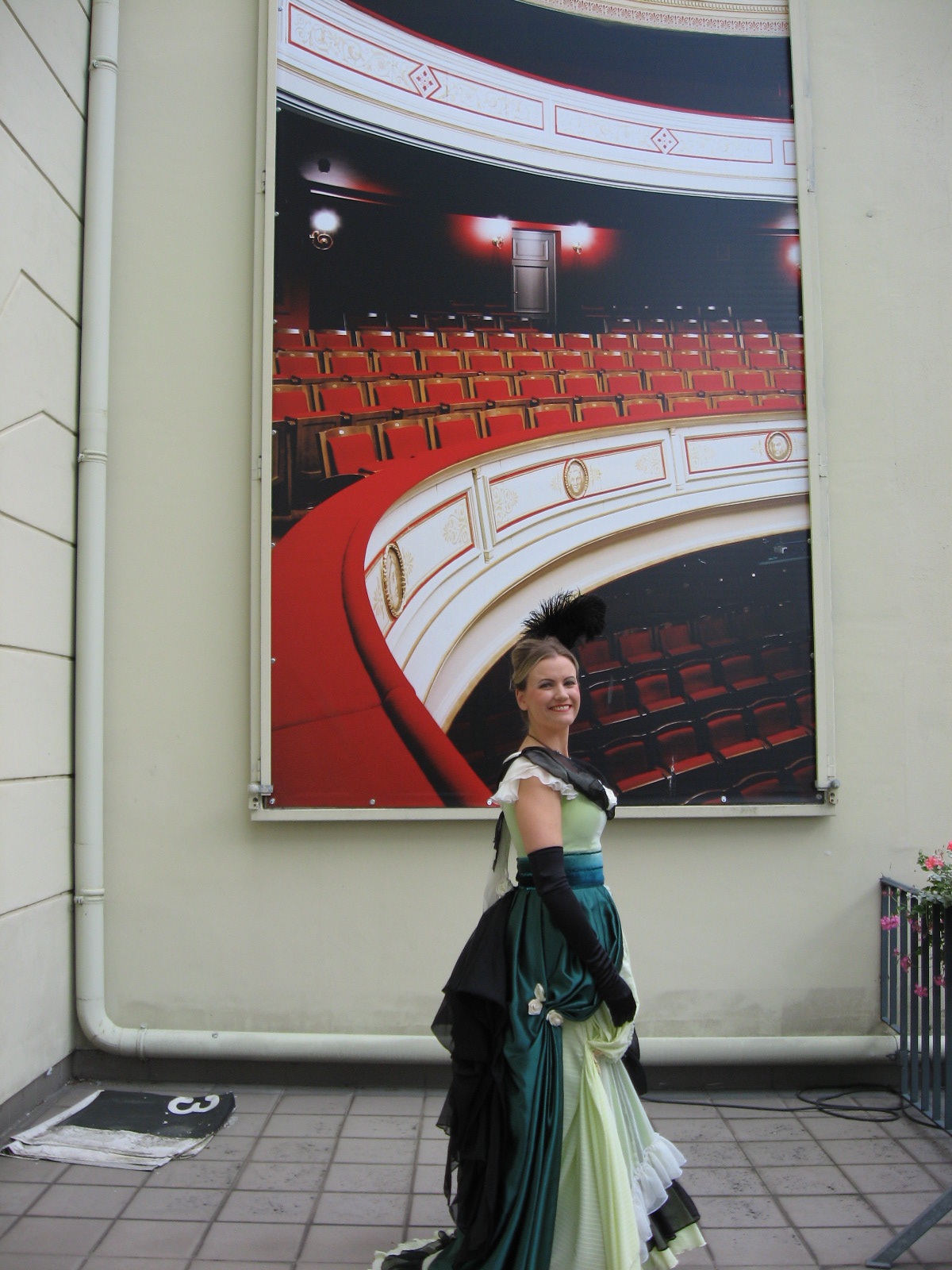
Ellie’s living in Goerlitz (a small town in the furthest part of East Germany, right on Poland’s border), singing under contract with the Opera theatre there. And now it’s audition season again and she’s eagerly looking ahead, working toward roles with other larger theatres—see, again, the writing connection: you get one gig, hurrah! But you haven’t arrived, you have to keep working, keep submitting, and repeat, repeat, repeat. 😉

The Terrace Standard and its sister publication, The Weekend Advertiser, ran articles about her recently because having any kind of an International performing career—let alone an Operatic one—is exciting news to the people you grew up around, but when you you’re a small town girl hailing from, of all places, Terrace, British Columbia, Canada, it’s that much more newsworthy.

A man who read the article approached me in the grocery store the other night.

“I saw that article about your sister in the paper,” he said.

I said something witty, like “Hello and oh yeah?”

“It was really cool.”

There was something so genuinely pleased for her in his tone that I can’t really explain it in words very well.

“I took it to work and showed all the guys—‘This is Wilf’s sister, man. She’s living in Germany and singing Opera.’” (Our brother used to work with him.)

We chatted on for a few minutes more about where she was exactly and how she was doing. Then he shook his head, and repeated with just a touch of wistfulness, “It’s just really cool. She’s doing it—she’s doing what she always wanted to do. Not many of us can say that.”

Bam! I was at once so happy and so sad, because he’s so right. Not many of us can say that. Somewhere along the way of growing up, getting married, and/or having dependents or other responsibilities, it’s easy to give up on that thing we always wanted to do, that artistic or athletic or fill-in-the-blank pursuit that made us happy, made us feel uniquely us. I think that’s what we love about someone else accomplishing something unique or special—it’s a reminder: Following your dream, living your dream, is possible.

I feel very fortunate. Dreams are about the experience you have while dreaming, not “results” and while my dream isn’t over yet, just like Ellie, I’m doing what I always wanted to. I wish I’d thought to ask the guy what it was he’d always dreamed about . . .

I hope Ellie knows what an inspiration she is . . . I think I’ll give her a call this week and remind her.

What do you want out of your writing?

What do I want out of my writing, or why do I write?

The other evening at my local writers’ group meeting, in honour of the new year and the evaluating, assessing and planning that usually goes with it, we each did a free write based on the above questions.

My answers weren’t anything incredibly deep (or that surprising to myself), but they were encouraging. It’s easy to get entangled in the outer elements of writing—word counts, markets, publishing “successes,” reader responses, etc—but the really important aspects of writing (for me, at least) are the immeasurable, non-trackable, non-recordable inner ones.

Here’s what I came up with—but wait, before you read mine, why don’t you take ten minutes and answer the questions as fast as you can, writing whatever comes to mind—then come back and read mine and if you want, share what you came up with. I’d love to read about why you write.

* * *

What do I want out of my writing, or why do I write?

Hmmm, they’re good questions, actually—ones that I ask myself semi-regularly in order to refocus my efforts, to motivate and re-inspire, and sometimes (especially if I’ve received a particularly disappointing rejection letter) to console myself.

I want many things from my writing. I write for many reasons!

In no particular order of importance—or rather, in order of importance that changes from day to day with whatever’s going on in my life—here are the main fuels for my for my muse:

Writing is pure fun! No matter what the genre, how picky and unfamiliar, thus arduous, the non-fiction topic, or how dreadfully thick a bog I may have hit in a plot, I just really love working with words and playing with stories.

Writing is a great comfort to me. Everyone has hard things they go through and while, yes, I suppose I’m saying I use writing as an escape at times, I also mean that seeing stories come out of me, out of my experiences, and out of the questions I have asked when confronted by my pain or the deep pain of others gives me comfort and a feeling of connection. We all have stories; it’s the one thing that all humans have in common.

Writing is a great way to think through what I believe, what I love, what I despise—and what, if anything, I can (or should!) do with those realizations.

Writing is cathartic. In terms of mental health, you can get a less expensive or more holistic form of therapy!

Writing helps me celebrate and remember beauty, love and all that’s good in the world. My non-fiction words (and who knows, maybe my fictional ones too) create a record of who I am and who I’ve been—and perhaps foreshadow who I will become.

Though I hope to one day make my living fully from my fiction writing (so I can have that much more time to write more!), writing is not (and has never been) about the money for me.

Going into a new year, the exercise was a lovely reminder: come whatever may, I am doing what I love to do. I hope reading this post—or even better, writing your own response—has been affirming for you.

Happy New Year and happy writing! May your words flow like they never have before.

Cheers,
Ev

Leigh Russell Interview

A couple of days ago I connected with Leigh Russell—a UK thriller writer with two titles fresh on the shelves (CUT SHORT and ROAD CLOSED), another soon to be published (DEAD END) and a fourth and fifth title for the series in the works. The fan girl part of my personality was jumping up and down and I won’t pretend I managed to be cool when she volunteered to be interviewed here.

It’s always wonderful to find a new author—and even more wonderful if you discover them early on and they’re prolific. I hope the writer in you enjoys Leigh’s comments, that the reader in you seeks out her books, and that the Christmas shopper we’re all called to be these days is relieved with a great idea about how to make a reader on your list very happy (or, at least, held in chilling suspense for 350 pages!).

– – – – – – – – – – – –
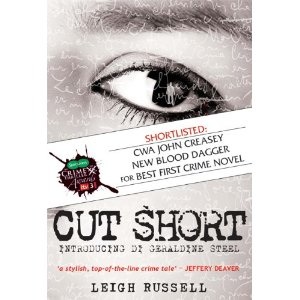
1. CUT SHORT, your first novel, introduces D.I. Geraldine Steel as she relocates to a small village (that’s right, guys, village, not town—we’re in the UK in this book), expecting peace, quiet and safety—a sheltered place to deal with the damage of her past. Instead she’s ensnared in a brutal serial murder investigation with herself as the killer’s next intended victim.

How did this story occur to you? Did the idea come fully formed? Did it originate with a character popping into your head?

Leigh: I was walking through my local park one day. It was raining and the park was deserted. As I approached a bend in the path beside a tangled copse of trees and shrubs a man suddenly appeared on the path, walking towards me. I’ve no idea where the idea came from but I wondered what I would do if I saw a body in the bushes and so became involved in a terrible crime, as a witness. I walked on and of course there was no body in the bushes, but the idea stayed with me and when I reached home I began to write it down. Who was the dead girl? Why was she killed? Who killed her? I became so engrossed in the narrative that I completed the first draft of my debut thriller in six weeks.

2. I understand that you broke into print in a way that most authors only dream about, receiving a three book deal just months into your writing life. Can you describe your personal journey from first deciding you wanted to write through to publication for us?

Leigh: F Scott Fitzgerald said, ‘You don’t write because you want to say something, you write because you have something to say.’ That was certainly my experience. There was no deliberate decision to write, I simply had an idea, started writing – and haven’t been able to stop since. I’m absolutely addicted! When I finished my manuscript I decided I might as well send it to a publisher who specialises in crime fiction, although I never really expected to hear back from them. You can imagine my surprise when two weeks later they called me for a meeting and soon after that signed me up for three books. I wrote somewhere that I fell into writing like Alice down the rabbit hole.

3. And now that you’ve “arrived,” how is publishing what you envisioned it to be? How is it not?

Leigh: We hear a lot about publishers who are distant and unhelpful but that hasn’t been my experience because my publishers are lovely people to work with. What I hadn’t realised was how much time I would spend promoting my books. I enjoy getting out and about meeting people and am passionate about supporting bookshops and libraries so most weeks I devote time to signing in bookshops. Just this week I signed in three bookshops and judged a short story competition for a writers group, and that’s fairly typical. I give talks at literary festivals, visit book groups and colleges, and give interviews to newspapers, on the radio and online – like this one! It’s all great fun but more time consuming than I’d anticipated.

4. Discovering that a book you enjoy is only the first in a series is a delight for any reader, and I was particularly excited to find out you’d done more with Geraldine. She’s a bit of tough character—very enigmatic—and by the end of CUT SHORT, though the ending was fantastic, there was still a lot I wanted to know about her.

Then I found out she had a series and I was excited because you’d left so much room to continue developing her (some series’ authors tell all, show all in Book 1 and don’t leave space for natural character growth and change).

Had you intended all the way along to write a series for D.I. Geraldine Steel or was it just good luck that you set your novel up to perfectly lead into one?

Leigh: Most authors plot the arc of their main character before they write the first book in a series, planning out the character’s journey throughout. I had no idea my initial manuscript would become a series so didn’t plan ahead in that way. As it turns out it was lucky I didn’t reveal too much about Geraldine in Cut Short. In Road Closed she sets out on a personal journey that is developed in Dead End in a plotline that will continue through quite a few books. I also have another idea for her, picking up on a character who is only mentioned briefly in Cut Short. Now I have a clear idea where Geraldine’s heading in her life, I have the end of the 20th book in the series in my mind and I know exactly how she is going to end up – although I might change my mind and come up with something entirely different.

5. What do you enjoy about writing a series? What are the challenges?

Leigh: I am enjoying developing my main character more and more as I get to know her better, but what I appreciate most about writing a series is that whenever I finish writing one book, the next one is waiting to be written. It means I haven’t had time to worry too much about how my books will be received, as I am constantly moving on the next story. One challenge is whether to write specifically for my growing fan base who are getting to know Geraldine, or for readers who are picking up one of my books for the first time. Another challenge for me is setting. In Cut Short and Road Closed I was rather vague about location, as I’m not very good with places. In Dead End I begin to tackle this, setting one scene in a real seaside town. In the following book Geraldine relocates to a real place.

6. Give us the blurb version of the plots for ROAD CLOSED and DEAD END. Please. 😉
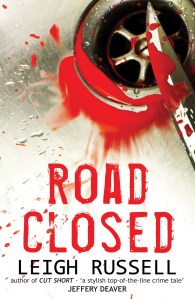
ROAD CLOSED. When a man dies in a gas explosion, the police suspect arson. The Murder Investigation Team are called in to investigate. The case takes on a new and terrible twist when a local villain is viciously attacked. As the police enquiries lead from the expensive Harchester Hill estate to the local brothel, a witness dies in a hit-and-run. Was it coincidence – or cold-blooded murder? The Murder Investigation Team has problems of its own – and so does Geraldine Steel. A shocking revelation threatens her peace of mind as the investigation races towards its dramatic climax.
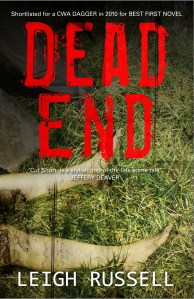
DEAD END. When the corpse of Abigail Kirby is discovered, police are shocked to learn that the victim’s tongue was cut out while she lay dying. Shortly after coming forward, a witness is blinded and murdered. Detective Inspector Geraldine Steel’s flirtation with the pathologist on the case helps her to cope with the distress of finding out she was adopted at birth. Abigail Kirby’s teenage daughter runs away from home to meet a girl who befriended her online. Too late, she realises she has made a dreadful mistake – a mistake that may cost her life. Detective Sergeant Ian Peterson uncovers a shocking secret about the serial killer who has been mutilating his murder victims. Does the sergeant’s discovery come too late to save Geraldine Steel from a similar dreadful fate?

7. To date, all your books (published and in the works) are thrillers of a dark variety. Did you set out to write creepy stuff or did it find you? Do you write in other genres as well, or do you hope to?

Leigh: You’ve probably realised by now that my stories found me, as I never set out to write a series of crime thrillers. I had an idea and ran with it and here I am. As for other genres, I might want to expand my range one day, but I have no time to explore other genres at the moment. If anyone had told me two years ago that I’d have written two bestsellers by now, I would have laughed, so I try not to predict what might happen next. The future is mysterious, doubtless peppered with surprises, and I’m just hoping for the best.

8. My kids are pretty blasé about “Mom” being a writer. Not that I don’t share details about my day or projects occasionally, but for them, it’s a lot like anecdotes about dishes or gardening—occasionally interesting, but not at all focus worthy.

You have two young daughters. What is their take on your career? How does (or does) writing about and investigating the topics that you explore in your books colour or affect your parenting?

Leigh: My daughters are not that young! I only started writing when they had both grown up and left home. They are members of my small and select group of readers and their comments are always very helpful. They love reading proof copies of my books, although they aren’t always happy with my behaviour. Last summer I was doing some research in London where Geraldine Steel will be relocating in my fourth book. I discovered a great location for a scene in the book and told my daughter excitedly, ‘I’ve found a perfect place to dump a dead body!’ She had quite a startled look on her face as she told me to ‘shhh’, while looking nervously over her shoulder.

9. What’s your favourite part of being a writer for a living? What do you like least about it?

Leigh: I love everything about writing.

10. What book(s) are you reading right now and what’s on your to read-list?

Leigh: Since I started writing I have very little time to read and when I do have any free time I tend to be writing. Authors I enjoy reading are Jeffery Deaver (who is a fan of my own books), Mark Billingham, Ian Rankin, Val Mcdiarmid, Sam Millar (another fan of my work)… the list is too long to include them all. I also admire many authors outside of crime fiction, Ian McEwan, Kazuo Ishiguro, as well as less contemporary authors like Dickens, Edith Wharton, Hardy, Steinbeck, Harper Lee – again, the list is a long one.

11. What would constitute a perfect day for Leigh Russell?

Leigh: I would get up late, write all morning, write all afternoon, and then spend the evening with my family. After that I would stay up half the night writing when everyone else was asleep.

12. Last but not least, do you have any word of advice, wisdom, or encouragement for aspiring novelists?

Leigh: I always give the same three pieces of advice to aspiring authors: Work hard, be brave, and be lucky.

– – – – – – – – – – – –

I don’t know about you, but I found that pretty darn inspiring. It’s fantastic to hear an author who’s doing it for a living still be so excited about the whole process. I love that she loves writing—and her books sound great, right?

If you’d like to read more about Leigh Russell in her own words, visit her online at No Exit Press or on her blog at
http://leighrussell.blogspot.com . You can buy her books (the first two anyway—DEAD END comes out early in 2011) in all major book stores. For your convenience, I hyperlinked the book covers to Amazon.ca for you. And if you’re interested in the kind of work Geraldine Steel does, check out this link: How to become forensic scientist

Happy reading and writing this month, all!

~Ev
December already!

It’s December already—unbelievable, but fun. Deck the halls—falalalala!

I’m a bit afraid, however, because every month I play the “this is the month where everything will slow down and I’ll finally be able to write a little bit more” game—and every month, well, you play the game too, you know what happens: life doesn’t slow down; it only speeds up. Schedules don’t free up; they shuffle so we can fit more in.

But December? I don’t even try to fool myself. Lovely, full month that it is, I know my writing time will only shrink. But that’s okay this year—in fact, I’m looking forward to it. I managed to clear all recent “must write” goals (well, except for the ones I botched—cough, cough, Nano 2010), and with the exception of a few Ev’s Writing Services jobs, I am going to write for the pure fun of it this month.

You read that right. Pure fun. No goals other than to write at least twenty days this month (any subject, form, genre, no minimum word count), plus one tiny structured one. I’m going to enter Jen Brubacher’s very fun sounding contest.

The whole take-it-easy and play theme for December 2010 is a much-needed Christmas present to myself.

How about you? Do you write more or less during December? Do you give yourself a break or do you use the month as one last push to meet your goals before the year turns? Whatever you end up doing writing-wise, I hope you pour yourself some eggnog and really enjoy it.

p.s. It’s not that my writing isn’t fun all year—it’s just that usually it’s goal-orientated, stories I want to submit, a novel I want to pitch, etc. What will be fun about this month is that I have no prior intentions . . . . 😉

Get Thee to a Conference!

I can’t believe that this time last week I was at SiWC sitting in a workshop called Polish and Shine led by Elizabeth Engstrom (fantastic class!). This Saturday is decidedly less glamorous and thrilling.

All this past week I rode the post conference high, but now the fuzzy glow is fading just a bit (or being blocked from my immediate view!) in the face of the dishes stacking up, the floors being in serious need of a sweep and mop (oh, my dogs–gotta love’em; wish I could shave’em!), the laundry and meals that never cease to need doing/making, and the bathroom, argh, the bathroom! Let’s just not talk about it. . . However, all grumbling and moping aside, my newly reaffirmed goals remain clear and focussed. My inspiration is freshly topped. And when I think of all I want to do, plan to do, need to do . . . Yes, I feel a bit intimidated, but even more, I feel stoked: being surrounded by 600+ writers for four days is seriously motivating.

Almost every year I hesitate before I hit submit to register for SiWC (my annual conference ;-)). Then I recall what it does for me: refuels me for another twelve months, reminds me that yes, writing is a solitary pursuit, but that I am not alone. Literally hundreds upon hundreds of other people identify with and embrace a similar madness!

Meeting with like minds (or at least similarly bent ones), being surrounded by a crowd of folks who really “get” this strange obsession you have with stories and words, and having the chance to learn from others in different places in the writing path than you–well, corny as it sounds, it’s priceless.

Not cost-free though. I’m already starting to put money away for next year, and I think you should do the same.

And less you’re not convinced you or your writing are worth the extravagance of a first conference (or a third, a tenth, a twentieth!), what am I doing right now? Sitting down to write while the house is empty and clear, dirty and in need of a clean as it is–and that’s the whole point, isn’t it? We want to be writers, so we write. We don’t need conferences to give us permission or to remind us–but they do help us remember it. If you have the chance to take part in a writer’s conference, big or small, nearby or far, I really recommend it. It makes all the time we spend in solitary sweet.