Where Stories Come From

People frequently ask me where I get ideas from and I’ve even blogged about this topic before in “Ye Olde Idea Shoppe.” While I occasionally have a clear connection between input and my vision for output (Oh, for “Such and Such” I was sitting under a bridge when X, Y and Z happened and Bam! I was hit with the story idea), I generally stumble through some lame mumble: Well, I don’t really know exactly. Ideas are everywhere.

Today, however, I’m happy to share a concrete bit of knowledge—including pictures—about where some of my ideas come from.

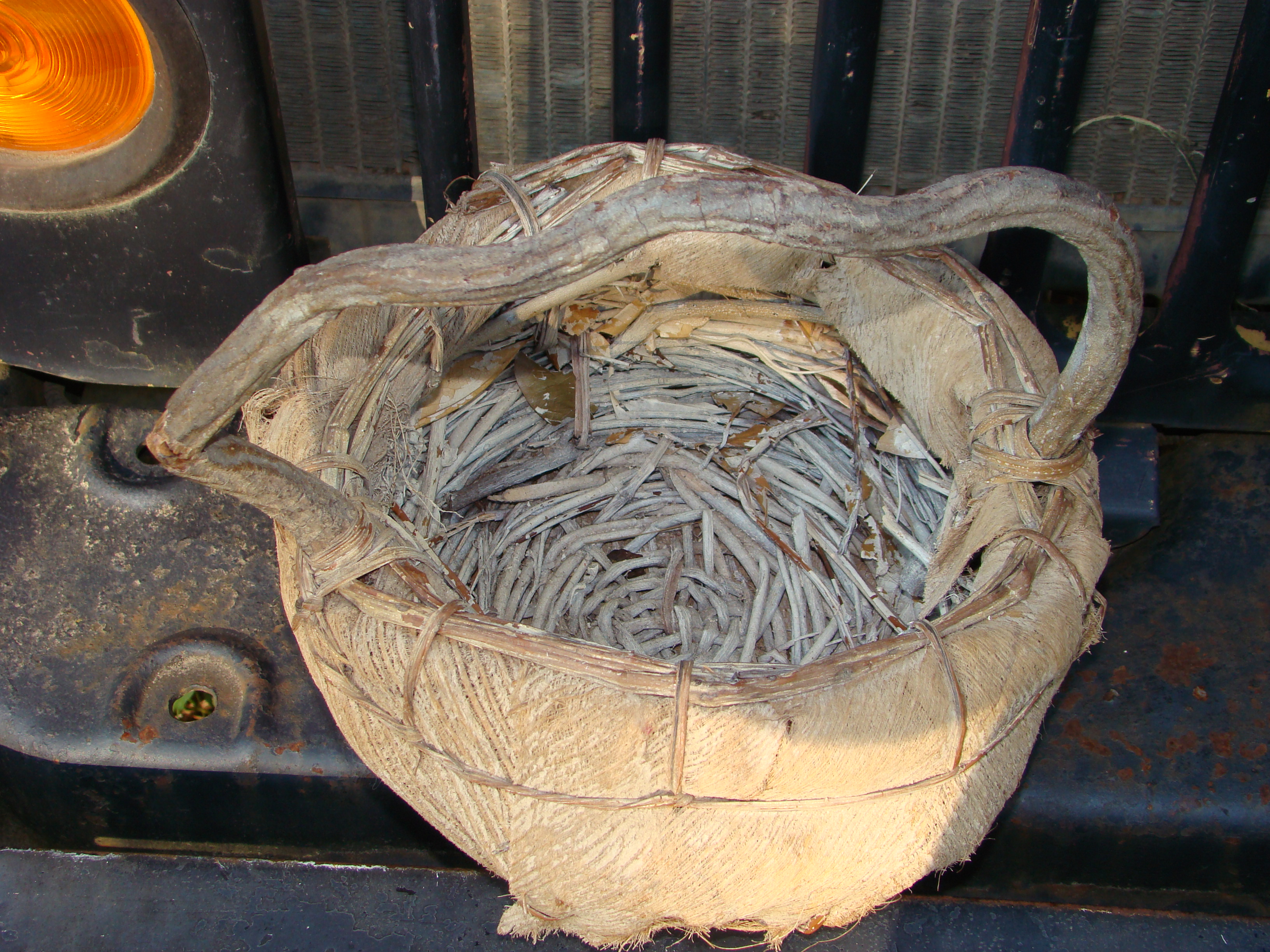
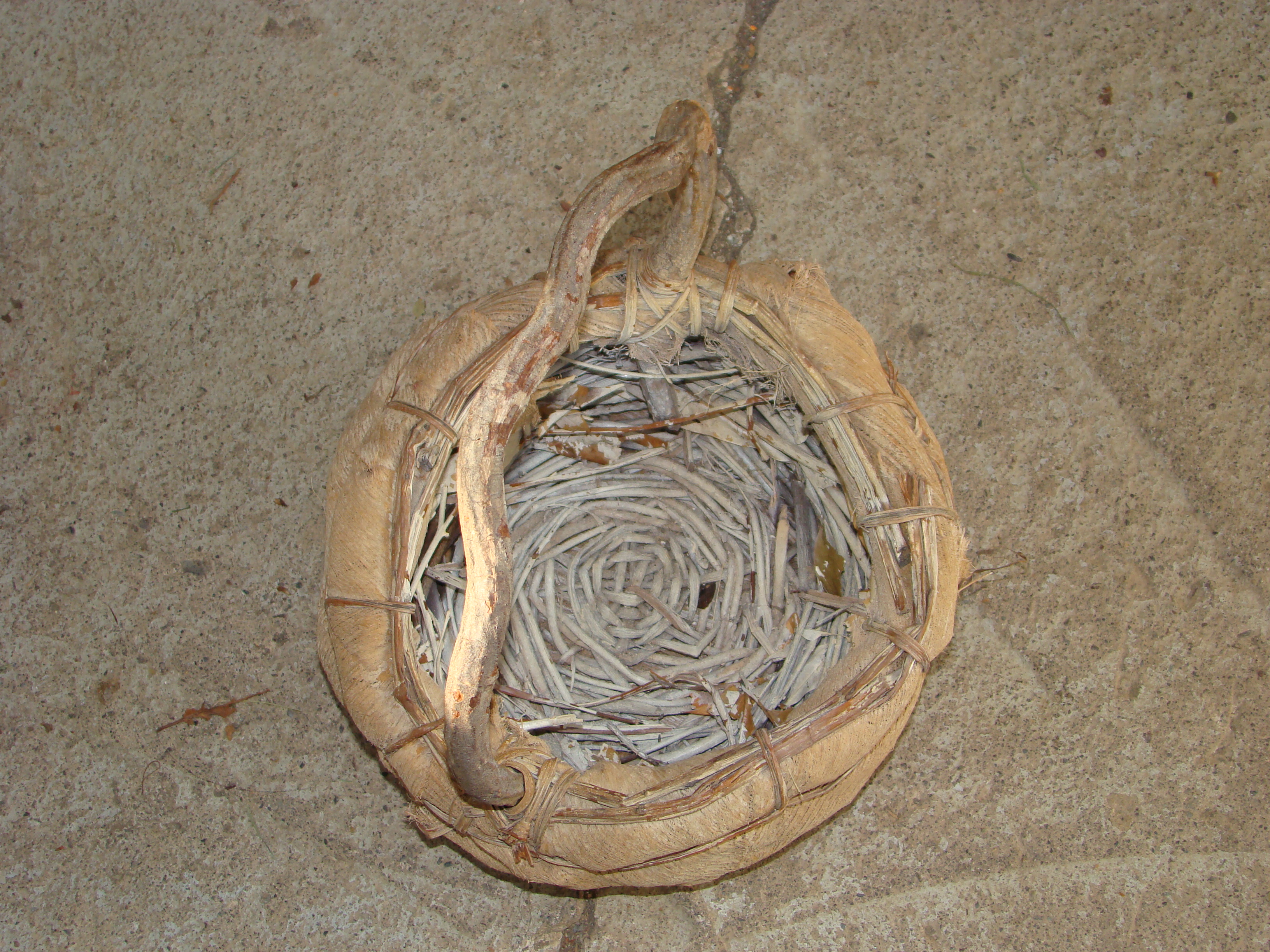
This weekend I was garage saling with my aunt and suddenly this crazy handcrafted basket made of twigs and burlap and leather appeared from out of nowhere.

“It’s a witch’s basket!” my aunt proclaimed with a small cackle. Indeed, it is Someone Interesting’s basket. I do not know what ideas exactly are coming from the basket, but there are many and I’m interested to see which ones I try to put to paper.

How about you? In the mood for a writing exercise? Here’s the basket—in three locations for your imagining pleasure. Write a scene or a short that features it or its owner, be he/she a long time keeper of the basket or someone who has just stumbled upon it.

If you do write something about this basket and want to share, I’d love to read what you come up with: just point me to the place!

Happy writing,
Ev

Hitting the Wall

I thought this hello-I’m-online-again-finally post would be something about the Internet and how I’d always thought that having constant access to the Web was an obstacle to writing. After all, almost every writer knows the mixed blessing/curse of such easy (fun!) access to, well, everything . . .

And I thought you’d all be surprised that when I found myself without access for three weeks, rather than write up a storm, finish eight projects, and win a Pulitzer (Yes, I seriously thought the World Wide Web was that much of a holder-backer!), I didn’t even open my novel. I wrote nothing new in it or for it. Not a word.

I can hear your disbelieving, shocked, “Whaaaaaaat?” from here. And I know. It’s absolutely bizarre. I tried to explain the strange result. I thought maybe it was because the draw of expected e-mails, the intrigue and interest of new blog posts, the fun of forums lured me to my computer and then, once I was done procrastinating, I felt compelled to write since I was on my computer anyway. And maybe there’s something in that.

But, as I’ve had my Internet back for almost a week and no new words in my novel have poured forth, despite being at my computer often and regardless of the fact that I have a lot of ideas churning for my story, I had to wonder if maybe it was something else keeping me from my story.

Then two nights ago I was getting dressed in my bedroom and I heard an animated, filled-with-laughter discussion between some family members and my husband out in our driveway. When I came out to say “Hi,” however, there was no one there. Just my husband. In the living room. In his chair. I still don’t know who I heard; it was very weird! And just like one of those old fashioned locks where pressing just the right spot triggers all kinds of sprockets to sproing and gears to engage, I knew what was wrong, why I hadn’t written!

In every novel I’ve written, I’ve come to place where I hit a wall. Where my write-by-the-seat-of-my-pants, no outline, no plan, style absolutely fails me. Where I’m sure that’s it, the book is dead, there’s not enough story to continue with . . . Unfortunately, though it’s obviously part of my writing-system, the wall always reveals itself differently. I never see it coming until I crash into it.

And this time the wall was its most subtle yet, just a series of quiet, unsettling questions that wouldn’t answer themselves and general angst that wouldn’t articulate itself . . .

That strange overhead conversation and laughter that I still have no idea about where it came from was the answer, however. I know what my book was missing and where exactly it’s going now. It does call for a rewrite right away, but I’m okay with that. I used to believe in writing the whole first draft, no stops. Now I often stop when I realize something’s not quite right and go back and fix it immediately.

Tomorrow I will commence a read through with notes, then the rewriting, then a 1-3 line plan for each chapter until the end. I’d be glum that it looks like I won’t hit my goal of having this book at third draft by October 21st, but I’m too happy: the Internet has been found innocent and my book is back on track. The wall wasn’t impenetrable. It ended up having a lovely huge arched doorway with a gothic-styled gate and a key just for me hanging on a velvet cord.

Slow Writer

I’m used to being a speedy writer, easily getting 1000 words, and usually closer to 2000 or 3000, on any given writing day—and that would just be on the fiction side, not reflecting my non-fiction work, blog entries, column ideas, or miscellaneous writing projects and experiments . . . And then I took a regularly-scheduled day job. I’m slowly getting into (and loving!) my new routine, but I was a bit worried a few days ago when I considered what it might be doing to my writing.

While I’ve been writing almost daily in June (to my huge relief, phew—in May I was worried about when I’d be able to return to that!), my word counts per session are way down. 380, 431, 494, 650, 733, 198 (gah!) . . . I only broke 1000 once this month. (Again though, not counting any non-fiction writing.) Yikes, my whole aim in getting a day job was to alleviate financial stress that was slowly quashing my creative joy—now was I in danger of potentially crushing my progress? Was I stuck in some lose/lose scenario? Absolutely not.

I did the math (funny how more and more as I get older I see the beauty and inspiration in numbers!); all those low numbers actually averaged 500 words per day. Even if I only write 20 days a month and even if I only get 500 words per session, that’s 10K in a month or, even more excitingly, 120K a year—a full novel, plus. And I suspect that most months I’ll write more than 20 days—and more than 500 words.

My worry changed to renewed excitement and fresh vigor. I love how my writing, no longer burdened with the need to generate money to live, is free to be my whimsy and passion again. And I especially love that I’ll be able to keep on track (easily!) with my novel a year goal, even if I keep being “slow.” I’m still striving to be a career novelist, hoping to write novels for enough money that I can work at them full time, writing even more of ‘em . . . but it’s nice to know that until that day comes, I don’t have to be a starving artist or sacrifice my writing goals.

It was a lovely realization and I’m thrilled to consider what my new routine will do for my writing.

How about you? Do you enjoy the luxury of writing full-time and still making ends meet? (Or perhaps struggle to make ends meet, but feel the pay off of doing what you love most makes it worth it?) Or do you balance your Art and a job/career? What are the benefits, pay-offs, or downsides of the type of writing life you lead?

Filling the Well

Many years ago I quit writing. The cessation lasted two years and almost drove me crazy. When I figured out what I needed (to write, regardless of the consequences—or maybe because of the consequences of not writing), a book called The Artist’s Way by Julia Cameron was incredibly, incredibly helpful to me.

Though I’ve forgotten many of the specifics of that great book, one of Cameron’s suggestions continues to be part of the philosophical foundation I build my writing life on: Fill the Well. It’s basically just the conviction that all ideas come out of a life lived, so rather than cloister yourself away to write every minute you have time because dammit-you’re-a-writer-and-writers-write, you should do things that aren’t writing related per se without guilt, because every activity, experience, moment with others, pours into your creative well and if you don’t have non-writing time, eventually you won’t have a well to draw from—or what you do manage to dreg up will be stale and bitter.

It can be easy to forget to freshen the well. If you’re like me, your life is busy and you covet writing time and feel guilty if you have time that you could write, but don’t use it “productively.” And there’s wisdom in our you-gotta-plant-your-butt-tyranny—but there’s also a line where too much discipline squashes—where I find myself writing only out of a sense of obligation, not that agony/ecstasy feeling of I MUST WRITE TO GET THIS ALL OUT OF MYSELF OR I WILL EXPLODE.

When my writing has that “Ugh, I have to write,” versus, “I get to write” feeling, I know I have to spend some time doing other things, and ironically, it’s usually when my work/life schedule is at its most hectic and my writing time is already at its scarcest that this need to make time to do other things is crucial.

My family is out at a cadet camp this weekend and after a ticket-selling shift yesterday (good volunteering mom, eh?) and getting a brochure I needed printed for a client, I planned to get A LOT done, because I have (like always, it seems these days) A LOT to do.


Instead, I:


Made a very yummy veggie and cheddar wrap and drank two glasses of wine, sitting in the sunshine with Twisted by Jonathan Kellerman (famous novelist, new to me—am enjoying very much!) 


Then I had a nap. Until 6:00 p.m. 


Then I worked in my delicious smelling flowerbed and yard until 9:00. 

Then I poured more wine, tossed up a stir-fry and watched TV—what a treat. 

Very rejuvenating. Just what I needed!

Today has been low-key too: sleeping in, drinking coffee, reading short stories—and I might clean my house a bit . . . But I’m starting to feel a building urge to get to my novel—there’s a scene burning, a character screaming to be let out . . .

What about you? Do you have similar feeling about the importance of sometimes NOT writing?

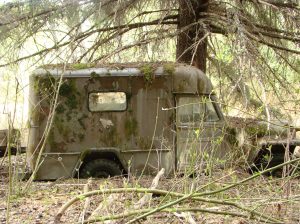
p.s. Where was that jeep found? Who did it belong to and why was it left? Last weekend found me wandering, filling the well—I hope the old ghosts don’t begrudge the pictures I took . . .

Where my head is at these days

Do you ever feel like a character in one of your own stories?

Ilene never regretted marrying young, choosing family over further formal education, and writing over a “real” job—until 2012 when colossal world ending shifts in the earth’s tectonic plates forces her to consider the path she chose. If she could do it all over again, would she change a thing?

Okay . . . my life is not exactly like Ilene’s or at all (hopefully!) like the theme of a certain year-titled film, but I have been doing some thinking on the choices I’ve made and will make in the future about my writing.

It’s not a case for panic—I go through these reassessment times fairly frequently, finding them invigorating and affirming (and sometimes a necessary correction: “Hey, you took a wrong turn back there, get back on the road.”) In fact, this current bout of reflection has me bouncing off walls and just feeling plain old excited about what’s ahead, because so far I’ve made almost all of my self-imposed goals.

I’ve been writing “seriously” for just over ten years. My non-fiction tends to sell when I submit it (if I keep it out there enough, anyway ;-). I’ve started to sell short stories. I have one standalone novel or (maybe) two ready for publication and a Book 1 ready to go, plus half of Book 2 of what I see being a three-book series.

By many writers’ measure, the above paragraph of accomplishments might seem scant, but to me it’s wonderful success: I have kept on keeping on. I have continued writing even when everyone around me (and a loud voice in my own head) says, “Why? Isn’t there something more worthwhile, more practical, more something you could do?”—And now my writing really is entrenched, accepted, and nary receives a condescending smile!

I don’t know what exactly is ahead in my writing life, but it feels like there is “something,” and I’m excited about it—or then again, maybe I do have a small notion, but I’m holding it back for a bit.

Thankfully the end-of-the-world shtick was just a plot device, but Ilene can’t be too angry. She’s relieved to embrace the life she’s leading and accepts that while she can’t know what the future holds, looking forward to good things rather than worrying about possible bad things is way more beneficial to every part of her life (and is way more fun!). She would not change a thing.

So that’s me, looking back at the past years of my writing life and looking ahead to possibility . . . What’s your writing head like these days?

Do-it-yourself online writing retreat

The writing life can be a tad isolating, so a few years back, I started my own writing forum, Procrastination, as a way of keeping my treasured friends-who-also write close as we grew further and further apart geographically. We’re a small board; maybe five of us post regularly, with only three or so more than that who pop in every couple of months. We’ve even taken to (most years) meeting up for the community-building/inspiration-boosting/writing-celebration of them all–the Surrey International Writers’ Conference.

Then this year at SiWC, late Saturday night, missing one of our Procrastinators who couldn’t make the conference, feeling sad and a bit blown away that our wonderful weekend was almost over again already, we started discussing (or maybe bellyaching, just a bit ;-)) how Surrey gives us energy/motivation for our whole writing year, and how the conference never arrived a moment too soon . . . In fact, wouldn’t it be great if we could afford do two a year–SiWC, plus some other retreat or something six months or so later?

Enter fantastic brain wave! It occurred to us that we already had a perfect meet-up place, and instead of just using it as a message/conversation board, as fun and valuable as that is, why not use it for something a little more planned out. An online writing retreat! Our set up was simple.

I created a private thread (only people who had signed up ahead of time could see the thread when they entered Procrastination.) On the set day, at a set time, we each posted one exercise. Then we spent that full day, plus one more day writing according to our own schedules. On the third day, again at a set time, we each posted our results to each exercise (with no disclaimers about perceived quality, etc). Everyone who signed up committed to reading and responding to each participant’s posts. The result was fantastic–much better than we’d even anticipated in terms of fun, inspiration, and concentrated, results-based motivation.

We all came away a bit in awe that we could write so much in such a short time period–and that a lot of it was “keeper” material, stuff we wanted to do more with, possibly lengthen, possibly tighten and polish and submit as short stories.

Seeing as it was such a success, and how (for now) our ability to take in bigger conferences/retreats is limited to annually, we decided to make it a seasonal event–our spring writing retreat is just around the corner; I’m already excited and brainstorming what exercise I’ll offer.

If you’re part of a small online writing community and feeling a bit low energy in the ol’ writing department, I highly recommend organizing some form of your own online writing retreat. And if you don’t have that kind of online community, but long for a bit of a writing extravaganza/refuelling? Well, come visit me here again soon. A while back I did a writing retreat for one and I’ll post a bit about that in a few days.

Happy writing!
🙂 Ev

Overnight success

A few years back I was listening to a radio interview of a musician who’d just made it big, and the DJ asked her, “So how does it feel to be an overnight success?”

She laughed. “People keep saying that and I have to keep telling them my overnight success took 13 years of really hard work.” She went on to say that her “secret” was to learn to keep working through disappointment and rejection, to keep focused on her love for the music she was creating.

I use her words for encouragement and motivation in my writing life, often—Don’t give up, Ev. Keep writing. You love it and you’re getting better and better. Persist, persist, persist!

Just before starting to write this post, I plugged overnight success took 13 years into Google and was amazed by how many hits it got. Apparently this long arrival of “overnight success” is the rule not the exception—10 years, 13 years, 15 years, 20 years, 32 years—all those were referred to as overnight successes, triumphs, sensations. . . .

And it makes sense. The Arts used to be referred to as Disciplines, a name that better reflects the nature of creative pursuits. I also like referring to writing as a craft, because of the word’s connotations of work, practice, honing, refining . . .

Then just last week, my attention was pointed to an article from August 2006’s Scientific American, “The Expert Mind” by Philip E. Ross. He makes a fascinating, well-supported argument for the idea that “effortful” study and motivation are far larger contributors to success in academic and artistic fields than innate ability.

Here are just two of the quotes that really struck me:

“The 10-year rule [coined by Herbert A. Simon of Carnegie Mellon University] states that it takes approximately a decade of heavy labour to master any field.” ~ Phillip E. Ross

“At this point, many skeptics will finally lose patience. Surely, they will say, it takes more to get to Carnegie Hall than practice, practice, practice. Yet this belief in the importance of innate talent, strongest perhaps among the experts themselves and their trainers, is strangely lacking in hard evidence to substantiate it.” ~ Phillip E. Ross

As I am often dubious about my talent, I find great hope in the studies that Ross references. I love all things word and story related, yes. And sometimes I think I have a modicum of talent, maybe. But I know too many people whose natural talent for storytelling exceeds mine to the point that I should have given up long ago if mastery and success were purely talent-based.

What I do possess, however, is tenacity. I’m stubborn. Always have been—childhood pictures prove me out: mini-Ev, all of four-years-old, brow furrowed obstinately, jaw jutting in firm commitment to my focus. And I have a strong work ethic (my euphemism for obsession ;-)).

But even importantly, I find joy and challenge (yes, even with the frustration!) in the learning, in the toil, in the striving to say it better, be more evocative, be more honest.

There’s a small, weird part of me that knows success as the world calls it won’t be my idea of success at all. The point of writing for me, the fun, is the growth, the power of developing writing muscle, and (I’m sorry, it’s the worst cliché!) the journey . . .

I’ve been writing seriously, working on my craft, for just over ten years. Do I hope to see my novels in print soon? Absolutely. I want to share my stories, to give (hopefully) a bit of what so many others have given to me through their carefully scribed words and thoughts. But when “it” has happened, when I have a book or ten out there, will I think I’ve arrived? Nope. I hope to be the kind of writer whose best work is always yet to come.

So here’s to the work and to overnight successes for us all—be they tomorrow, ten years, or even more from now.

Happy writing,
Ev

Axe sharpening . . .

I was introduced to Ecclesiastes 10:10 the other day—Using a dull axe requires great strength, so sharpen the blade.

The verse was used in the context of faith, how it can be easy to go through the motions, to seem fine when really you’re discouraged and struggling. How instead of taking strength, joy and peace from your faith, sometimes clinging to it can seem like drudgery. The speaker went on to talk about how to sharpen your blade and the importance of doing so.

I appreciated the message and felt the verse applied to a lot aspects of life—relationships, jobs, writing. Almost everything in life, no matter how passionate we are about it, has seasons where continuing on just feels like work, where we wonder if what we seek is actually attainable, where we question whether there is anything special or valuable in what we’re trying to hold on to…

If you’re like me (and since you’re probably a writer reading this blog before getting to down to work, I suspect you are), you’re no stranger to hard work. You’re used to sitting down whether you’re inspired or not and putting words on the page. You’ve steeled yourself against rejection. You will keep wielding your axe because it’s what you need to do—and let’s face it, in the end, a dull axe does the same job as a sharp one. And for that pragmatic attitude and ethic, we should be congratulated. We rock!

Thankfully, not every writing session fit the description above—far from it. We know flow. We’ve embraced the muse. Had those wonderful times when the stories and thoughts in our heads pour out faster than we can type, those moments when we finally glance at the clock we can’t believe that we’ve been writing for hours and we still feel so energized. All is right in the world. All is right in our heads. We are writers; we pour our inky-hearts out on paper—we rock!

I guess what I’m trying to say is yes, persevere when the work is hard and it’s all sweat and fear. But yes, double-yes!—seek those things that remind you that writing is your passion, that make your time spent at the computer less like hacking and more running a warm blade through butter that has fresh bread waiting for it.

Here are a few of the things that sharpen my blade and make me feel that I’ll burst with contentment because I get to write: Spending time with my opera-singer sister and laughing about the angst of the artist’s life. Keeping close contact with writing friends, through e-mail and an online forum. Reading good books. Writing things that are just for me, like poetry. Doing writing exercises and taking “no pressure” classes and workshops—and, maybe ironically, giving workshops. Playing outside, rain, snow, or shine. Making sure I have do-absolutely-nothing slouch time. And (again, perhaps ironically) writing through those uninspired dull-hatchet times.

Have a wonderful writing week, fellow axe-wielders! And if you have time to share, I’d love to know: What sharpens your blade?

Beware the Audience!

I’ve been writing for a long while now, and over the past twelve years, I’ve been fortunate enough to see some of my words go to print.

Knowing that I will have at least a few readers is almost entirely wonderful. I always dreamed of sharing my stories, so as corny as it is, every time I’m published, it’s a bit of a dream come true. It’s inspiring—At least one person (the editor!) feels my thoughts are worthy of being read . . . It’s motivating—Oh, rats. I can’t watch The Office Season 3 all day and night again. My fill-in-the-blank-with-current-project is due. (Deadlines = this writer’s best friend.)

There is a downside to knowing you have an audience, though—and it’s a sneaky one, one I hadn’t known I was affected by until yesterday when I was journaling about the past year. I was mid-scribble in my private notebook, when I realized I was holding back, just a bit. I was writing about the parts of my life readers might be interested in, instead of all the myopic navel gazing stuff that’s only important to me.

I was candid. I whined. But I was candid, politely. I whined only in a philosophical, interesting way, not in a full out temper-tantrum-brat way (and I wish it was because I’m more inclined to be philosophical and interesting than beastly, but no, that’s not it at all).

I found myself editing my thoughts before I spilled them, consciously choosing a synonym if I’d just used the word I was about to scrawl down.

And it hit me—Beware the Audience! Don’t let the fact that you might have readers keep you from saying what you need to say. It is crucial to get what you’re thinking, feeling, observing out on the page in the ugliest, most uncensored way. And likewise, sometimes you just need to spill Pollyannaish clichés of joy and happiness out in ink.

Writers who want to share stories, poems, ideas, and thoughts with others have to consider their audience. (Hello, Punctuation and Word Choice. Greetings, Grammar Conventions! Good-bye, Incoherent Ranting. See ya, Said-that-twenty-times-already-aren’t-you-over-it-already. Put on a towel, Too-much-information-girl.)

However, writers who want to have stories, poems, ideas and thoughts to share must have times when they completely ignore the possibility of there ever being a reader. They have to write things that make them cringe, things that they burn, literally, once they’re out on the page. Or at least I need to.

I have to get out the junk, so that the things I really wonder and care about are freed from the mire of everyday stuff. The process is akin to wading into my closet and weeding through a whole bunch of things that are out of season, that I want to keep but don’t wear anymore, that I’m holding onto for someone else, to get the one item that’s perfect for right now.

I’d love to hear thoughts on this topic. Does thinking about potential readers freeze you or inspire you? Can (should!) a writer ever fully forget the possibility of an audience?

Life imitates art—the editing part anyway . . .

I’ve commented before about how I see connections between almost everything in my life and writing. Caving? Well, that’s absolutely a metaphor for writing, of course. Scary movies in childhood? Obviously a lesson in recognizing and dealing with avoidance techniques that might be hurting your writing. Lazy and procrastinating? No, no, no—that’s feeding the muse.

And the latest case of life echoing writing work or vice-versa? Electrical upgrades done in your home (while you’re trying to live and work there) is just like editing a novel. It’s an electrifying truth. (Sorry, couldn’t resist!)

I was not happy to hear that my older home needed to have its panel upgraded from 70-amp service to 200-amp service. (Yes, I’m just showing off newly acquired technical lingo.) My house was comfortable and warm. It had (has!) character. I liked it just fine as it was and it never gave any trouble. Current “code” regulations seem a little on the bizarre side: I’m living here, not operating a nuclear plant . . . but I digress. However unhappy I was to hear it, the needed reno wasn’t a surprise. We knew our house needed more power.

I was not happy to hear from my beloved and much trusted, much appreciated first readers that my latest WIP needed more work. Yes, not happy, but again, not surprised. I already knew I wanted to amp up the tension, rewire a few scenes to dim the focus on the killer, spotlight some red herrings . . .

I thought it would be lovely if the very competent electrician could figure out a way to fix the problems without bashing huge holes in my walls and cutting through lovely painted walls and moulding to get at what he needed to address. He, of course, all artistry aside, could not. Fixing the problem required getting at the guts of the house.

I thought, Hey, I’ve edited a lot of novels now. I’ll just cut in neatly, splice in a line of intrigue, throw a couple of exciting switches . . .

I trust you see where this analogy is going. My eight-inch-thick walls were dismembered and unstuffed. My ceiling is, well, missing in chunks . . . My scenes were (are!) just as mangled. So much for artistry.

But there’s good news. All the hard work, the gruelling work, the omigoodness-please-not-really-don’t-make-me-fix-that-too work pays off.

My house was built to last and the new fixtures, forced air electric heaters, and lovely high-powered service, breakers, fuses, etc. just make what was already there that much better—shine that much brighter.

I trust that I won’t have to resort to mudding and taping and painting my novel to get the same power upgrade in my story.