“On the Wall” will be up at everydayfiction.com tomorrow!

I’ve been writing a fair amount of short stories lately–very short, like under 1000 words. These little tales are fun to write and also beneficial from a craft point-of-view. (I usually write them as a form of exercise, practicing something specific in each one.) Then, as more “exercise,” I’ve been taking the stories a few steps further–through an edit and polish and then submission (when I like what I’ve come up with that is. I don’t rework/submit every one).

Tomorrow (Friday, May 7) one of my short stories will be the story of the day at Every Day Fiction Magazine.Please go and read it and leave a comment: “On the Wall” by Ev Bishop. I’d love to receive responses!

Happy writing and reading this week, everyone!

~Ev

Every Day Fiction

April has been an incredibly hectic month for me. I keep thinking I’ll be able to post all about it–and then something else happens. Oh well, that’s life sometimes. I do have a little something in the works though . . . maybe it’ll get put up Monday?

Happy news for today though–I had a leisurely writing morning, yay! Complete with warm, delicious coffee after coffee, time to play on the Internet and about 800 words in my WIP. 800 words isn’t much to get excited about, I realize, but they were good words and I was excited by how quickly and HARD I fell back into the story.

In other good news: Every Day Fiction accepted a short story I wrote today, which was very fun for me, since I go to their site and read the day’s short story, pretty much every day. If you don’t already, check them out at: http://www.everydayfiction.com

When I know the publication date, I will post it here.

And . . . well, that’s it for today. Have a lovely weekend, everyone. I hope you’re out enjoying sunshine or inside curled up with a good book–or right, you could be writing–that’d be great too! 😀

~Ev

On Rewriting – a link to Alexandra Sokoloff’s wisdom

I’m not in rewriting mode right now, but Alexandra Sokoloff’s latest post at Murderati, “Top Ten Things I Know About Rewriting,” struck me anyway. It’s jammed full of really helpful information, laid out in a clear, easy-to-adopt way.

I wanted to keep a link to it for my own further reference, and I thought what easier place than here on my blog? Convenient for me and a nice resource for you all too.

Happy writing (or editing, as the case may be! :)),
Ev

Wherever you go, there you are . . .

Photo by Ev BishopOnce upon a time, a long time ago, I was sitting at the end of a wooden dock in the purple-not-quite-dark haze of a warm northern summer night with a dear friend. We were discussing places we’d been (or he was) and places we hadn’t (me, everywhere; him, it seemed then, nowhere). I confess I was expressing a bit of jealousy and at one point he looked out over the shimmering dark mass of the tiny isolated lake we visited, and his side profile was a perfect black shadow.

“Nah, you don’t get it,” he said. “Wherever you go, you bring yourself. After about two weeks in any place, you stop being a visitor and they’re just the same as anywhere else, because you’re the same person. So if you enjoy where you are in general, you enjoy the place. If you aren’t happy in general, you aren’t happy in a new place.”

It was a life changing moment, though I didn’t realize it then; it grew on me over the years as the wisdom in his casual words came back to me time and again, applying aptly to so many facets of life.

And just recently, a variation of its truth struck me in how it relates to reading and story. I was commenting on a short exercise one of my friends did called *The Iceburg. In her reply to my comments, it became obviously, embarrassingly clear that I had completely missed her intended “understory” and put my own feelings and sentiments and past onto the character and his motivations/feelings.

I felt kind of stupid, but then I didn’t, because I realized that’s what readers do. They bring themselves to the book. To the short story. To the poem. Despite our best and most skilled writing, despite our subtle pointers and sometimes even didactic scenes meant to reveal something specific, readers will immerse themselves, with their personal histories, their guilts, their persuasions, in your story.

So can you challenge readers whom I’ve basically just said come into your story with preconceptions, prejudices, set ideas, notions, etc? Absolutely. The power and joy of reading—and its value—is that through story, you experience a new or different world and can add others’ experiences to your own, enlarging your thinking and ways of seeing/perceiving the world.

But equally absolutely, you will sometimes be surprised by what conclusions a reader arrives at about your story . . . hopefully not in too negative a way—my friend wasn’t offended—I hadn’t said anything offensive—she was just curious about how I’d gotten what I had from my read . . . and quite simply this was how: her character reminded me of someone I knew and I put all my “stuff” with that person on to her character.

So what does this fact that the reader brings him/herself to the story, thus colouring its reading, mean for us as writers? At least two things: 1) We should write our stories putting as much personal heart, care, and detail as possible. They are ours. 2) We should share our stories, knowing that once we do, they are ours no longer—or, at very least, not in the way they were, because now they are the reader’s. Precious and loved—or hated and scorned—perhaps for reasons we skilfully intended, perhaps for reasons that have nothing to do at all with what was actually in the story we wrote.

For me, it takes a bit of the pressure off—yes, I want to write stories that people love, relate to in some way, “get” . . . But if they don’t, perhaps it’s not me. It’s them. 🙂


* The Iceberg comes from a book of writing exercises that I recommend you buy: The 3 am Epiphany by Brian Kiteley.

If you’d like to try the exercise yourself—it’s a great one—here you go: “Write a small story or storylet that works with the idea of an iceberg, whose great mass is mostly below the water and therefore unseeable. Write a scene in which much of the actual story is not told. Let us feel the rest of the story that bobs quietly underwater, but don’t let us see it concretely. 500 words.”

If you do the exercise, I’d love to hear how it went, or better yet, let me read your resulting short story.

Where my head is at these days

Do you ever feel like a character in one of your own stories?

Ilene never regretted marrying young, choosing family over further formal education, and writing over a “real” job—until 2012 when colossal world ending shifts in the earth’s tectonic plates forces her to consider the path she chose. If she could do it all over again, would she change a thing?

Okay . . . my life is not exactly like Ilene’s or at all (hopefully!) like the theme of a certain year-titled film, but I have been doing some thinking on the choices I’ve made and will make in the future about my writing.

It’s not a case for panic—I go through these reassessment times fairly frequently, finding them invigorating and affirming (and sometimes a necessary correction: “Hey, you took a wrong turn back there, get back on the road.”) In fact, this current bout of reflection has me bouncing off walls and just feeling plain old excited about what’s ahead, because so far I’ve made almost all of my self-imposed goals.

I’ve been writing “seriously” for just over ten years. My non-fiction tends to sell when I submit it (if I keep it out there enough, anyway ;-). I’ve started to sell short stories. I have one standalone novel or (maybe) two ready for publication and a Book 1 ready to go, plus half of Book 2 of what I see being a three-book series.

By many writers’ measure, the above paragraph of accomplishments might seem scant, but to me it’s wonderful success: I have kept on keeping on. I have continued writing even when everyone around me (and a loud voice in my own head) says, “Why? Isn’t there something more worthwhile, more practical, more something you could do?”—And now my writing really is entrenched, accepted, and nary receives a condescending smile!

I don’t know what exactly is ahead in my writing life, but it feels like there is “something,” and I’m excited about it—or then again, maybe I do have a small notion, but I’m holding it back for a bit.

Thankfully the end-of-the-world shtick was just a plot device, but Ilene can’t be too angry. She’s relieved to embrace the life she’s leading and accepts that while she can’t know what the future holds, looking forward to good things rather than worrying about possible bad things is way more beneficial to every part of her life (and is way more fun!). She would not change a thing.

So that’s me, looking back at the past years of my writing life and looking ahead to possibility . . . What’s your writing head like these days?

How many drafts?

Earlier today on Twitter, my friend Jen Brubacher retweeted about Anne Rice and how she only writes one draft: Doing drafts.

I watched/listened to the short blip with great interest. Anne Rice’s process supports some thinking I’ve been doing since I started perusing Dean Wesley Smith’s Killing the Sacred Cows of Publishing, especially his ideas on Speed and ReWriting. (Okay, I’ve been pretty obsessed with his pontifications about agents too, but the thoughts sparked there are beyond the scope of this post!)

I don’t think I will ever get to a place where I do only one draft, and I’m not sure I want to. There’s huge value in going through work with the purpose of getting it to say what you want it to say, how you want it said . . . And there’s equally huge value in having that “Don’t worry” card to hand your nasty inner editor (presuming you have one of those too): Just let me fly through my story–it’s wonderful fun. And if I’ve screwed something up? Don’t worry. I’ll fix it when I’m done. (A cheerful rhyme infuriates my I.E. to no end!)

Most writing I do (and most writing I edit for others) needs at least one thorough self-edit, one more edit after trusted reader response, plus a proofing. But even that — for me to say, maybe things only need four drafts, total — well, that’s an enormous change in my approach to craft and process.

I didn’t rewrite my first novel; I just wanted to know I could write one. And I did it — 86K, with a solid beginning, middle, and end . . . What a rush!

I rewrote my second novel, literally, about 20 times. And tried to sell it. Sort of. I sent it out to about 30 people at various stages of its 20 drafts. But I knew as I edited, I wasn’t really so much editing as I was teaching myself how to write.

My last novel was stronger at the end of its first draft than that second one was at its 18th. And these days I rarely put things through more than four edits. I felt incredibly intimidated by that. Maybe I’m fooling myself? I wondered. Maybe I’m embracing mediocrity. Maybe . . . ARGH.

Lately my maybes have changed. Maybe, just maybe, I show a story better on the first wonderful spill . . . and again, just maybe, I see better _exactly_ what needs to be added, chopped, refined, respun, deleted on my first read . . .

I don’t think how many drafts a writer does actually matters. We all have our own processes and methods for getting stories out on the page, and so long as we’re finishing things, sending them out, and starting new stories at pretty regular intervals, our differing systems are perfect.

It’s been really motivating to have my current way of doing things affirmed by pros, however, even if it’s also a bit scary (in a delicious, wonderful way). I have quite a body of work. It’s time to stop stop hacking at it and starting sending it out with greater focus and energy (and less fear!) than I have before.

Wish me luck!

And now it’s your turn. Weigh in, please. 🙂 How many times do you work through a story (short or novel length)? Do you have an overarching system and rules, or is your approach to editing more piece-by-piece?

Happy writing (and editing),
Ev

Souping it up

I’m a bit of a soup addict. Whenever I’m stressed, inching toward depressed, or feeling blue about something, I make soup. Chopping and grating, bringing to a boil, simmering. . . tasting. The steamy aromas of mingled garlic, onion, occasionally ginger . . . Mmm.

There’s something Zen about cooking in general, and making soup from scratch especially. And like my aunt says, even if you can’t cook, it’s hard not to make great soup, so long as you use quality ingredients. It will sound corny, but I think she’s right only to a point. Something of yourself has to go into the pot too—your love, your affection, your hope, your well wishes . . .

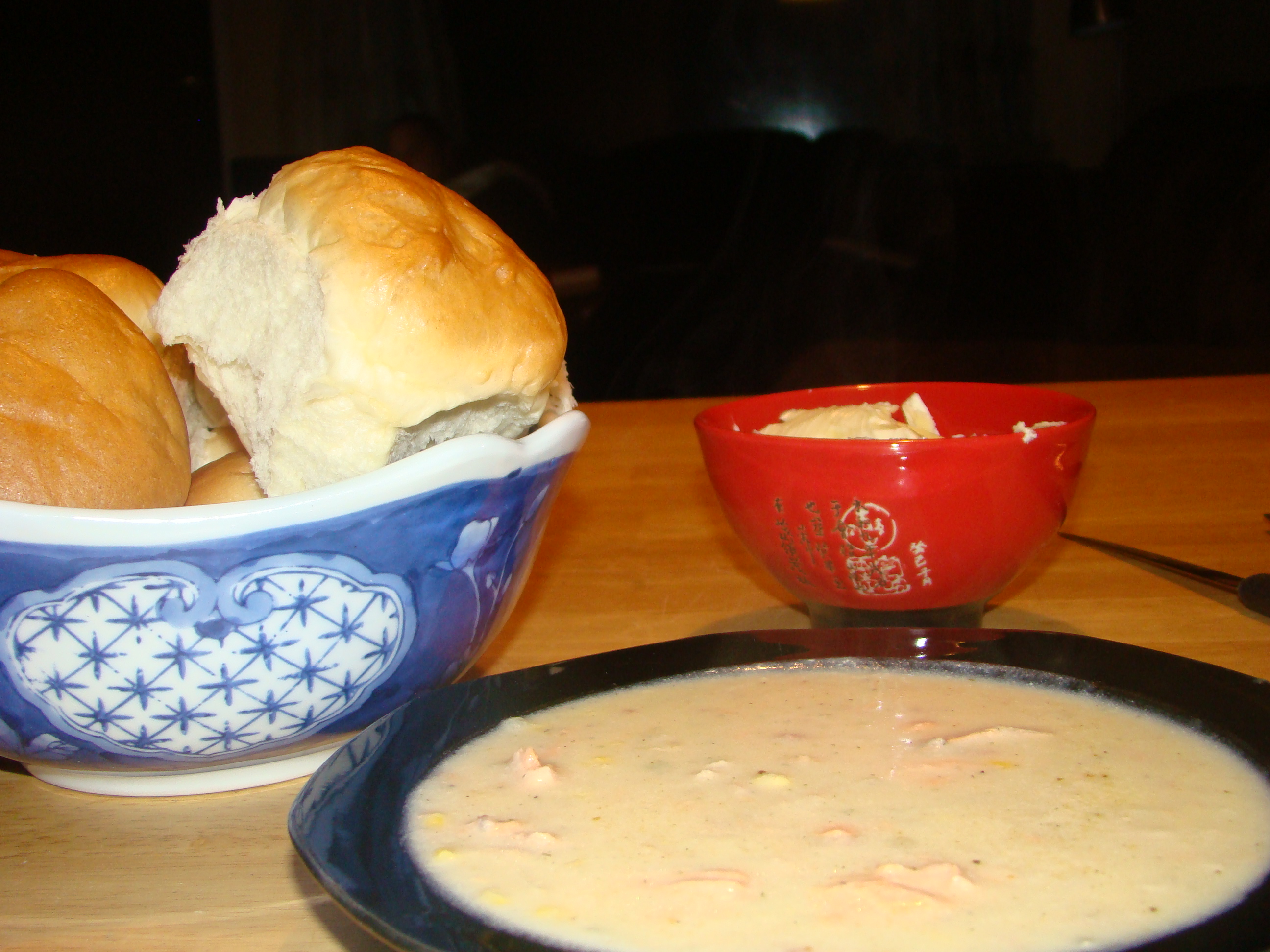
Yesterday I made salmon chowder (from a Spring my son caught last summer) and while I consider myself a decent cook, I impressed even myself. I was wowed by the scrumptious creamy, savoury results. I used a recipe from Allrecipes.com, then modified it (as is my style) ‘til the concoction in my pot could never be recreated using the recipe card sitting on my counter.

As I cooked (and tasted!), my mind wandered all over the place, but especially back to the novel that I’m working on. In the last scene, written just shortly before I started dinner, my MC was making soup. And there were soup references in my last novel too. The books aren’t the type that will be marketed at gourmands, with recipes in the back (though I do love those). In fact, the scenes are very brief—I don’t know if a reader would even consciously remember them, but they are, I realized, symbolic.

Soup is the epitome of comfort food, belonging and home. Every culture has its own variations of the dish, and while soup can be whimsical, there’s nothing trendy or passé about throwing things in a pot to simmer and blend all together into something, always a bit different, always good. Soup, regardless of its name, is as old as the human race.

And what does my character want and crave, but not have? Family. A sense of belonging. A home.

Food and eating of all kinds (not just soup!) has weighty (no pun intended) positive and negative connotations for the character as an individual and within his/her relationships. What your character eats or doesn’t eat, and the way they eat—standing over the kitchen sink, or with wine and candles even when alone—says a lot about their personality, their desires, their family background, their financial situation and so much more.

The way characters prepare food (or don’t) also shows who they are, how they perceive themselves, and how they want to be perceived by others. I don’t know what this says about me, but when I make soup, I feel like a good mom. What does your character feel like? A house elf? A slave? A fortunate soul to be able to cook when so many people in the world can’t put food on the table?

We shouldn’t make every scene about drinking tea or buttering fresh baguette, but we should remember that all humans everywhere eat—or need to eat—and have strong feelings about food. Sneaking in small sensory details about this primal need can be a great way to reveal information about your character.

So how about it? Have you ever considered what the food references in your story might be saying about your characters? Would adding some details about eating somehow enhance your characterization?

Do-it-yourself online writing retreat

The writing life can be a tad isolating, so a few years back, I started my own writing forum, Procrastination, as a way of keeping my treasured friends-who-also write close as we grew further and further apart geographically. We’re a small board; maybe five of us post regularly, with only three or so more than that who pop in every couple of months. We’ve even taken to (most years) meeting up for the community-building/inspiration-boosting/writing-celebration of them all–the Surrey International Writers’ Conference.

Then this year at SiWC, late Saturday night, missing one of our Procrastinators who couldn’t make the conference, feeling sad and a bit blown away that our wonderful weekend was almost over again already, we started discussing (or maybe bellyaching, just a bit ;-)) how Surrey gives us energy/motivation for our whole writing year, and how the conference never arrived a moment too soon . . . In fact, wouldn’t it be great if we could afford do two a year–SiWC, plus some other retreat or something six months or so later?

Enter fantastic brain wave! It occurred to us that we already had a perfect meet-up place, and instead of just using it as a message/conversation board, as fun and valuable as that is, why not use it for something a little more planned out. An online writing retreat! Our set up was simple.

I created a private thread (only people who had signed up ahead of time could see the thread when they entered Procrastination.) On the set day, at a set time, we each posted one exercise. Then we spent that full day, plus one more day writing according to our own schedules. On the third day, again at a set time, we each posted our results to each exercise (with no disclaimers about perceived quality, etc). Everyone who signed up committed to reading and responding to each participant’s posts. The result was fantastic–much better than we’d even anticipated in terms of fun, inspiration, and concentrated, results-based motivation.

We all came away a bit in awe that we could write so much in such a short time period–and that a lot of it was “keeper” material, stuff we wanted to do more with, possibly lengthen, possibly tighten and polish and submit as short stories.

Seeing as it was such a success, and how (for now) our ability to take in bigger conferences/retreats is limited to annually, we decided to make it a seasonal event–our spring writing retreat is just around the corner; I’m already excited and brainstorming what exercise I’ll offer.

If you’re part of a small online writing community and feeling a bit low energy in the ol’ writing department, I highly recommend organizing some form of your own online writing retreat. And if you don’t have that kind of online community, but long for a bit of a writing extravaganza/refuelling? Well, come visit me here again soon. A while back I did a writing retreat for one and I’ll post a bit about that in a few days.

Happy writing!
🙂 Ev

Overnight success

A few years back I was listening to a radio interview of a musician who’d just made it big, and the DJ asked her, “So how does it feel to be an overnight success?”

She laughed. “People keep saying that and I have to keep telling them my overnight success took 13 years of really hard work.” She went on to say that her “secret” was to learn to keep working through disappointment and rejection, to keep focused on her love for the music she was creating.

I use her words for encouragement and motivation in my writing life, often—Don’t give up, Ev. Keep writing. You love it and you’re getting better and better. Persist, persist, persist!

Just before starting to write this post, I plugged overnight success took 13 years into Google and was amazed by how many hits it got. Apparently this long arrival of “overnight success” is the rule not the exception—10 years, 13 years, 15 years, 20 years, 32 years—all those were referred to as overnight successes, triumphs, sensations. . . .

And it makes sense. The Arts used to be referred to as Disciplines, a name that better reflects the nature of creative pursuits. I also like referring to writing as a craft, because of the word’s connotations of work, practice, honing, refining . . .

Then just last week, my attention was pointed to an article from August 2006’s Scientific American, “The Expert Mind” by Philip E. Ross. He makes a fascinating, well-supported argument for the idea that “effortful” study and motivation are far larger contributors to success in academic and artistic fields than innate ability.

Here are just two of the quotes that really struck me:

“The 10-year rule [coined by Herbert A. Simon of Carnegie Mellon University] states that it takes approximately a decade of heavy labour to master any field.” ~ Phillip E. Ross

“At this point, many skeptics will finally lose patience. Surely, they will say, it takes more to get to Carnegie Hall than practice, practice, practice. Yet this belief in the importance of innate talent, strongest perhaps among the experts themselves and their trainers, is strangely lacking in hard evidence to substantiate it.” ~ Phillip E. Ross

As I am often dubious about my talent, I find great hope in the studies that Ross references. I love all things word and story related, yes. And sometimes I think I have a modicum of talent, maybe. But I know too many people whose natural talent for storytelling exceeds mine to the point that I should have given up long ago if mastery and success were purely talent-based.

What I do possess, however, is tenacity. I’m stubborn. Always have been—childhood pictures prove me out: mini-Ev, all of four-years-old, brow furrowed obstinately, jaw jutting in firm commitment to my focus. And I have a strong work ethic (my euphemism for obsession ;-)).

But even importantly, I find joy and challenge (yes, even with the frustration!) in the learning, in the toil, in the striving to say it better, be more evocative, be more honest.

There’s a small, weird part of me that knows success as the world calls it won’t be my idea of success at all. The point of writing for me, the fun, is the growth, the power of developing writing muscle, and (I’m sorry, it’s the worst cliché!) the journey . . .

I’ve been writing seriously, working on my craft, for just over ten years. Do I hope to see my novels in print soon? Absolutely. I want to share my stories, to give (hopefully) a bit of what so many others have given to me through their carefully scribed words and thoughts. But when “it” has happened, when I have a book or ten out there, will I think I’ve arrived? Nope. I hope to be the kind of writer whose best work is always yet to come.

So here’s to the work and to overnight successes for us all—be they tomorrow, ten years, or even more from now.

Happy writing,
Ev
INK WELL Winter 2010 – I’m so proud of my young writers!

Just a short happy blip for today:

My young writers club at CCS waxed poetic and worked hard the past few months. Then end result? INK WELL Winter 2010 – a really beautiful issue if I do say so myself. Check it out here; you can even browse through the pages!