Can a writer (or should a writer) ever really go it alone?

If you have other things in your life—family, friends, good productive day work—these can interact with your writing and the sum will be all the richer.  ~ David Brin

Last night I met with the Northwords Writers’ Camp writers and presented on how the Internet fits into/enhances my writing life.  I mentioned how it’s a great resource for:

  • Support, Inspiration, Community
  • Education, Practice
  • Writing markets, Publishers
  • Marketing, Communicating and building relationships with readers

I also delivered the reminder that we all apparently need to hear on on occasion. Just like any super hero has their kryptonite, the Internet has a side that can cripple even the most stalwart writer. It’s called TIME SUCKAGE. Only writing is writing.

And I touched on a few other things to beware of online (in blogs or public forums):

  • Nothing is private
  • Nothing goes away
  • Published online (even “just” on your blog) is published.

But feeling that the pros of getting involved in the Internet writing community (how it can help one grow in and enjoy his/her writing life) far outweigh any small cons, I encouraged each attendee to start their own blog and we spent the rest of our time talking about Do’s and Don’ts of great blogs and did some writing exercise to per chance get us started.

As ever I was blown away by people’s creativity and how unique and highly individual each person’s results were, even with exercises as specific and guided as the ones we did together were. It reminded me yet again of why I write, why I readto share, to learn, to grow.  To think, to laugh and sometimes, though definitely not last night, to cry.

It also reminded me of how good it is to get together with other writers (in person, live!) and talk craft. The Internet is awesome and I’m incredibly grateful for it, but it doesn’t replace the value and importance (and fun :)) of getting together in real-time with flesh and blood people who share your interests. (We talked about that too.)

If you’ve been writing in solitary confinement (as is, of course, the necessity and norm)or perhaps are feeling that you’re not getting enough alone time with your wordsre-read the quote I opened this post with. It’s good to have people and other activities in our lives. They refill the well.

Yes, only writing is writing, but sometimes to keep on track with our writing (in a way that brings joy, refreshes our inspiration, soothes our fears, etc) connection with other kindred soulsonline or face-to-faceis just what the Dr ordered.

What do you think? Can any writer truly go it alone?

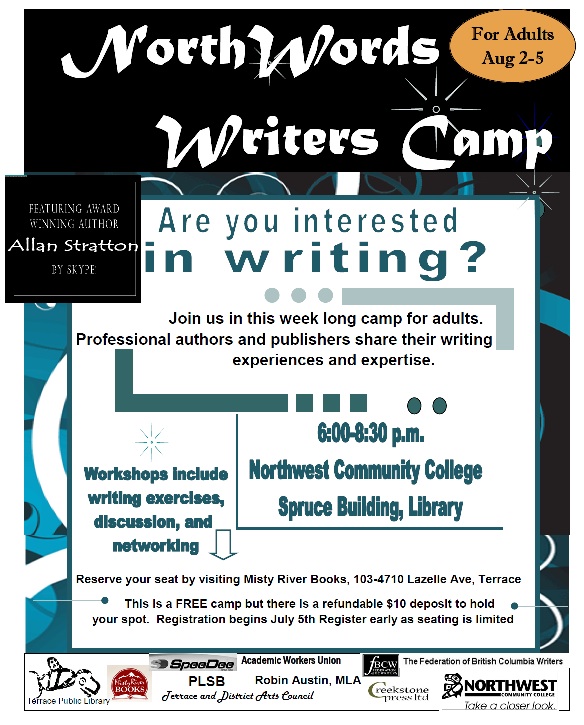
Northwords Writing Camps 2011

Dear All,

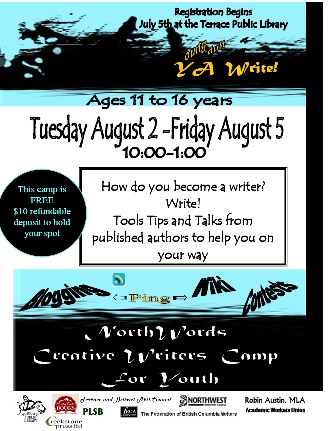
If you happen to be in lovely Terrace, BC early this August (or if you could be) and you’re a writer (established or newbie), the Northwords Writing Camps are running again and you should be there!  There’s an adult camp running August 2-5 from 6 – 8:30 for four evenings and a youth one (ages 11 – 16) running the same dates from 10:00 – 1:00.  The camps are FREE (thanks to the wonderful Terrace Public Library and generous sponsors noted on the posters below) and feature three different authors presenting–including me. 🙂 


You can register for the youth camp at the library and for the adult camp at Misty River Books. I hope to see you there!

Your Package Will Arrive in the Mail

When I was a kid I was addicted to Scholastic Book Orders. Remember when your teacher would walk desk row to desk row, peeling off six or seven brightly-coloured multiple-page flyers at a time, handing each set to the person at the head of the row, instructing them to please take one and pass the rest back?

I was tall for my age Grades 3 through 7 so inevitably I was near the back and had to wait, wait, wait as head of the row enjoyed the power of having all the book orders, person number 2 had the co-ordination of a stone and fumbled trying to separate just one order from the next, person number 3 or 4 was somewhere else entirely and had to be yelled at ten times before finally—FINALLY!—saying, “Huh? What? Oh!” and passing the remainders on.

I don’t know what I enjoyed more: the hours (literally) scanning and rescanning each offering, then carefully checking off the appropriate boxes and tallying the price making sure it fit the amount my mom had given me permission to spend or the weeks of heady anticipation. Someday not soon enough the teacher would walk in with a large box and distribute plastic bags with the books each student had ordered!

I tried book clubs for adults as I got older, but they weren’t the same (I don’t like being automatically sent selections of anything. I like to choose, darn it!). But hello—then came Amazon and the like. Ordering books online is pretty fantastic. I love, love, love having books on order and checking the mailbox all too frequently for my latest parcel.

In the quest for perfect summer reads, I’m currently I’m waiting for two short story collections, 100 Stories for Queensland and Nothing But Flowers: tales of post-apocalyptic love  and Leigh Russell’s latest novel Dead End.

I’ve yammered on about Leigh (and her previous novels, Cut Short and Road Closed) and interviewed her before, so imagine my extreme delight when she contacted me and asked if I wanted a review copy of Dead End. Did I!

Dead End has been receiving rave reviews, as evidenced here, and her publisher (No Exit Press) sums the story up, thus: “When the corpse of Abigail Kirby is discovered, police are shocked to learn that the victim’s tongue was cut out while she lay dying. Shortly after coming forward, a witness is blinded and murdered. Detective Inspector Geraldine Steel’s flirtation with the pathologist on the case helps her to cope with the distress of finding out she was adopted at birth. Abigail Kirby’s teenage daughter runs away from home to meet a girl who befriended her online. Too late, she realises she has made a dreadful mistake – a mistake that may cost her life. Detective Sergeant Ian Peterson uncovers a shocking secret about the serial killer who has been mutilating his murder victims. Does the sergeant’s discovery come too late to save Geraldine Steel from a similar dreadful fate?”

I’ll give my thoughts on Dead End, especially whether I feel it lives up to all the high praises (heh heh), once I’ve read it, but if you want to beat me to the punch and read it first, you can snap it up for your e-reader. For Kindle readers in the States and the UK, it’s part of a summer promotion, selling so inexpensively you should grab it now, even if you plan to read Cut Short and Road Closed first. For us Canadians, it still hasn’t been officially released so pre-order it or put it on your wish list and get cracking on the first two novels (that’s if you’re a crime fiction fan, of course).

I love bookstores, but I’m stoked to have two parcels to fanatically watch for in the mail. What about you? Do you buy primarily through shops or online? What are you waiting for in the book department for this summer’s reading?

p.s. And for all you blossoming Leigh Russell fans and/or writers who adore listening to other authors talk about writing, check out Leigh’s author channel on youtube. She has about five posts up now, sharing on topics like the inspiration for the Geraldine Steel series, the importance of research, and how to get published, with more to come.

What Writing Means To Me

I was just tagged by my friend and fellow author Jen Brubacher in a meme about what writing means to me.

She wrote that writing is truth and her elaborations are so perfect and true that I’m kind of jealous she wrote it, not me. It’s particularly worth reading for a certain drunken dwarf’s quote and her thoughts on said quote.

The person who tagged her, Icy Sedgwick, wrote that writing is escapism—and I wonder, really, if any writer lives who wouldn’t agree with her on some level at least.

And the “it” who got Icy? Tony Noland, who expressed that writing is freedom.

And just before him, Ruchira Mandal expounded on how writing is a journey.

Am I trying to cheat by giving the answers those other writers provided? Not at all. It’s just that their answers fit perfectly with what I want to say: writing is many things to me. The reasons I write, what I “get” from my writing, and how I feel about the process vary from day to day, even from hour to hour—yet I find there are always similar tendrils of desire as put my pen to paper or my fingers to my keyboard (to discover, to explore what’s “known,” to have fun).

Writing is a science—especially non-fiction, where I work from a hypothesis (thesis!) (articulated or not) and hone each phrase, insert each fact, and carefully draw each picture or stage I want to reveal to my reader, all the while deliberating on what I know and what I can reasonably infer about life.

The results can be surprising—sometime I realize I need to discard my initial premise because my experimenting (my writing) reveals a flaw in my thinking or logic—a new hypothesis is needed. Other times, the conclusion is exactly what I had hoped/envisioned/felt sure it would be—very affirming stuff. And, as in all science, while there are breakthroughs and massive epiphanies, there is never an arrival moment where all is known, all is suddenly clear.

And writing is magic—especially fiction. Us odd few called to the task, take strange ingredients, some commonplace, some only hinted at in polite company, some imagined, some completely undefined, only intuited, and throw them all together in simmering mess (or carefully measure out and weigh and add in at specific times, depending on our style).

It’s a shadowy art, unpredictable and dangerous even when it’s white. It’s often exhilarating, joyful and fun—but no words appear without some personal sacrifice (even if it’s just time that we worry could or should be better spent) and sometimes there is pain.

When the magic works, we conjure people long dead and still to come. We play with time, sending readers back and forward in both this world and others. A barrage of scents—good and gross—waft from our pages. People curl up, relax and smile—and freeze, sweat, flinch and flee—at what we smooth across their brow, glide along their chest—jab into their bellies. They grow embarrassed, become livid and enraged—weep, laugh, bite their lip and nod—with emotions evoked by lines of text.

We reveal strangers’ stories and end up showing the readers themselves. We hold up a mirror, but it’s our guts and innards that are reflected back at the reader with their lives, past and present, transposed over top.

When the magic doesn’t work—or, at least, doesn’t yield the results we were aiming for—we, sometimes weeping, bleeding, and beaten, return to our worktables to try different combinations, to explore different roots and weeds. We work, despite the pitying looks of naysayers and the laughter, even jeers, of those who doubt our ability or think we’re merely crazy for trying.

And why do people turn to science and/or magic? Because they are searching. They are longing. I am searching. I am longing. For connection, for understanding, for hope and to give hope . . . for many things actually. So for me, perhaps above all else, writing is a quest.

I don’t know why you write or what writing means to you—perhaps, like me, you find your thoughts on the subject toss and change like the ocean—but I’d like to find out and would love you to share thoughts here.

And to keep the meme-tag game going, I tag:

Laura Best
Jennifer Neri
Angela Dorsey
Kathy Chung
Vello Sork

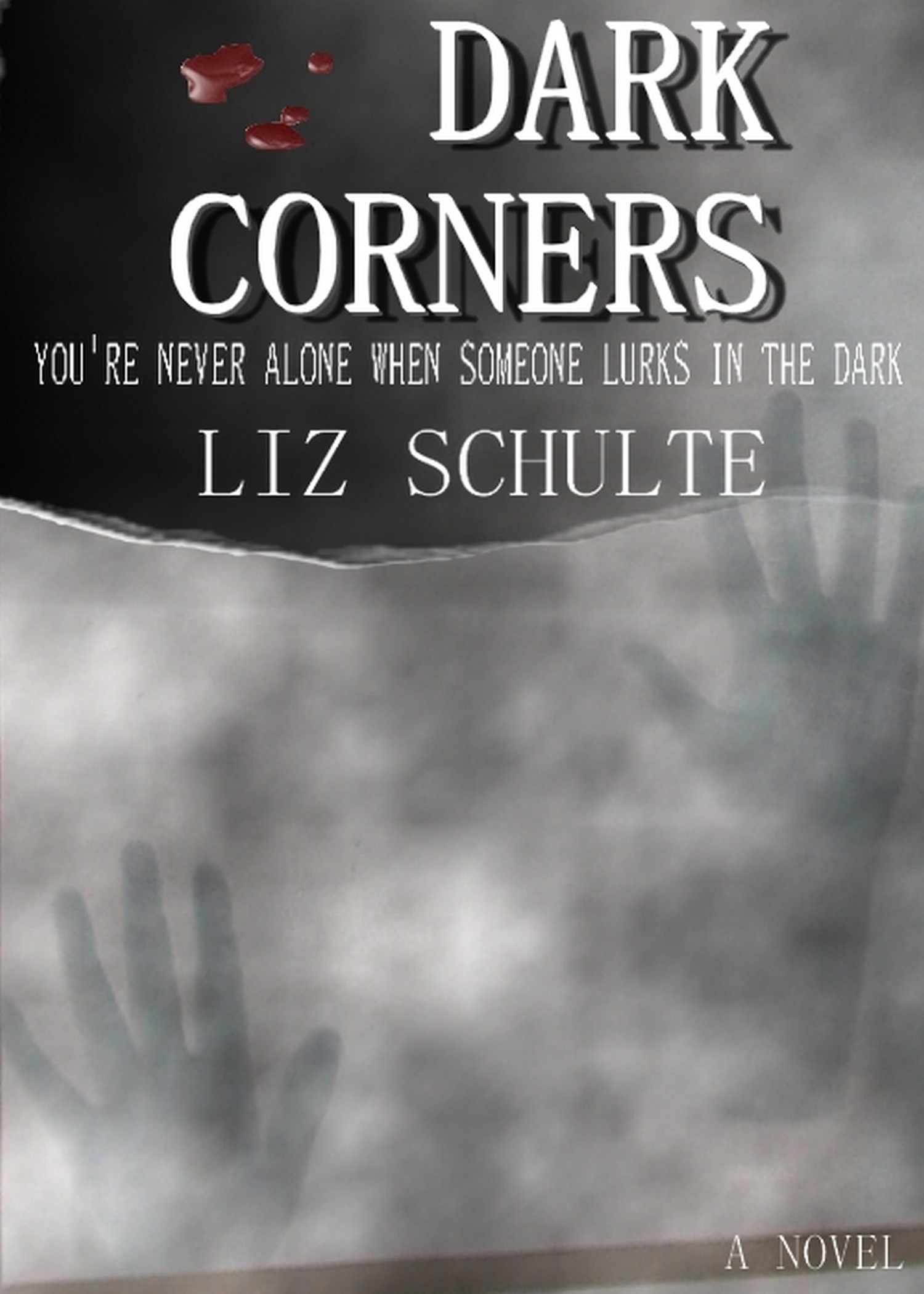
Dark Corners by Liz Schulte

One of my favourite things happened yesterday! An author friend of mine, Liz Schulte, celebrated the launch of her new novel, Dark Corners, a mystery-suspense with paranormal elements that keeps you turning pages and constantly second-guessing who the villain is (or are!).

Ella Reynolds knew from the first moment she walked into the old house that someone or something was watching her. Waiting. Her husband’s violent murder sent her spiraling into a world of grief and isolation, but Ella isn’t alone. Who or what is responsible for her husband’s death is still with her. Every day reality slips a little more between her fingers as she struggles to break free from her memories. A string of uncanny events takes place and practical explanations run thin as Ella follows the terrifying road to closure. As the past and present come to a head, Ella must decipher who or what the murderer is before it takes her as well.

Watch the trailer!

Dark Corners is available through Smashwords and on Amazon.

If you’d like to read Liz Schulte’s own words about Dark Corners’ launch, or just want to congratulate her, pop by her blog, http://enteringbatcountry.blogspot.com/, or click here. Liz is also a friendly, fun person to follow on Twitter: @LizSchulte

HUGE congratulations, Liz! Dark Corners is great and I’m already looking forward to your next novel. Write fast.

And same to all of you: happy, prolific writing this week!

Sex, violence, morality and other Scintillating-somewhat-scary stuff . . .

Déjà vu Thursday – In light of my last post, I thought I share one in a similar vein, written way back on October 12, 2009. Enjoy and as ever, I’d love to hear your thoughts.

– – – – – – – – – – – – – – – – – – – – –

I spent a lovely morning reading and contemplating various writing blogs. Kathy Chung (of Kathy – Rambling—a new blog I will now frequent) wrote about questions of morality that she’s been pondering because of one of her characters.

Joseph Grinton (Writing about modern romance), also newly frequented by me, had thought-provoking words in How To Write Sex Scenes.

I didn’t come across a blog post that opined on how much detail should be given in depicting violent acts, or discussed how to write violent scenes realistically, or tackled realism versus gratuity, but somehow (and not just because I think Sex, Violence and Morality makes a grabbing title) the three things seemed linked in my mind. Writing about them (and similar high-octane subjects) demands a certain bravery.

In the early days of my fiction, I realized that I was guilty of writing in the same manner that I watched scary movies as a kid. Scary music cues something Awful about to happen—swoop, blanket over my eyes. Smack, hands over my ears to tune out screaming and howling . . . I’d actually ask, “Is it over yet?” and wait for confirmation that the most horrible bits had passed before I’d peek again.

In writing that avoidance technique looked like this: Write a hook or some great invocative scene that foreshadows emotional or physical (or better, both at once) danger to character. Insert # # # to show that time has elapsed. New scene starts immediately after Event deemed too violent, too sexy, too something-scary to delve into comfortably. Often, since the reader needed to have some knowledge of the ordeal, I would do some sort of recounting, usually in the form of a conversation between the sufferer of the atrocity and his/her close friend.

“I can’t believe you went through that.”

“I can’t believe it either. I thought I would die when Joe pulled that knife on me and proceeded to—”

“It must’ve been even more terrifying because it probably triggered childhood memories of watching your own mom be killed in front of you . . . ”

“It did—but I managed to summon the will to fight, because I pictured my own daughter Macy’s little innocent face—I want her to grow up strong, to not feel like being a victim is inevitable the way I always did . . . ”

(Okay, please, please note, my writing was never really that bad—or Gah, I hope it wasn’t! But if a person avoids showing events as they happen, unnatural, stilted summary scenes become necessary—and if you’re even thinking, “My summary scenes aren’t stilted. They’re graceful and elegant,” go slap yourself and delete/rewrite the scene!)

I’m still working through what I feel is a good balance between portraying life as it is really experienced and what is too much—a completely subjective line, I realize. And I still battle with self-consciousness and worry. What will people think of me when they see the things that make up my head? What will people close to me say if my stories don’t line up with their ideas of morality? GAH—I write sex scenes and have children who read—awkward! I keep returning to the fact that to avoid writing something because it makes me (or someone else) uncomfortable is stupid and goes against the very reasons I write: to explore the world I live in, to figure out what I think, to yell into space: I am here, trying to figure things out . . . And in the end, if I offend or make someone close to me feel awkward? Well, they don’t have to read me.

So how about you? Are there topics you “don’t go”? What scenes are (were) your Kryptonite? Have you found ways to overcome your inhibitions? Should writers even try to overcome a shyness? Maybe some boundaries are good things . . .

Going There

So I just finished Cure For Souls by Phil Rickman. When I was taking it out of the library (I actually buy all his books, but my favourite bookstore had to order it in and I couldn’t wait, I had to rent it first ;)), the librarian exclaimed. “Oh, I love him—I love all his Merrily books. He’s not afraid to go there—he’ll tackle anything.”

I agreed that his books about Merrily Watkins, a deliverance consultant (a.k.a. Diocesan Exorcist) in Hereford, a small community on the England/Wales border are amazing (Read them in order, starting with The Wine of Angels, Midwinter of the Spirit, and A Crown of Lights.), but the way the librarian worded her compliment made me think.

I have an aunt who frequently, with vehemence, exclaims, “Don’t even go there!” whenever family discussions get heated (which is often because we’re all fairly passionate folk).

Her command is a bit hilarious to me (and probably to others) because one of the wonderful things about her is how she trudges into tough places, tackles taboo subjects, battles things that needed to be confronted (and even some things that we wish she’d let lie.).

Her “Don’t go there” command and simultaneous fearless disregard for her own warning contrasts dramatically with people who will go on at length about how things should be discussed, made known, blah, blah, blah—but really their self-acclaimed interest in being “transparent” is just so much smoke and mirrors. They don’t really get to the guts of things. They don’t really throw open the closet and jangle the skeleton bones. They don’t rock the boat. And they don’t want you to do those things either.

At least a couple times a year, I’m laughingly warned to not write a column about such and such or informed that some specific deed or event better not make it into a novel one day. Or I’m given wide-eyed looks and told that I’m so brave, that they’d never put such personal details out there for the whole world to read—something’s that is (a) flattering (They really think I have a lot of readers?!) and (b) a bit crazy-making. I try not to behave badly, but usually fail and say something juvenile like, “Hey, I’m not writing about my sex life—yet.”

But seriously, my columns are not risque. At all. They’re for the community section of a small town newspaper and meant to be enjoyed (or at least not hated) by the general public. The only formal “rule” regarding content I received was the instruction that my column was/is “not to be a forum for hot political or religious debate,” which suits me fine because I’ve always thought the most important details of life, those most worthy of exploration, those most powerful to change us for better or for worse are the small, stuff of life moments. Hopefully a reader or two agrees. ☺

But G-rated or not, perhaps (or I flatter myself by hoping) what people who are occasionally uncomfortable with some of my words are responding to is that I try to be honest. Little things make me incredibly happy and grateful. A lot of things make me horribly confused/sad/angry. I have a tendency to be sentimental, melancholy and neurotic—and/or spinney and silly and ecstatic, often in strange swings. . . .

Interestingly the more I resist writing about a particular subject, the more I worry, This is it, this is the column everyone will hate, the more likely said essay is to get lots of feedback and/or the (highest) compliment, “I feel just like, but never have been able to put it into words.”

In my fiction though, perhaps ironically, I used to find it harder to write with abandon. When you’re writing non-fiction or memoir, you can always say, “You don’t like it? Well, sorry, but it’s my life. It’s true. What can you do?”

When you’re writing “make-believe,” you don’t have that duck and hide escape.

I worried (worry!) about what people might think of the things that come out of my imagination. I fretted (fret!) about what some might say about the subjects I choose to write about (though the whole idea of “choosing” your story and characters is sort of humorous and inaccurate as some of you who also write probably know).

I’m getting better, but my inner censor is still alive and brutal, especially if I don’t write regularly (I think a constant flow quashes her quite a bit). The librarian’s chance comment couldn’t have come at a better time or served as a better reminder.

Phil Rickman’s stories are not only enthralling for readers, they’re inspiring to writers (this one at least), because as that librarian so sagely observed: he goes there.

His characters feel as real as can be, exploring or being exposed to various types and expressions of sexuality (and deviance), romantic love in all its glory and confusion and angst, religious faith and doubt and contradictions, opposing philosophical and religious views, evil and goodness (and questions about the nature/existence of both), parenting (success and failures and everything in between), being a child (the brazen fun—and desperate stress—of growing up), being an artist and the neurosis so often attached to that identity . . .

And what may be my favourite thing about his writing: he shows how self-doubt seems to go hand in hand with being human. He makes me feel like it’s okay, that not being sure I’m always on the right track, in fact, being pretty sure that I’m completely off the rails is okay, is normal, is, well, at the very least, probably survivable.

I’m sure he’s sometimes taken aback by a plot turn or detail that suddenly emerges regarding one of his characters, but he doesn’t turn back—maybe simply because his fiction is so much like life. There are many things we wish we could avoid, but can’t . . .

I hope that people who read my fiction will relate to my stories—and I really believe that identifying with a story occurs when authors are brave. When they’re not afraid to go there. And I hope I’ll always remember that while fiction may be a cleverly woven tapestry of pretty, entertaining, intriguing lies—regardless of genre, my stories had better be emotionally true and I’d better not be afraid of going there, of delving into things I really care about, worry about, fear or love—or really, what’s the point?

p.s. This post was getting long, so I stopped myself from delving into another thought. There is a difference between what I mean by “going there” and being gratuitous in terms of sexuality, violence, etc. I will try to elaborate on that some time soon!
100 Stories for Queensland

As I may have happily blurted before, having a new story go to print never grows old, and today I’m thrilled to announce that 100 Stories For Queensland has hit the shelves. It contains my story, “Riddles”—about a boy and his Grandfather and questions that arise during tough times.

The anthology is chocked full of more than a hundred uplifting, heart-warming stories of every genre. In a year where there has been so much global bad news, it’s extra lovely to be a part of it. Plus, all of its proceeds got to the Queensland Premier’s Flood Appeal. )—and while the floods in Australia may feel far away in time and place to us in other parts of the world, for people still rebuilding, continuing help, support, and encouragement are crucial.

And on a similar note (great reads and great causes like charities and emerging writers!), I’d also like to mention another charity anthology, also from Emergent Publishing: Nothing But Flowers—a collection of 24 quirky short stories (including “I Dream of Cherry Pies” by my good friend and fellow writing fiend, Jen Brubacher) that in some way or another all celebrate and laud love—in the time of apocalypse. A little bit strange, a little bit odd, and definitely great fun.

Click on the covers to buy the books on Amazon—or, if you don’t want to splurge right now, add them to your wish list to help boost the books’ chart standing.

Happy reading and writing,
🙂 Ev

Star Spinner

My family plays a game called Star Spinner. You go outside when it’s dark and find a large field (or at the very least, a space moderately free of dangerous obstacles). One person has a flashlight (turned off for the time being) and heads away from the group. Everyone playing holds his/her arms out to their sides and spins and spins and spins, until from far away the flashlight holder yells, “Go!” and turns on the light.

Dizzy and blind—laughing hysterically, shrieking with nervousness or moaning with a sick feeling of nausea—each person runs as fast at they can (which is always, at best, some lurching, stumbling gait) toward the light.

I’ve played many times, but I’m still not sure who wins. I think the person who gets closest to the target thinks it’s him, but really it’s anyone who participates, who runs stumbling toward their goal, who gets up after falling, who perseveres in spite of the nagging, sensible voices in their heads and the fear (it’s dark; you’re dizzy; you might fall; stand still for crying out loud, stand still!).

Lying (inevitably) on the cool grass, staring up at the stars, still feeling slightly queasy (from spinning, from laughing, from nerves), it doesn’t matter how far you got. You’re just pleased you played. You were dizzy, had no idea where to go, but you ran full out.

Star Spinner—in addition to being just a crazy amount of fun—has always struck me as a powerful metaphor for various aspects of life: for writing, for faith, for relationships. . . .

I can only see so much—and half the time I’m anxious beyond words—but if I push past that and run screaming and laughing into the dark, I overcome fear and realize I’m completely exhilarated. The goal is often still shining somewhere beyond me, but the more I play, the more that part doesn’t matter.

Ev Bishop on Ether Books

As some of you know, three of my short stories (“HVS,” “Wishful,” and “Red Bird”) are available through Ether Books, a fantastic forward-thinking publishing company that I can’t say enough good things about. Not only have they published my work, they supply me with an inexhaustible source of new short fiction!

I’ve been playing with the idea of promoting some of my work with video and since Maureen Scott, one of the gurus behind Ether, put a call out for Ether authors to share their sentiments about Ether Books in 30 seconds or less and post them on youtube, I’d thought I’d start there. So all that said, here’s me, Ev Bishop, on Ether Books. Enjoy!


When I have my office back under control, I may do short blip on each of the stories they’ve published. Stay tuned.

And hey, if you haven’t read “Wishful,” or “Red Bird,” or “HVS”—you don’t need to wait ’til there’s a video promo! Grab your iPhone, iPod, or iPad, download Ether Books’ free app here and check me out. 🙂 I hope you enjoy them.