Can (should!) a writer ever really go it alone?

Déjà vu Thursday – This is a re-post of a fairly recent pondering (written originally August 5, 2011), but it feels timely because the Internet—and its friend and foe ways—has been a big part of my writing life again lately. Just last night I was thinking, Yeesh, if it wasn’t for my writing friends and cohorts, what would I do? Maybe you’re feeling a similar blessing (or a sad lack?). As ever, I’d love to hear your thoughts.

* * *

If you have other things in your life—family, friends, good productive day work—these can interact with your writing and the sum will be all the richer. ~ David Brin

Last night I met with the Northwords Writers’ Camp writers and presented on how the Internet fits into/enhances my writing life. I mentioned how it’s a great resource for:

Support, Inspiration, Community
Education, Practice
Writing markets, Publishers
Marketing, Communicating and building relationships with readers

I also delivered the reminder that we all apparently need to hear on on occasion. Just like any super hero has their kryptonite, the Internet has a side that can cripple even the most stalwart writer. It’s called TIME SUCKAGE. Only writing is writing.

And I touched on a few other things to beware of online (in blogs or public forums):

Nothing is private
Nothing goes away
Published online (even “just” on your blog) is published.

But feeling that the pros of getting involved in the Internet writing community (how it can help one grow in and enjoy his/her writing life) far outweigh any small cons, I encouraged each attendee to start their own blog and we spent the rest of our time talking about Do’s and Don’ts of great blogs and did some writing exercise to per chance get us started.

As ever I was blown away by people’s creativity and how unique and highly individual each person’s results were, even with exercises as specific and guided as the ones we did together were. It reminded me yet again of why I write, why I read—to share, to learn, to grow. To think, to laugh and sometimes, though definitely not last night, to cry.

It also reminded me of how good it is to get together with other writers (in person, live!) and talk craft. The Internet is awesome and I’m incredibly grateful for it, but it doesn’t replace the value and importance (and fun :)) of getting together in real-time with flesh and blood people who share your interests. (We talked about that too.)

If you’ve been writing in solitary confinement (as is, of course, the necessity and norm)—or perhaps are feeling that you’re not getting enough alone time with your words—re-read the quote I opened this post with. It’s good to have people and other activities in our lives. They refill the well.

Yes, only writing is writing, but sometimes to keep on track with our writing (in a way that brings joy, refreshes our inspiration, soothes our fears, etc) connection with other kindred souls—online or face-to-face—is just what the Dr ordered.

What do you think? Can any writer truly go it alone?
Day jobs—the good, the bad, the ugly!

About a year and a half ago, I decided to take a part-time day job—to supplement my writing and editing income, yes, but also (more importantly), because I wanted to free up my creative mind.

Nothing kills creativity like wondering how the mortgage will get paid and the freelance life (mine at least) was a bit feast or famine—some months were fantastic. Others—eek, not so much.

I’m not alone in extolling the benefits of working—at least part-time—for someone else when you’re in an artistic field. Over the years I’ve heard many professional authors and writers warn not to quit your day job too soon. Some even advocate never quitting your day job entirely—always keeping a ladle in the stew, so to speak. . . . Sometimes the recommendation’s based on the issue of money. The freelancer or novelist’s income can be irregular, like I mentioned. Sometimes it’s because the speaker feels that having a job in the “real” world gives inspiration to draw from, plus a much needed break (at times) from the solitary, inner realms that writers live in.

I can see both sides.

Most of us understand the comfort (and necessity) of at least a certain amount of dependable income, so I won’t spend much time on that. Ditto, we tend to be able to understand that having co-workers—both the ones easy to get along with and the ones that . . . aren’t—can inspire, perhaps act as sounding boards, etc. . . .

The big lure of going out one’s own is time. After all, what’s more tempting than the idea of business casual (or business professional) equaling pajamas? What could be more ideal than having an uninterrupted 8 hours to write—well, an uninterrupted 8 hours, minus the two hours for a cool lunch with other like-minded, pajama wearing intellectuals, that is. We romanticize (or I should say, I romanticize) the image of the madwomen in the attic a little too much. And there are, of course, days when the daily grind feels, well, like a grind—and we just want to be free from it.

I maintain, however, that if you really want to write a lot, to make your writing be your life’s work (a very separate thing from your primary source of earnings, by the way)—whether or not you have to do other work to pay your mortgage or buy groceries won’t stop you. It might even motivate you (when you have eight hours stretching ahead of you, it’s easy to wile away 6 of ‘em. When you want to get in 1000 words and you only have an hour or two, you tend to get on it).

And less than satisfactory days at work—even the occasional rotten days? Even better. (Just make sure that you’re not in a job you absolutely hate, because that could be muse-killing—though that’s a side tangent.)

If your “day job” is too perfect, too all-absorbing and fascinating, there’s the danger that you will feel, well, fulfilled by it and the desire, the drive, the compulsion to write will diminish.

If your job is creative and calls for imagining and envisioning and brainstorming—it could feed your writing, sure, but it could also easily satiate the part of your psyche that craves all that creating and thinking.

Chaffing a bit at work—whether it’s because the job doesn’t stimulate you mentally or inspire you creatively, or it doesn’t pay enough, or because of personality clashes with other staff members—is a good thing.

If you’re lucky enough to have job to go to that pays the bills, gives you fodder for characters (maybe even villains!), and you have the added benefit of not loving it too much, good on you! You’re in the perfect place to kindle your writing fire and motivate you to get your stories out. (Or that’s what I tell myself anyway. Heh heh.)

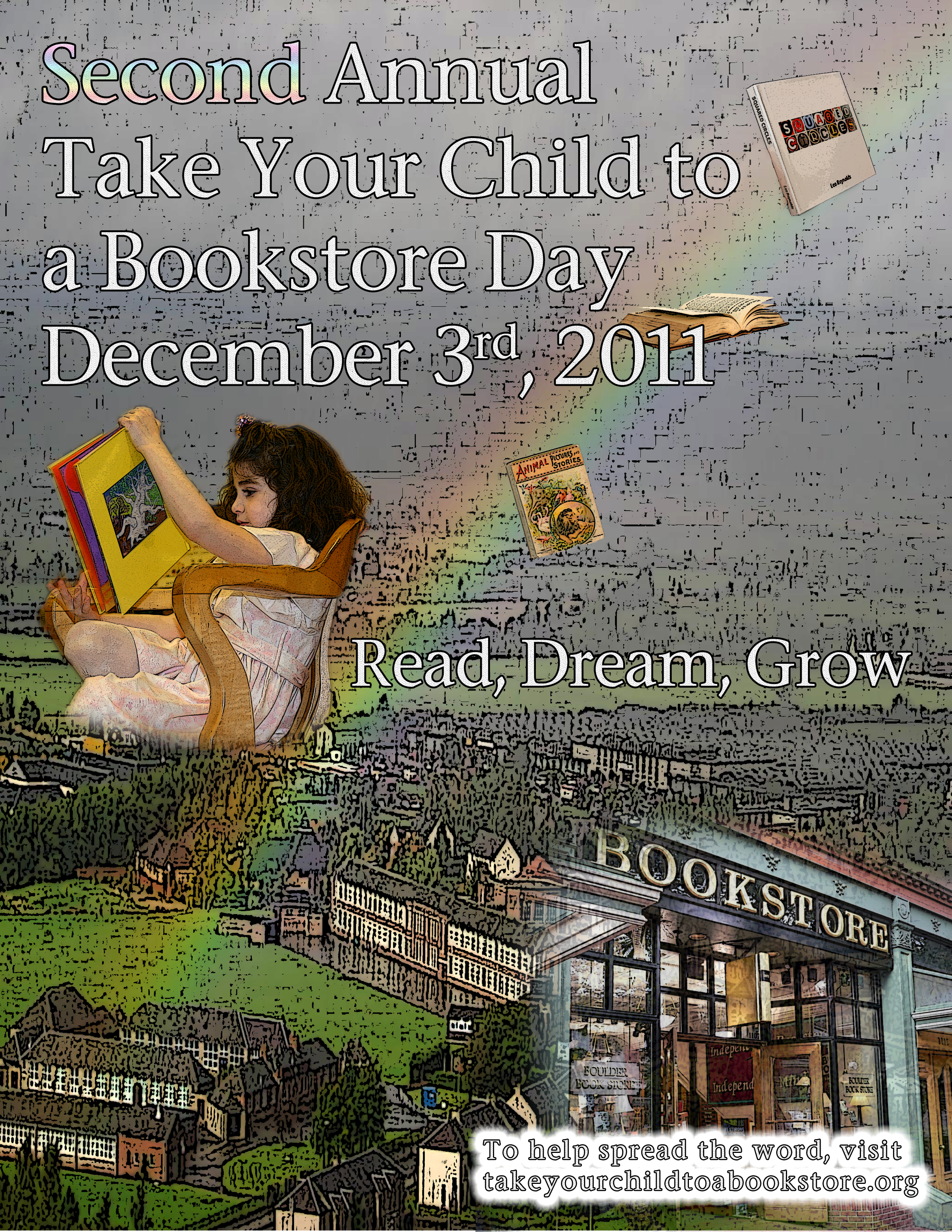
Annual Take Your Child to a Bookstore Day!


I just learned about this new “annual” day and I’m stoked! As my own kids are getting to the age where they’re often busy (though my daughter at least would never say no to a trip to the bookstore with me), I’m using it as a great excuse to hang out with my two of my sweet little nieces. We’ll each buy a book, then go for a coffee shop treat—and after that, I think we’re heading to my sister’s to make Christmas cards all afternoon. They’re almost as excited as I am!

How about you? Had you heard of this day before and are you planning to celebrate it? I’m definitely planning to make it an annual tradition (because I don’t go to bookstores enough, lol) because it’s fun, yes, to have a special day, but also because bookstores are important and I don’t want them to disappear from our towns and cities. Buying books online is great, but you tend to shop already knowing what you’re looking for. Browsing bookstores (and libraries), you discover stories and authors absolutely brand new to you. If going to bookstores isn’t something our kids do now, it’s not something they’ll do as adults—and the chances that they’ll only read what’s “popular” will be all the greater. And did I say it was fun?! 😉

Find out more about Take Your Child to a Bookstore Day at http://www.takeyourchildtoabookstore.org/

Quiet Daze

I wish I had some great graphic to post: a sprawling barren desert—its emptiness broken only by the odd three-armed prickly cactus here and there and errant ball of tumbleweed bumbling through every so often. (Add a whistling, lonesome soundtrack too.)

Or perhaps, more in keeping with a landscape I’m familiar with, perhaps I should insert a deep dark night with no recognizable landmarks, everything swathed in thick white snow—the only movement, the only sound, the occasional tree branch failing under its load, bending or breaking in a wet, heavy swoosh.

In both those scenes, the viewer would feel nothing was going on—and in both those scenes, the viewer would be wrong. Somewhere deep below the apparent nothingness, life would be stirring or going on full tilt—or, at the very least, hibernating, waiting for the exact right combination of natural elements to spring it forth. (Insert two new images here, please: the legendary bloom of desert flowers that occur after rare, precious rains and whatever greening, blossoming spring photo you have handy.)

That’s the case with my writing life these days too—outwardly things are pretty quiet, without a lot of news or action or ideas to go on about. Yet inwardly, I feel like I’m on the cusp. Any day now, new energy will flood through me, refreshing me and bursting my current projects to completion. Any week, new ideas—mere murky presences, buried deep in the compost of my mind for now—are going to sprout, and going into 2012 I’ll be overcome with plans and enthusiasm and questions about what’s to come.

But for now (Turn up the volume on that whistling, lonely gunfight showdown tune again.) I’ll just have to wait in eager (if quiet) anticipation.

Sticky Note Solutions

November—already, can you believe it? Some of you are probably happily bogged down with Nanowrimo this month. It’s early in, the inspiration is thick and humid, the words and ideas are growing like crazy, but despite your amazing work ethic and exciting word counts thus far, you’re ever cognisant of the reality that you need to log 1666.66 words per day (better round that up to 1667!) to nail this bad boy.

Others of you, like me, decided to forgo the 50 000 word extravaganza this month, because you have other writing priorities yelling loudly in your head that you don’t want to ignore.

Whatever camp you fall in, I suspect that because you have spectacularly lofty goals this month, life will throw a lot of unexpected distractions at you this month, including but not limited to things like: surprise visits from old friends, birthday bashes, baby showers, or other celebratory not to be missed events, extra work hours, a small family crisis or two, etc . . .

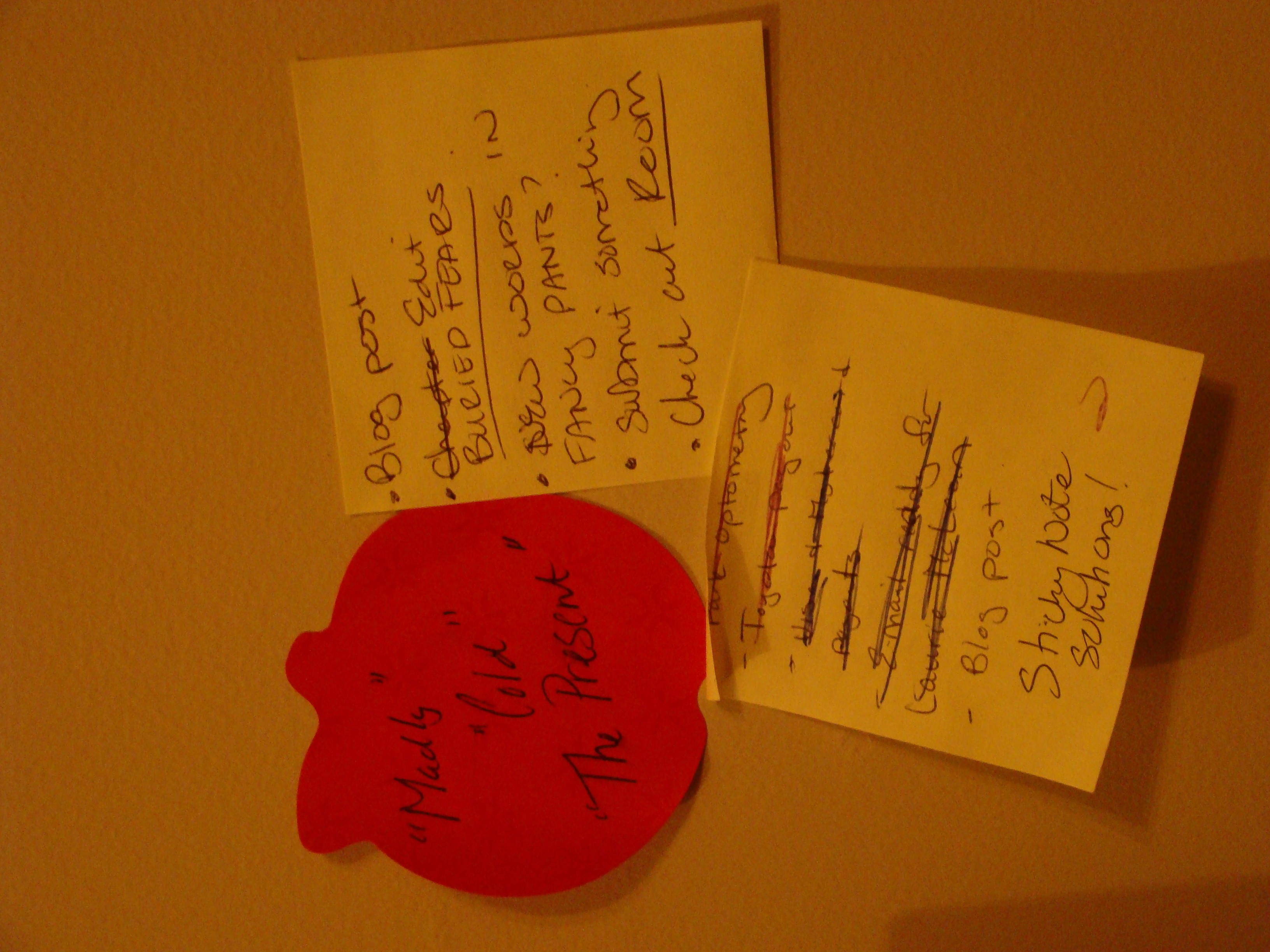
Wait? Am I talking about November particularly or the writing life in general? Rats, you caught me. Nano or no Nano, my writing life, despite my best laid plans, always gets interrupted. I still manage to get quite a lot done most months, however, and one of the easiest ways I’ve learned to motivate and focus myself (not to mention remind myself of what I actually want to accomplish) is to use sticky notes. And not the sticky note app—the actual, messy little pieces of paper that one scrawls notes on and sticks up all over the place.

The idea is not uniquely mine, of course. After all, sticky notes were invented to leave memos for yourself. And I took a class with author Kerri Nelson, called “The Book Factory—Produce Multiple Novels in a Year” that I raved about before in “Take 15 . . .

Kerri advocated constructing a brief list of things you need to get done in a day or in a chunk of writing time, keeping it in a highly visible place, then before you got to bed that evening making sure you’ve accomplished each one.

There’s something powerful in the act of prioritizing (only so many goals fit on a sticky note) and then crossing each accomplishment with swift stroke of ink. The more specific the goals, the better.

When I jot down “Blog post,” it’s a little tougher to get down to, than if I write “Blog post + TITLE,” because just writing a title is consideration of an idea—and idea that stirs about in the muck and mire of my brain, and is then more than ready to muddy up the page once I sit down to it.

When I write “Edit TITLE,” it’s not as effective as when I write, “Edit three chapters of TITLE.”

“Write a chapter” is not as forward-driving as “Write scene where blah-blah-blah.” (Of “blah blah blah” is actually spelled out on the note—even if so cryptically that only I know at a glance what on earth I’m talking about.)

I also write mundane, non-writing tasks on my sticky notes (“Toyota Payment, “Park Optometry,” etc.), not because I consider them writing-related per se, but because my brain sometimes uses menial chores and other trivial “must-do’s” as a way to avoid writing. “You shouldn’t write right now. You should insert-silly-but-practical-distraction.” Once those chores make it to the sticky note, I can make my procrastinator shut-up. (It’s on the sticky note, it’ll get done. Now be quiet, I have work to do!)

I don’t know if sticky notes will revolutionize your writing days or the short sessions you try to sneak in around the other demands of life, but I know that when I’m using my sticky note system, I’m always a little blown away, by how I manage to get things done when I have no time.

I wish you crazy productivity this month—especially if you’re Nanowrimoing! And if you have special methods or tips for breaking down your big goals into smaller, manageable ones, please share.:)

It’s all rock ‘n’ roll to me.

Digital image, Copyright 2011 Marriah Bishop, used with permission.

My daughter has started painting. She also takes a lot of photos (digital and old school 35mm). Lately, I’ve been struck by the contrast between her two arts—and how those differences relate to writing.

Photographers strive to capture images of what’s already visible in the world and focus in on it, with the goal of revealing what exists—what is tangible, what is right there in front of us—in a new way, making people see.

And, of course, most artists wielding a camera hope to make us feel—to invoke peace, hope, or joy showing the lovely things that exist all around us. To stir up empathy or make us angry (thus, hopefully, motivated to do something about whatever issue riled us up). To kindle awe or understanding about the world around us. To make us laugh. To make us cry. But they attempt to do that by showing us what already exists.

Painters, or the ones whose work I relate to most anyway, seem to approach their work the opposite way. They start with reaction (emotion) triggered by something real and try to express how feeling looks. The results on the canvas may be realistic and identifiable—a brook, a tree, a face . . . but they just as easily might be abstract colours and shapes and form, or some combination thereof. The final piece creates something real, yet isn’t fact-based or often a literal representation.

For me, those visual processes are close cousins to writing—non-fiction is like photography. I write about what really exists, for a variety of reasons—to create a record, to encourage, to challenge, to entertain, to inform. . . .

In fiction, I start with an idea or emotion or question and explore it through story—sometimes realistic, sometimes absolutely fantastic. Every time, with the hope of stirring the fears, concerns, rages—and the dreams, worries, and hopes—of the reader. I’m not concerned with the factual at all.

Whether the setting is a modern high school classroom, the moon, or a castle in a land of fairies, what I want is for people to feel—to recognise that emotional truths exist separate from literal events, times and places. After all, there’s something surreal about being human—there’s our physical reality, but then again, something so, so much more than that, in which we live and move and have our being.

Poetry and music are like what mixed-media is to visual arts—seeking to express what almost defies expression, to give substance to what is invisible yet is also somehow the crux of existence. Oxygen to plant life.

I read a comment on a blog recently that said that “real” writers don’t write blogs. (The irony that the comment was made on a blog, by a writer made me smile—and in a large part helped fuel this slightly odd post. As much as I see differences within the forms, mostly I see connections and related pathways between all modes of artistic and creative output. I’m not sure there’s any definitive definition for a writer—except that he or she writes. And although it’s interesting and fun (perhaps even helpful, occasionally) to wax poetic on the purpose and function of various forms of writing, I don’t know if it really matters how or why or what a person writes.

What about you? Do you write in a variety forms? Are you a writer and another type of artist as well? If yes, how do your processes/intentions differ according to the craft? If no, any specific reason why not?

Motivation

I’m gearing up for SiWC 2011 (leaving on Wednesday actually, yay!), and as usual I’m super stoked for the conference and all the workshops, presenters and kibitzing with other writers—lots of whom have become friends by now, my eighth year. (Ohmigoodness, do you know how wildly affirming and inspiring and plain ol’ fun it is to be in the midst of 600+ people who all share your obsession? I live in a small town, so perhaps the huge gathering of like-but-very-different minds is that much more amazing, but it is good, good stuff—worth every penny I pay every year. It fires me up, re-energizes and refocuses me for the next 12 months, every time.

That all said, as much as I relish the conference itself, an equal draw is the time I’ll spend with three other writers—Barb Cameron, Angela Dorsey, and Jen Brubacher. While Jen is unable to attend SiWC, because of the way her trip to Canada worked this year, she is able to make our annual pre-conference sushi and gab-fest—a group meeting of what we informally call Woodstockers 5—a name with a story behind it that makes sense only to us.

Thursday night, we’ll meet at a certain restaurant that’s become tradition, slide our bottoms onto bright-coloured satin cushions, and commence blabbing our heads off over our past year’s literary successes, woes, accomplishments, and challenges.

Then we’ll pull out our Woodstocker 5 Goals and share what we followed through with—and confess what we didn’t. A couple of us will then go onto elaborate about plans for November 2011 through October 2012 (our writing year has started to mimic the months that pass from one SiWC to the next). A couple of us (or at least one of us, me) will have to share our plans later, via a small online writers’ forum, after the conference has done its magic and put wild dreams in our (my) head.

Writing is by necessity a solitary pursuit and like a lot of writers, I’m okay with that—thrive in seclusion, actually. Need a lot of alone time. However, over years I’ve noticed that I write better—and am much more prolific—if I have a few close writing friends to celebrate and commiserate with. And to give me the occasional swift, motivational kick. (Thankfully, the boot is usually just a figurative.)

If you’re feeling in need of a bit of motivation, I can’t encourage you enough: try to find a writing workshop or conference to take part in over the next months or track down a writing friend or two to start meeting semi-regularly with. There can be a danger to spending too much time talking about writing and not doing enough writing (a post for another day, perhaps!), but for some of us, too much isolation is just as inspiration-killing.

p.s. I’d love to hear what works best to keep you on track with your writing goals (so I can steal your method, lol).

p.p.s. I think I’ve written on this topic before. What can I say? Sometimes I need reminding of what “works” to keep me working!

Thanksgiving 2011

In just a little while I’ll be heading out to a second day of Thanksgiving feasting and I’m hoping I can do the spread justice, as I’m still full from yesterday’s imbibing and merrymaking at my house.

My stomach isn’t the only thing that’s bursting, however. As corny as it is, my heart and mind are too.

My dad, though unfortunately not—and maybe not ever—out of the woods, is, however, home again after many months away. Having him back and looking well and feeling energetic and a bit angst-ridden because he’s chomping at the bit, wanting to do stuff is amazing. He has a great appetite and is more than up to visiting.

And one of my oldest and dearest friends is up visiting from The House in Spruce Grove, Alberta—and another of my most kindred spirits is arriving from across the pond later this week.

My little kids (actually not so little) are healthy and thriving. My husband and I are enjoying autumn and the crisp air, vivid colours, and food prep (Mmmmm, blackberry jam, smoked salmon, pickles and huge batches of homemade soups for the freezer) that come with it.

Writing inspiration has been more plentiful than ever lately (two new novel ideas, and schemes about a putting together a poetry chapbook), I’m almost finished the second draft of my latest work-in-progress, and I’m preparing to head off to SiWC 2012 in ten days—yay and yay!

There are always hard things in life and some seasons that are tougher than others. After a few particularly gruelling months, coming together with people I love and consciously focussing on and celebrating the good things—the blessed things—that co-exist with the hard ones is wonderful.

Whether it’s your Thanksgiving month or not, I hope little things happen this week that remind you of all the good in your life—particularly if you have some not-so-good stuff you’re dealing, too.

Happy reading, writing, thinking—eating.

🙂 Ev

Art lessons with Noreen Spence!

Radelet's Cherry Tree. Copyright Noreen Spence. Digital Image used with permission.

I was ecstatic to receive an e-mail the other day from one of my favourite artists (her trees, her trees!), Noreen Spence, announcing that she has her “fabulous new studio set up” and is back to painting large (as in huge canvases!).

AND she’s offering painting lessons–at said new, fabulous studio where you’ll be “ surrounded by the nurturing forest, where the generous light pours in through five enormous windows, and where there is room to move.”

In addition to be wildly talented, Noreen is a really caring, thoughtful, affirming person and whether your goals are just to try something new, to have fun, or even to yes, give yourself permssion to be or become an artist, I know her lessons will enhance your life and your craft.

She offers three different fee structures:

Individual 1 hr lessons, $30 per hour
Group lessons, 1.5 hrs, 3 people, $15 per session
Individual 2 hr lessons, $50 per session

To find out more or to register, give Noreen a call at (250) 635-6938.

Back on the horse

I found it pretty amusing (actually giggled) when I popped in to my little cobweb-growing blog today and realized that the last thing I posted before disappearing into the offline hinterlands for over a month was basically an ode to the online writing world. I really wasn’t trying to be a big hypocrite, I promise.

The online world is everything to me that “Can a writer (or should a writer) ever go it alone” claimed it was—but sometimes the physical world seduces me away (especially in the summer) and/or less romantic aspects of “real life” demand my attention.

And while I didn’t fall off my writing and editing pony, a bit of sacrifice was needed and that sacrifice was called Internet Time.

Now though, my holidays are but good memories of sunshine, sand, salt water, and visits with dear friends and family. The sky has opened up (yet again) and there are (still more) record rainfalls. My kids and husband have returned to school and regular work hours. The end of September is herding me, as it usually does, back here and to various other online haunts. Yep, I’m back on the horse again (even if I still feel slightly headless).

I like the renewed discipline and passion that always seems to strike at this time of year, along with a fresh sense of possibility and promise. I love that September beckons to October—who will come quickly and bring SiWC along with. I revel in a return to warm drinks perched close by and the soothing click-click of keyboard keys.

In the summer, I work hard to fit my writing in. In the fall and winter, the long evenings and nights remind me that I’ve been silly. What could there ever be to do that’s more important or more fun than getting my thoughts down and letting stories run from my brain to the page?

How about you, dear readers? Are you back, comfy in the saddle of your desk chair, or do you need to go off on a few more end-of-summer gallops before reining yourself in?

Either way, happy reading, writing and dreaming this autumn! I’ll say good night now, before I stretch my already thin metaphor to breaking point.  🙂

~Ev