Waves of Change and Continuity at Lakelse Lake

It has been a strange summer weather-wise where I live (understatement!), with weeks of unseasonably cold weather, followed by surprising heatwaves, then cold again, then hot. At the beginning of August, we thought we’d seen the last of the sunshine and that fall had moved in way too early—only to have it come back with force around the middle of the month. Now it’s the end of August, but it feels like high summer. 

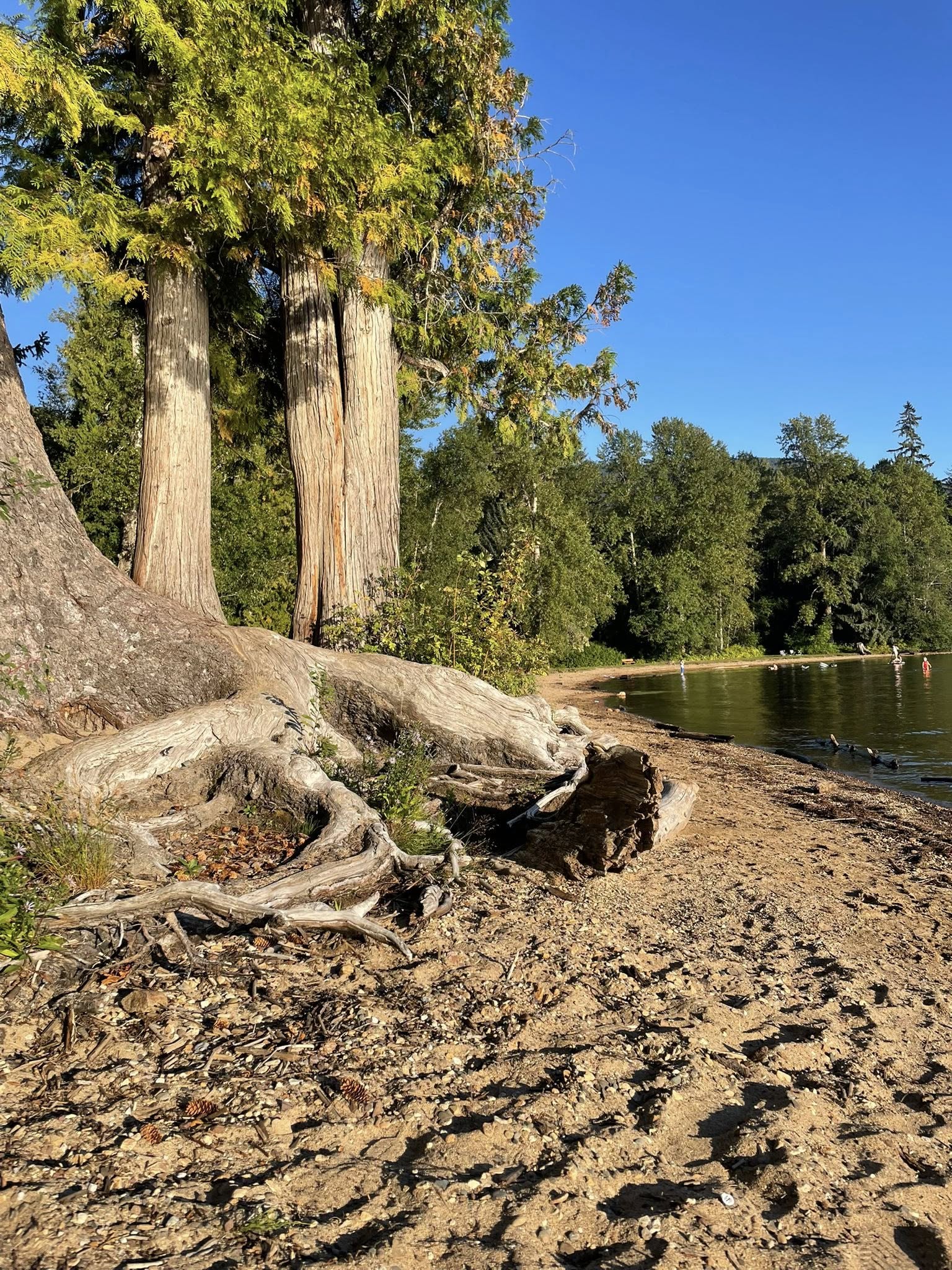
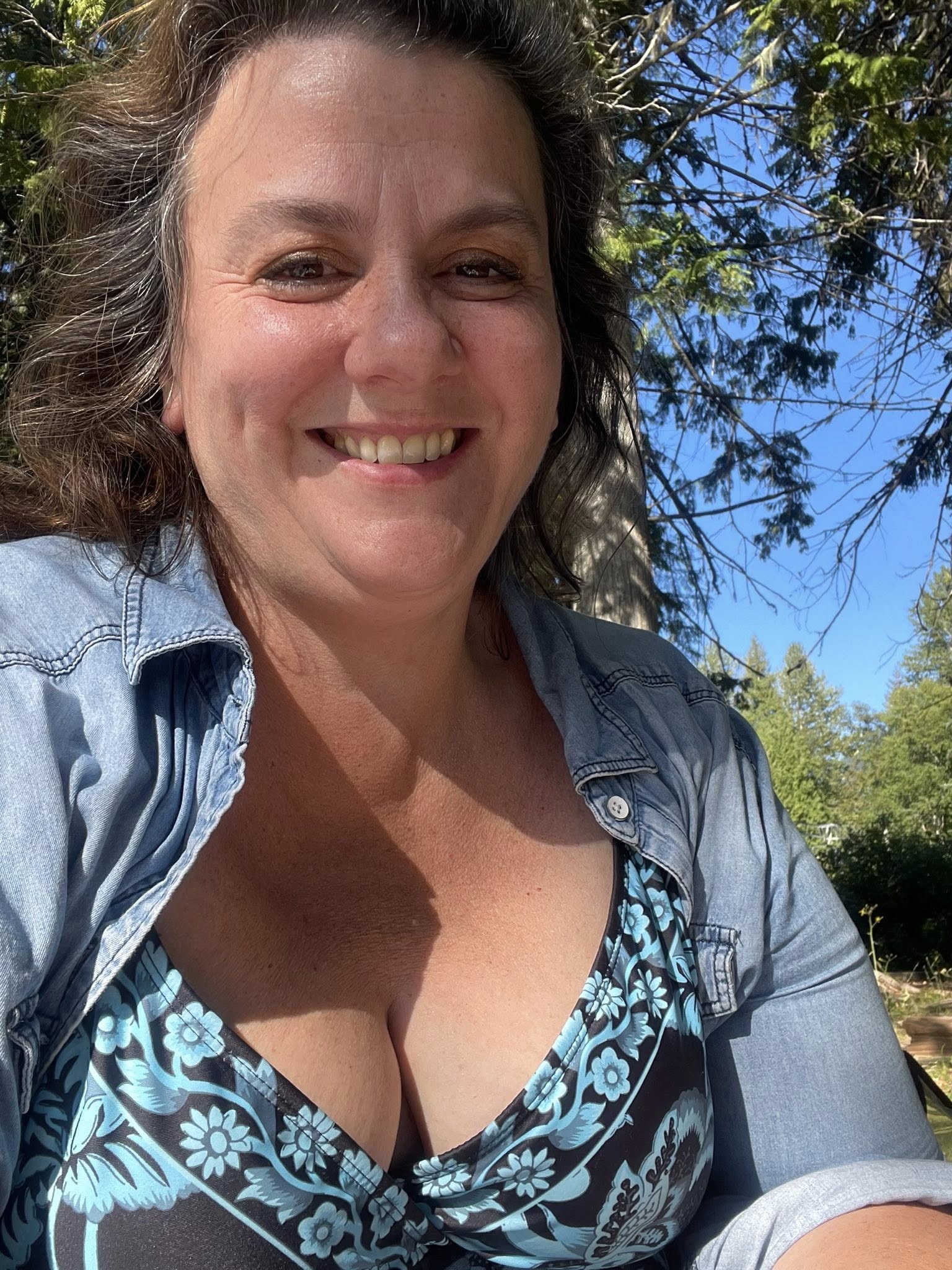
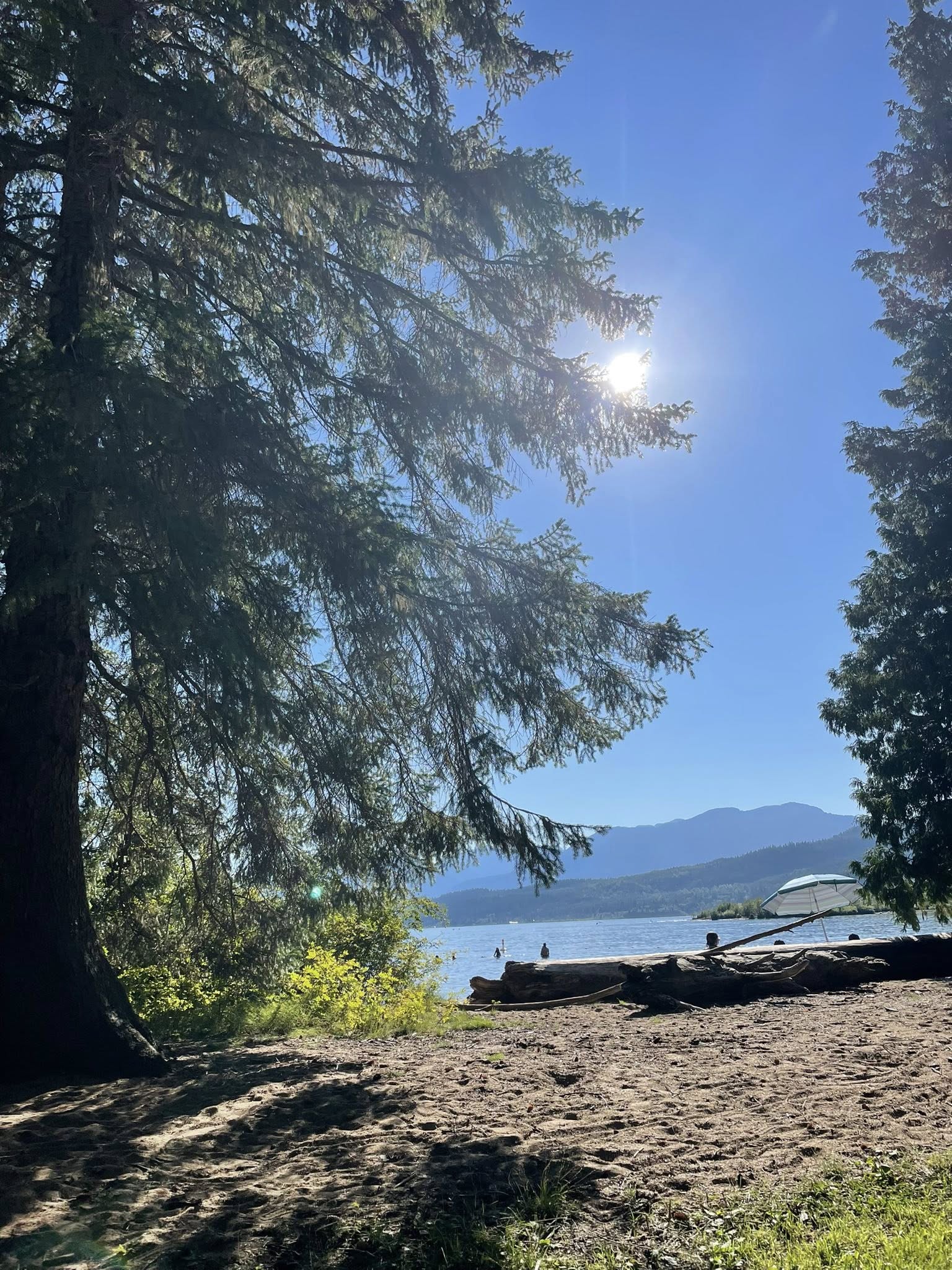
I’ve been taking advantage of the glorious blue skies and visiting Lakelse Lake Picnic site, aka “my” lake :D, as much as I possibly can, even if it’s just for a quick dip. Lakelse Lake Picnic Site has been a big part of my summer, a source of infinite joy (that’s not an exaggeration) and huge balm for my sorrows, for over 45 years now. A fact that both delights and boggles me! On her golden sands, I feel Holly Smale’s words in the novel from I Know How This Ends to my bones: “Time is somehow before me and also every memory is there too.”

I moved to Terrace in 1979. Driving into town that first time, I was horrified. Had we moved back to Kamloops? The lawns had the same parched, burnt-to-beige color. Every strip of dirt was hard-baked clay. My legs stuck to the ivory vinyl seats of the station wagon. My hair was wet on my neck and glued by sweat to my forehead. It was HOT.

My brother and I unpacked our rooms and tried to explore, but it was too warm. For days, we lived in our sprinkler and wading pool. Then water restrictions ruled; no sprinkler all day. We could fill the pool once a day, but a whole day of three kids playing in one small pool quickly creates a grass clippings and dead bug infested mess. It lost its appeal. One day, our mother, driven to desperation by the heat and our constant whining, announced we were going to the lake.

A lake? Finally, something that sounded interesting. We packed up chips, green grapes, and sand toys, and off we went. Our legs still stuck to the vinyl seats, but now it didn’t seem as complaint-worthy. Plus, though they stung if you lifted them too quickly, they made farting noises if you lifted them slowly. Endlessly amusing.

“We’ll never get there,” we moaned eventually. Then suddenly we were at the top of a hill, and what could we see shimmering blue between the trees and mountains in the distance? Could it be?

“Look guys, there’s the lake,” my mom confirmed.

“Hooray,” we yelled, dragging out the vowels with heady excitement and enough volume that our mom yelled, “Enough!” (It would become our tradition to repeat those exact words, with feverish glee, every time we spotted the lake in the future.)

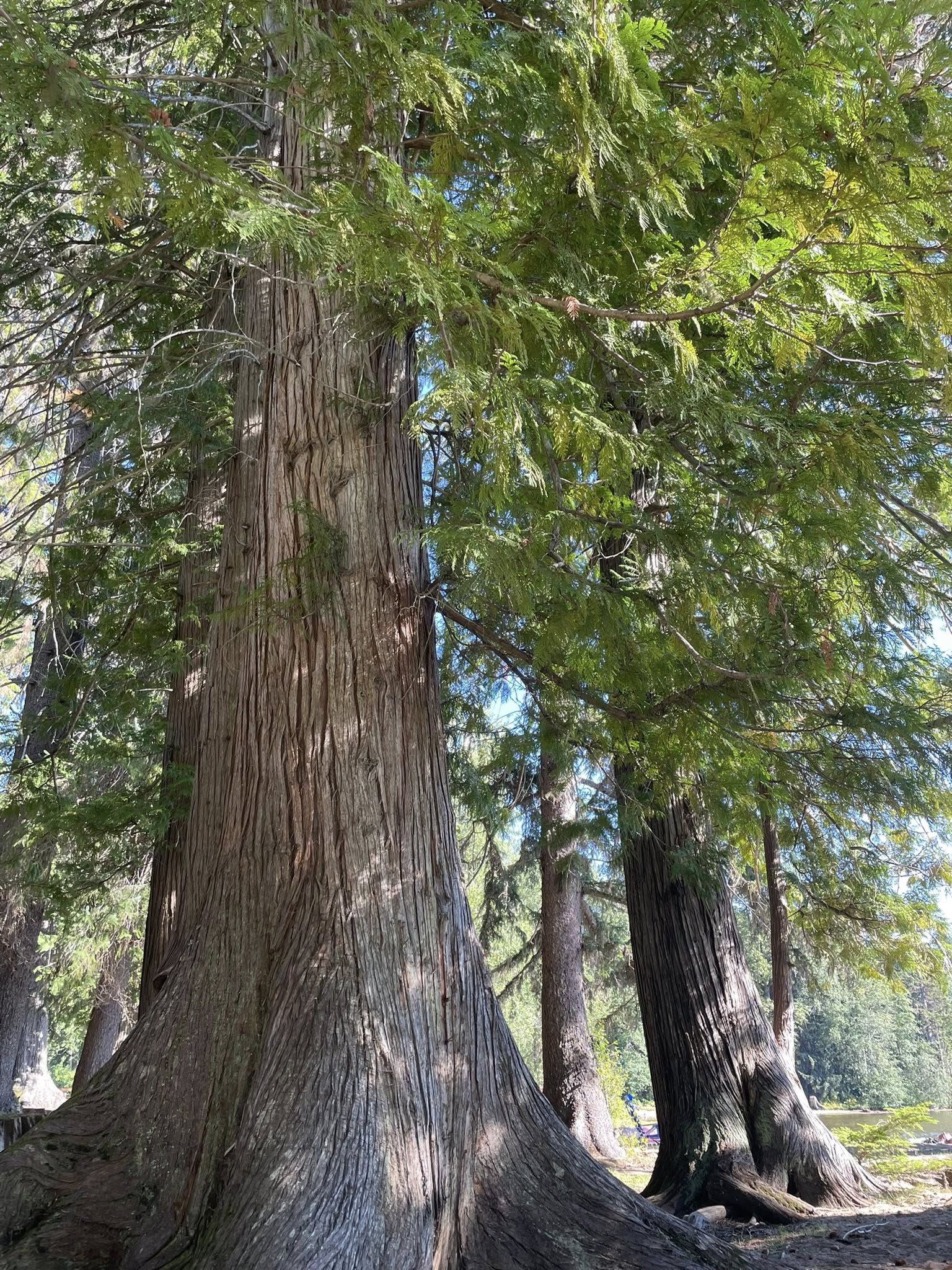
Walking the paved path to the graveled picnic area and coming upon the incredible, giant fairy tale trees and the glimmering expanse of water that looked golden in the afternoon sun made me, for the first time, think that maybe, just maybe, this living in Terrace idea could be okay.

We visited the lake almost every day for the rest of the summer. We’d work all morning (my mom could bribe us to do nearly anything with the promise of a lake trip), and by afternoon, it would be so hot that even she wouldn’t feel like working. Thus started a habit I’ve kept for over forty-five years: hit the lake as soon and as often as possible.

Now, when I sit on the rough bark of a natural tree bench that I’ve visited for years, squishing sand through my toes, my mind and my body remember my childhood.

In the water, I am forever eight. My feet delight in the soft-as-silk rippled sand under the water. I still alligator walk and do dolphin dives and continuous back rolls; I can’t help myself. I still know the disgusting but hilarious feeling of a handful of lake bottom on my back or head. A weed grabbing my ankle still makes me shriek, and the underwater whine of boat engines still creeps me out. I daydream about mermaids.

Staring up at the sky, I realize that visiting this spot is the most consistent thing in my life. The water has seen every bathing suit I’ve owned. Every person I’ve tried to be, or thought I was, has walked the beach. I was a child here and a dream-filled teen. This site has known my friends, boyfriends, and the husband I had for over thirty years. I’ve been pregnant on its sands and nursed my newborns in its huge trees’ shade. My children played here, and in a seeming blink, I would arrive on its shores and splash in the waves with my adult son and daughter and her husband.

And in between the magical, happiest of memories times, I mourned on its shores too: the passing of my parents, the death of my marriage, and myriad other smaller, though at the time not inconsequential, hurts and questions. How many tears Lakelse’s golden waters generously carried for me—and how much laughter ripples in her waves again, as I introduce my new love to her beauty, and he’s as taken with her as I am. As I dolphin about and alligator walk with grandkids now!

I swim far from shore as a regular form of meditation and appreciation, contemplating the mountains that frame the lake like the protective walls of a giant bowl, admiring all their various shades of hazy blue in the distance, feeling that some part of me will always and forever be both a mermaid child and a mermaid crone in these waters. And in the ever-changing waters of life.

The drive is shorter to me now that I’m an adult, my car has cloth seats that I don’t stick to, and often I’m alone, though equally often I’ll be meeting my kids and grans somewhere on the “right hand side,” and lovely Lee might be driving out after work. But when I get to that particular place on the hill, I still announce, “There’s the lake!” and my whole body feels it: Hooray! Yeah, this living in Terrace idea is a pretty good one after all.

– – – – – – – – – –

“Lake Days” originally ran in The Terrace Standard in July 2001, and because I liked it so much, I thought it was a lovely one to share once more, edited slightly to adjust for the passage of time—and my editor agreed. Thus, it was reprinted in The Standard on August 25, 2015. 

In August 2020, I shared it again on my blog here at evbishop.com because Lakelse was still my favourite of favourite places, only made more special by how little it changed over time, while everything else in life seemed to morph at a crazy pace. Case in point, and beyond special, at that time I had two little grandsons to share my timeless beach with. 

Today, August 30, 2025: With the passage (Wow!) of so much more time, and it still being such a special place to me, and having the addition of a precious granddaughter added to my grandsons, as well as a new life partner, I found myself needing to edit this piece again to reflect on and express gratitude for all Lakelse continues to be for me. I fully expect and hope to continue sharing my life with its sandy shores and soft waters, and suspect there will be edited versions and shares in the future.


I hope reading the latest version triggers fond memories of your own childhood. Enjoy these last long days of summer, everyone—and get thee to the lake! ~ Ev

Little by Little

Petit á petit, l’oiseau fait son nid. 

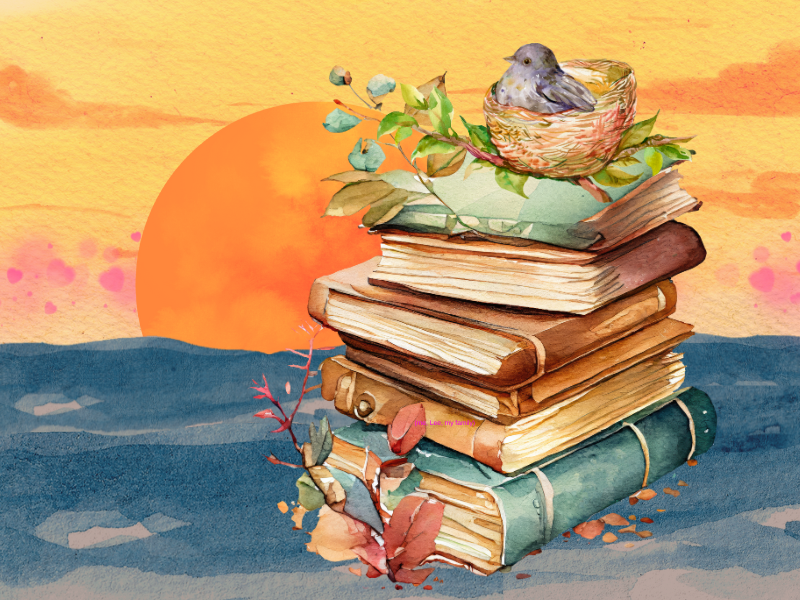
When I came across this lovely saying in French recently, it wrapped around me like the comforting, encouraging, celebratory hug of a dear friend. Little by little, the bird makes his nest.

Ever full of dreams, plans, and schemes (and prone to being very hard on myself, something I’m working diligently to change!), rather than reflect on things I’ve accomplished, I’m someone who finds it easier to focus on everything I haven’t done yet but want to, the project that I haven’t tackled, the idea birthed but not yet brought to fruition. (And I’m one hundred percent sure I’m not alone in this. In fact, I’d go so far, dear reader, as to suggest it’s something you do too!) 

Almost simultaneously with discovering that quote, I embarked on a new exciting quest: applying for a couple of Writers in Residence programs. A large part of the application process was creating a CV and a list of publishing credits. As I went through the task of recording each of my published novels, short stories, and poems, documenting awards and honours I’ve received, and summarizing workshops, presentations, panels, and readings I’ve created, led, or taken part in, I was a little . . . well, awed, actually. I have written a lot of things across genres and in many forms, and it was really exciting to see them all laid out in black and white. (It doesn’t diminish my goals and plans for future writing projects in any way, but it was very encouraging: I probably will get around to those dreams and schemes because look at all the things I’ve completed and explored before!)

Petit á petit, l’oiseau fait son nid. 

It doesn’t just apply to creative goals or writing aspirations. I’m sometimes impatient about my yard and garden, but those types of activities can’t be rushed. Trees take time to mature and bear fruit, flowers only blossom in their season, and even when plants appear to be dormant, that is only appearance. Beneath the surface, life is just waiting for the right time to burst forth. And when I look back at rose bushes that were once newly planted sticks with just a leaf or two, proving they were alive, or at various masses of perennials that were each, once, just one solitary planting, I’m struck again: little by little. My latest lesson here is two new grape varieties, about which the man who sold them to me advised, “Don’t do anything to them for at least two years, and even better, three. Let them get really rooted and established before pruning.” 

Relationships too. We can’t Abracadabra lifelong friendships into being. You build friendships, shared experience by shared experience, laugh by laugh, shared tear by tear. 

I’ve tried—and failed—to see if there’s a part of life that the lovely saying doesn’t apply to. And if one of our nests literally or figuratively gets destroyed? Again, the bird (if it’s a robin, anyway!) is a good inspiration. Little by little, the resilient creatures build a new one—often with the same materials and methods if they weren’t the problem. 

So that’s me these days, busily, happily enjoying my various nests, some of which I’ve mentioned, some of which I haven’t, all the while knowing that I’m still building and rebuilding. And may I ever be. And may you ever be, too.  

Petit á petit, l’oiseau fait son nid. 

A New Year, A New Page Workshop

Hello and happy New Year!

I hope this super quick update finds you doing well and happily bundled up in this surprising cold snap with reading and/or writing goals to keep you company.

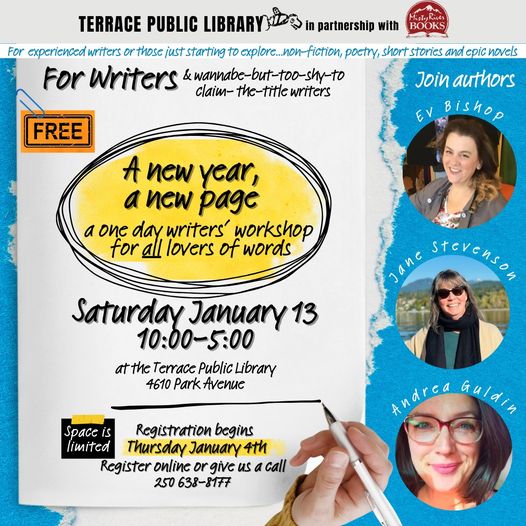
I realize it’s super short notice, but it felt weird not to share it here in case you happen to live in the Terrace area (or close enough that a spontaneous jaunt is a possibility for you). If any of your hopes or intentions for 2024 (or just in general!) involved wanting to start writing, to get back to writing, or to write more (in any form or genre), this FREE full-day workshop is just the artist date you need to treat yourself to.

Register online here https://www.terracelibrary.ca/programs/workshop/ or by calling the Terrace Public Library at 250-638-8177. Here’s a brief breakdown of the day so you know what to expect. I hope to see you there! 😊

10:00: Kick off, including introductions

10:30 – 12:00: Ev Bishop. Write your heart. From non-fiction articles to poetry to short stories and epic novels, writing about the things you care about most deeply is the key to developing a satisfying, motivated writing practice and finishing pieces.  

12:00 – 12:45: lunch

12:45 – 2:15: Jane Stevenson. Setting and location. Physical geography provides a map for our passions—and often our stories. Strengthen your fiction by connecting your readers to a strong sense of place.

2:30 – 4:00: Andrea Guldin. The Hero’s Journey. Incorporate internal motivation into your hero’s journey to create dynamic characters that challenge your protagonist and drive the plot forward.

4:00: Q&A

4:45: Wrap up

An artist’s date, a.k.a. playing with paint

Playing!In my late teens/early twenties, I decided that was it. I was done writing. I would never pen again. I quit. (I could bore you with stories of my insecurity, of neuroses and perfectionism, of worries about what people might—gasp—think of me and the horrors that come from my brain, but as I now think all those “blocks” are common stuff that all artists struggle to work through—that might even be a necessary part of the process—I will spare you. Or I’ll spare you for now. I may write about young Ev someday!)

For many reasons I couldn’t, I wouldn’t, listen to the deep inner-whisper that never let up, Write, write, write, write, you need to write, it’s you to write, you love to write, write, write . . .

Then one day I was at a friend’s cabin on Lakelse Lake (Mark Anson—I am forever grateful to you!), and I came across The Artist’s Way by Julia Cameron.

I asked Mark about it, and he raved about how good it was, then added, “Actually, I pulled it out because I was thinking you need to read it.”

It sounds cheesy to say the book revolutionized my life. But that’s what happened. I “did” the book. (It’s laid out as a 12-week artist recovery program. But don’t laugh. That’s exactly what I needed.) I answered all the prying questions. Took the assignments seriously. Adopted a habit of morning pages. Started taking artist dates . . .

And by the end, though I realized I’d no doubt be plagued by insecurity again off and on (and that’s definitely been the case!), I had the tools to overcome the negative voices that would see me stifled and sure I couldn’t create—and more importantly: I was infused with joy and excitement and a huge AHA! I was a writer. A storyteller. Maybe even a poet. Not crazy. (Or at least, not all the time.) Not depressed. (Ha—again, at least not all the time!) Just angst-ridden because I wasn’t doing what I was meant to do. What was essential to making me me.

Does it all sound more than a little self-helpey? I guess so. But did it help me? Absolutely.

To this day, whenever I feel my courage regarding my writing start to wane, whenever I begin to second guess the time and effort I put into something so “selfish,” whenever I doubt that I’m working in the direction I need to be, I return to the steps in The Artist’s Way. I take up morning pages again. (I probably should never stop them to begin with, but that’s another topic.) I strive to “fill the well,” which basically just means intentionally doing things that nourish your soul, like going on artist dates (a.k.a. visiting inspiring places), taking classes or workshops directly related (or not!) to fostering/developing creativity, treating yourself to a little craft-related splurge, etc.

This month I found myself needing a little encouragement, a little more play in my work (and a lot less obligation), so I decided to bring back artist’s dates. Yay! (What’s not to love about taking time out to do things that you know will inspire or refresh you?)

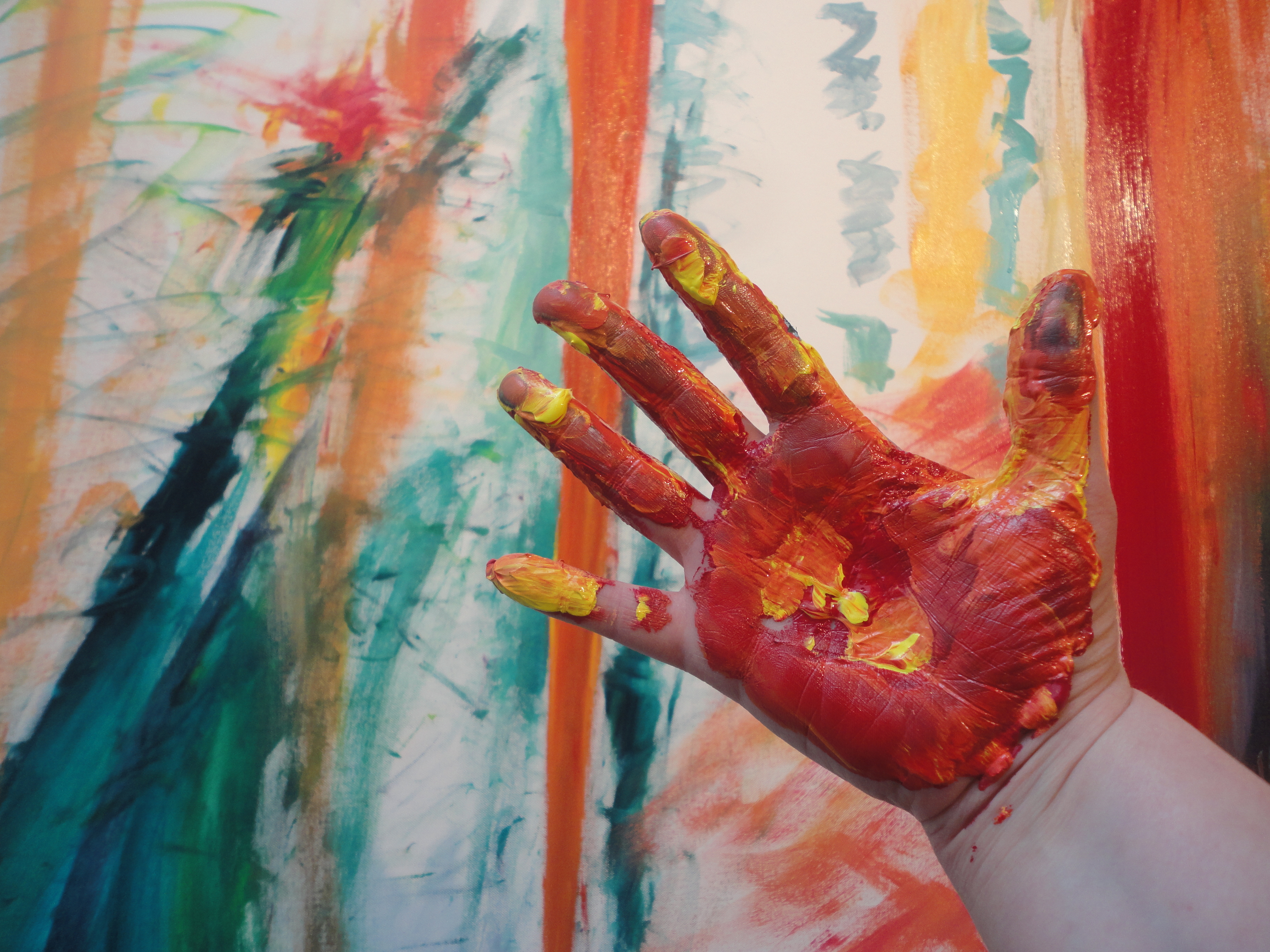
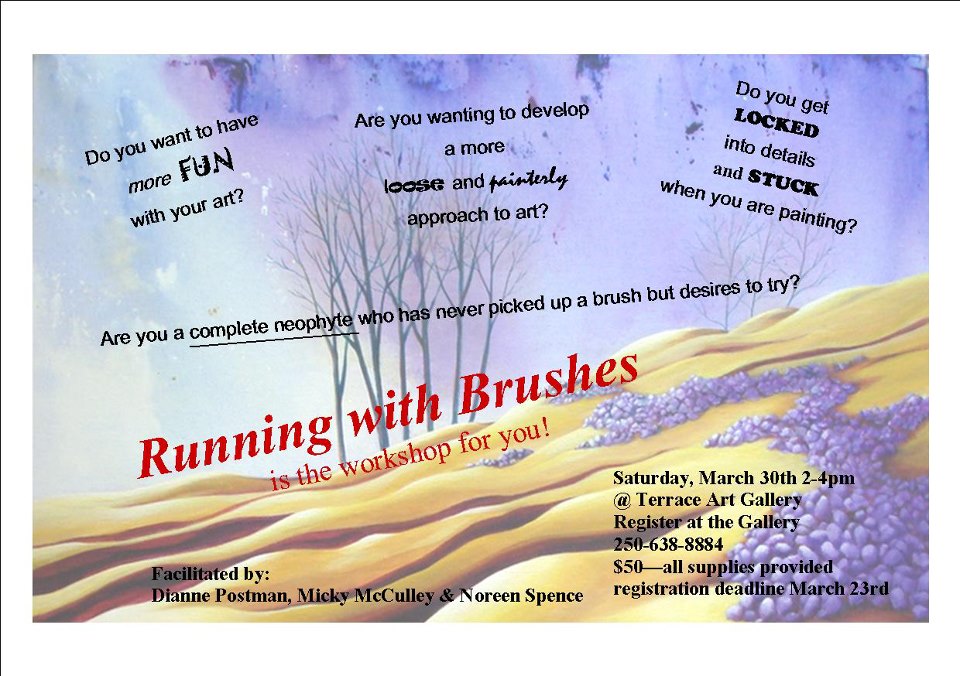
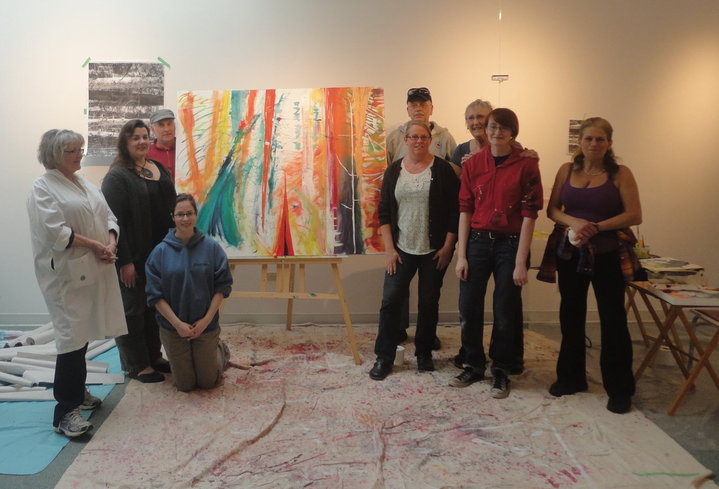
Running With BrushesMy first “official” date was a workshop called Running With Brushes, led by Noreen Spence and Dianne Postman. It was incredibly fun. And what we “put out” was . . . Well, I actually have to say, it was art. 🙂 Judge for yourself.

The two-hour paint fest was pure fun, but it also had practical carryover for my writing life—a reminder (with exuberant “practice”) to not over think, plan to death, obsess about each detail . . . just CREATE. Worry about craft and polish at some far off date when the created work is out there in full, where you can see its whole shape, wackiness, potential, nightmare spots, etc. At least that’s what I took from the workshop anyway. 🙂

I don’t know if you’re feeling a bit slumpish, or burned out, or burdened with lofty goals in whatever creative pursuit you hold dear . . . And don’t get me wrong. Goals are good. Plans are great. But artistic dreams shouldn’t feel like drudgery or chores. There will be agony and sweat and work, yes—but there should also be joy and euphoria—fun!If you’re experiencing lots of the former, not so much of the latter . . . Maybe you, like me, need to give your inner artist a play date or two. I highly recommend paint! ☺

Now I leave you with a quote Noreen gave us at the beginning of the workshop. It was exactly what I needed to hear, to remember, and to celebrate. 🙂

“Nothing is a mistake. There is no win and no fail. There’s only make.” ~ Corita Kent

Running With Brushes!

It’s all rock ‘n’ roll to me.

Digital image, Copyright 2011 Marriah Bishop, used with permission.

My daughter has started painting. She also takes a lot of photos (digital and old school 35mm). Lately, I’ve been struck by the contrast between her two arts—and how those differences relate to writing.

Photographers strive to capture images of what’s already visible in the world and focus in on it, with the goal of revealing what exists—what is tangible, what is right there in front of us—in a new way, making people see.

And, of course, most artists wielding a camera hope to make us feel—to invoke peace, hope, or joy showing the lovely things that exist all around us. To stir up empathy or make us angry (thus, hopefully, motivated to do something about whatever issue riled us up). To kindle awe or understanding about the world around us. To make us laugh. To make us cry. But they attempt to do that by showing us what already exists.

Painters, or the ones whose work I relate to most anyway, seem to approach their work the opposite way. They start with reaction (emotion) triggered by something real and try to express how feeling looks. The results on the canvas may be realistic and identifiable—a brook, a tree, a face . . . but they just as easily might be abstract colours and shapes and form, or some combination thereof. The final piece creates something real, yet isn’t fact-based or often a literal representation.

For me, those visual processes are close cousins to writing—non-fiction is like photography. I write about what really exists, for a variety of reasons—to create a record, to encourage, to challenge, to entertain, to inform. . . .

In fiction, I start with an idea or emotion or question and explore it through story—sometimes realistic, sometimes absolutely fantastic. Every time, with the hope of stirring the fears, concerns, rages—and the dreams, worries, and hopes—of the reader. I’m not concerned with the factual at all.

Whether the setting is a modern high school classroom, the moon, or a castle in a land of fairies, what I want is for people to feel—to recognise that emotional truths exist separate from literal events, times and places. After all, there’s something surreal about being human—there’s our physical reality, but then again, something so, so much more than that, in which we live and move and have our being.

Poetry and music are like what mixed-media is to visual arts—seeking to express what almost defies expression, to give substance to what is invisible yet is also somehow the crux of existence. Oxygen to plant life.

I read a comment on a blog recently that said that “real” writers don’t write blogs. (The irony that the comment was made on a blog, by a writer made me smile—and in a large part helped fuel this slightly odd post. As much as I see differences within the forms, mostly I see connections and related pathways between all modes of artistic and creative output. I’m not sure there’s any definitive definition for a writer—except that he or she writes. And although it’s interesting and fun (perhaps even helpful, occasionally) to wax poetic on the purpose and function of various forms of writing, I don’t know if it really matters how or why or what a person writes.

What about you? Do you write in a variety forms? Are you a writer and another type of artist as well? If yes, how do your processes/intentions differ according to the craft? If no, any specific reason why not?

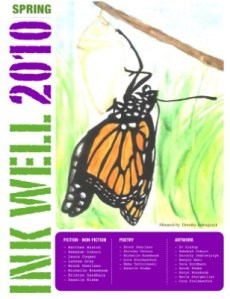
INK WELL Spring 2010

Yay, another issue of Centennial Christian’s artzine INK WELL has been put to bed. We had over twenty contributions this time!

Click HERE to preview the whole magazine online. I think you’ll like it.

It features stories by Matthew Buxton, Rebekah Coburn, Laura Cooper, Brook Peerless, Michelle Roseboom, Brixton Sandhals, and Danelle Wiebe, plus poems by Brook Peerless, Shivohn Peters, Michelle Roseboom, Cora Stelmaschuk, Emma Tettolowski, and Danelle Wiebe.

Artwork contributors include me, Rebekah Coburn, Dorothy Jedrzejczyk, Reegin Maki, Vera Nordmann, Sarah Peden, Karyn Roseboom, Maria Steigmiller, and Cora Stelmaschuk.

Working with these freakishly inspired creatives makes me really happy and puts me in excellent company! I’m grateful that I get to know them and I hope that as they go onto bigger endeavors and publications, they keep me in the loop, so I can add their work to my reading piles (or their art to my walls).

Life imitates art—the editing part anyway . . .

I’ve commented before about how I see connections between almost everything in my life and writing. Caving? Well, that’s absolutely a metaphor for writing, of course. Scary movies in childhood? Obviously a lesson in recognizing and dealing with avoidance techniques that might be hurting your writing. Lazy and procrastinating? No, no, no—that’s feeding the muse.

And the latest case of life echoing writing work or vice-versa? Electrical upgrades done in your home (while you’re trying to live and work there) is just like editing a novel. It’s an electrifying truth. (Sorry, couldn’t resist!)

I was not happy to hear that my older home needed to have its panel upgraded from 70-amp service to 200-amp service. (Yes, I’m just showing off newly acquired technical lingo.) My house was comfortable and warm. It had (has!) character. I liked it just fine as it was and it never gave any trouble. Current “code” regulations seem a little on the bizarre side: I’m living here, not operating a nuclear plant . . . but I digress. However unhappy I was to hear it, the needed reno wasn’t a surprise. We knew our house needed more power.

I was not happy to hear from my beloved and much trusted, much appreciated first readers that my latest WIP needed more work. Yes, not happy, but again, not surprised. I already knew I wanted to amp up the tension, rewire a few scenes to dim the focus on the killer, spotlight some red herrings . . .

I thought it would be lovely if the very competent electrician could figure out a way to fix the problems without bashing huge holes in my walls and cutting through lovely painted walls and moulding to get at what he needed to address. He, of course, all artistry aside, could not. Fixing the problem required getting at the guts of the house.

I thought, Hey, I’ve edited a lot of novels now. I’ll just cut in neatly, splice in a line of intrigue, throw a couple of exciting switches . . .

I trust you see where this analogy is going. My eight-inch-thick walls were dismembered and unstuffed. My ceiling is, well, missing in chunks . . . My scenes were (are!) just as mangled. So much for artistry.

But there’s good news. All the hard work, the gruelling work, the omigoodness-please-not-really-don’t-make-me-fix-that-too work pays off.

My house was built to last and the new fixtures, forced air electric heaters, and lovely high-powered service, breakers, fuses, etc. just make what was already there that much better—shine that much brighter.

I trust that I won’t have to resort to mudding and taping and painting my novel to get the same power upgrade in my story.

Pen caving . . .

I’m sorry there was such a long time between my last post and this one. I was off gallivanting for much of July and all of August, but don’t worry, I kept busy, doing NO WRITING AT ALL. Yes, you read that right. I didn’t write. *Anything. Perhaps that seems a weird admission from a writer who calls her blog, “Write here, write now,” and uses most posts to thump the drum: write daily, write regularly, don’t get out of practice, write, write, write . . .

I wasn’t just being a slacker, however. And it wasn’t that I kept meaning to write, but got too busy and didn’t get around to it. My four-week hiatus was intentional. Once a year or so, I take some time off from writing (this year’s 4-weeks was a bit extreme, and I don’t think I’ll ever go that long again). I find the break beneficial for a number of reasons, the biggest being that not being allowed to write makes me want to nothing but write. By the time I let myself back to it, I’m a bit crazy in my eagerness and the words flow and flow–which brings me to a weird phenomenon.

Sometimes in the middle of feeling, thinking, observing and ruminating “face-to-face” with an event, person, or moment, I find myself slightly removed, watching with my psychic pen in hand, wondering even as I experience something how I will write about it.

It’s not a bad thing. It might even intensify living in the moment, forcing me to really note the small details and nuances, similar to how going for a walk with a camera in tow makes you focus on the millions of tiny details that make up the “big picture.” The view you have and even think you appreciate in a cursory glance suddenly becomes deeply intricate and profound.

This slightly strange, constantly penning side of my brain grew louder and louder the longer I denied it a paper outlet, and I was fascinated by a growing awareness of parallels between various adventures I was having and my writing life.

At no time was this kinship more dramatic or clear than when I was caving in Horne Lake. Yes, caving. As in burrowing deep into the earth via rocky tunnels and winding, blacker-than-black channels into surprisingly wide caverns and the like.

My obsession with caves (and writing) started when I was young; I blame Mark Twain. While I loved Tom Sawyer (of course) and could never understand his passion for insipid Becky Thatcher, I adored Huck Finn. And the descriptions of the caves he got to explore (where Injun Joe lived for a long while) always threw me into paroxysms of jealousy. Why couldn’t I live in a cave? Why couldn’t I at least live near caves? Second only to sunken treasure, caves were the top of my romantic-things list.

Fast forward to holiday planning 2009. As I investigated interesting things we could if we got tired of Rathtrevor Beach or jumping off small cliffs into Englishman River (which would never happen, but it was nice fun to see all the things the Island offers), I came across ads promoting Horne Lake caves. Real caves. Twisty, freaky, creepy, awesome ones.

We knew we were leaving the surface before we even entered the cave; the change in temperature is immediate and complete, even just at the mouth. Squeezing through crevices that put off the claustrophobic, we ended up in strange room after strange room (there were even, I swear, platformed layers in various nooks and crannies that would’ve made perfect sleeping quarters!). I was almost giddy with the knowledge of how much there was to explore (so much that I suspect no one could ever get through all of it). It didn’t matter that other people were doing the same thing, sometimes in the same area–caves are unique through each person’s eyes, imagination, fears, and purpose. I felt completely alone and cut off–in a delicious, adventuresome way at times. In a slightly awed, fearful way at others–what have I got myself into? Can I get myself out?

The light from our headlamps (and from any others in the caves, though for the most part my son and I were alone and even went our own separate ways a few times) shone in single narrow beams, the inside of the earth being so dark, so void of light that it seemed to devour the rays we tried to cast. I could see only as far ahead as I could shine the light directly. But it was enough. For fun (???), we turned off our lights and tried to figure out where to go next, how to get out of a particular spot, by feel. Worms of panic squirmed occasionally–what would we do if our lamps went out? Or if we turned them off and they wouldn’t turn back on? The answer was simple and obvious: we would get out the same way we came in. Step by step, hand-over-hand. We’d close our eyes, so the dark would feel like a choice, and move by thoughtful gut, prodding the air ahead with hand and foot, making sure a steady hold waited for us. Eventually we’d make it through.

The terrain of the caves was captivating and varied: by turns rough and jagged, alternatively smooth and rounded, like mounds of mud rolled down in layers. Deceptively soft looking. Bone dry in parts, sweating beads of moisture in others–and in still others, crystal clear pools glimmered with reflections when your light happened to touch upon them. Often, but no less delightful for the frequency, the glow from my headlamp would bounce against seemingly black, dense stone only to have it light up and sparkle like it was dusted in stars. The phenomena, I think it’s actually called “cave glitter,” brought to mind those writing sessions where you go in feeling blah, sure that your project is a full flop, only to get ten minutes into working and realize that you have idea after idea.

Yes, my writing life is like exploring caves in every way. Exhilarating. Intimidating. Sometimes fear-invoking. Challenging. Revealing. Often I can see no further in a story than to the end of a line. I know I have to accept the necessity of feeling my way around in the dark. I am continually amazed by the depths and diversity I discover. And just like I can’t wait to do more spelunking, I’m excited to be back in the cavern of my office, climbing through the gnarl of passageways, dead ends, and mysterious spaces that make up my writing. And my head. 😉

I hope you had a great summer–and whether you took a conscious break to “fill the well” as Julia Cameron calls it, or wrote ferociously, making the most of longer days, I hope you’re feeling inspired and itchy to do some keyboard caving of your own.

I’d love to hear about the types of non-writing activities you feel work as analogies for your writing life.

~ Ev

*Okay, with two exceptions. (1) My family and I have a camping journal that we take on trips and leave randomly about the campsite, cabin, or hotel room. Throughout our vacation, we take turns jotting down memorable moments/thoughts. But this year, I reined myself in even there and wrote entries in keeping with everyone else’s, so two. Under a page each. (2) I did work required to keep my business afloat, of course. For me, limiting myself to those few things is not writing. 🙂

Ye Olde Idea Shoppe

Stephen King has said he’s frequently asked where he gets his ideas. He gives slightly varying answers, but one of *my favourites, he attributes to a friend of his: “I buy them at the supermarket.” Now it’s obvious he was being a bit facetious—on some level asking a writer where he/she gets ideas is like asking the moon why it hangs in the sky or where the ocean gets its water. There probably is a perfectly reasonable scientific explanation to the query, but I’ll be darned if I’d ever know how to articulate it. And even the best responses would be destroyed with one further question: why? Why do you get ideas for stories? Why indeed. But I digress. Back to ideas, where they come from, and the ones at grocery stores—oh yes, the grocery store. S.K. and his quoted buddy were speaking partially in jest, but they would agree that the statement is factual.

Story ideas abound in grocery stores. They arrive in the produce section (who hasn’t lifted a big yellow clump of bananas and thought about the huge, hairy spider that might have arrived with the shipment?). They lurk about the deli. Why does man keep standing there like that? Is he going to try to shoplift bulk olives? Does he have a thing for the girl at the counter? Is she his long lost child? They sit in well-ordered rows in the canned foods sections. Do you know what’s in that can of refried beans—the third one back in the middle of the row? Well, do you?

When short on cash, or just not in the mood for a big shop, have no fear. Ideas are everywhere:

In conversation, like when a friend recently expressed his suspicion that the reason there are so many more vaccinations now than when we were kids isn’t disease-prevention at all. It’s a safe guard for world governments worried about over-population. If at anytime they want to cull the population, they just have to press a button and release whatever it is that reacts with whatever injection. Story idea!

In overheard snippets of dialogue. “I can’t believe she’d do that. It’s sickening.” What can’t the speaker believe she’d do? And who’s she? And who, come to think of it, is the speaker? And what’s sickening? How sickening?

In dreams (See, that’s what I’d like to know—forget ideas—where do dreams come from? Come to think of it, a story about where dreams come from would be pretty fascinating!)

In physical work, especially it seems to me, in gardening and yard work.

In doing absolutely nothing (which is why, even when I’m really busy, I strive to have do-nothing time . . . It’s good for your brain).

Even in random personal moments. I bought a full-length formal gown (of all things) two weeks ago. Wearing a dress like that makes you (or makes me, anyway) just feel different. And that made me think of a story idea—what if you walked into a vintage store, tried on an outfit, and suddenly—poof—you were you no longer—or you were, but only in the flesh suit and life of the person who’d owned the apparel you now sported? (Hey, I didn’t say every idea was a good idea.)

Chances are if you’re a writer, you don’t need to find ideas. You need to somehow stop tripping on them as they lift the floorboards late at night. You need to carefully replace the stone you moved only to find another one scuttling beside a centipede. You need to do something, anything, to stifle them, so you don’t lose focus on the ones you’ve already collected and are trying to coax onto the bright white page. You understand full well how ideas just appear, well, everywhere, from nowhere.

My question for people who ask, “Where do you get your ideas?” is this: Don’t you get random weird ideas all the time?

I know that not everyone writes, but it never actually occurred to me that perhaps not everyone is inundated with the what-ifs, questions, and strange observations that spark story ideas. I think I thought that ideas came to everyone, just that some people are compelled to do something with them . . .

* If you happen to know where on earth I read this bit—I want to say it’s in On Writing—could you give me page number? I’d like to give the actual name of the person King attributes it to, and I’d like to confirm how it’s worded. Thanks!

The Waiting Game

Is there anything more onerous to a writer than the waiting game? Most people tackle a project and then, well, they’re done. Not fiction writers, oh no. They “finish” their work (which could take months, a year, or even years) and send it away, only to have the really time consuming part of the job start: the waiting.

Lurking dangers surround all that waiting. Self-doubt has lots of time to imagine unkind things being said to your story’s face (and to do its own unkind muttering in your head). The desire for regular coffee money might trick you into some cave of a job where you’re paid by the hour. Writer’s block (if you subscribe to that kind of notion) is more prone to leap upon you and starting chewing on your throat—especially if what you want to write next might depend (foolishly!) on whether the circulating work sells (my advice: write like it sells, or don’t and start something entirely new—just write!).

It’s not all bad though. If you let it, waiting to hear back can be kind of like counting down to a vacation. Each passing day is one closer to at least some sort of a response, the wait gets sweeter, the anticipation builds. I’ve learned to use the hope that just won’t die (I’m bandaging my throat here as you read!) as motivation to write the next thing. While your words sit on someone’s desk, there is the endless opportunity that said words might find a home—someone might like that story, poem, article, or what-have-you. Nothing is more inspiring than the idea that someone might relate to your offerings and even (gleep!) want more of them. Exciting stuff.

I try to take full advantage of this wait/hope phenomenon by keeping 6 – 8 things “out there” all the time. That way, rejection doesn’t hurt as much (hope sprints over to another project to rest on) and my inner-creep can’t do as much of a job on my self-esteem.

Hmmmm . . . Is there a point to this post? Yes (lectures self), get your stuff out there and keep it out there until it finds a home. And in the meantime, the waiting time, get busy on the next idea.

Happy writing,
☺ Ev