Lessons From Bubble Pop

I have an embarrassing confession. I have an addiction. To Facebook games—specifically Tetris Battle and silly, bright-coloured, manically cheerful Bubble Pop Battle. I live in two states: on the wagon and off the wagon.
 
When I’m on the wagon, I accomplish things, meet deadlines, get work done in the yard, and even, occasionally, clean my house. When I’m off the wagon (have broken its wheels and driven it over a cliff!), I stay up way too late to play just one more round, lament how I never have time to write, explain to my family that we might move permanently to fend-for-yourself meals for dinner—and that will probably only work if Dad goes grocery shopping.
 
When I’m in this hand-cramped, escalating-theme-music-wormed state (the later, in case you don’t know, is when a song lodges in your head and won’t go away), I justify my lack of self-control with soothing rationalizations: “It’s good stress release,” or “These types of games help improve spatial skills,” or . . . “I don’t have a lot of other vices.”
 
Then something amazing happened. I actually learned a legitimately important lesson, or rather, had something I know but sometimes forget, reinforced in a silly, bright-coloured, manically cheerful way!
 
Like so many lessons, the Bubble Pop epiphany was triggered by crisis.
 
I logged into Facebook to play, I promise, just five rounds of Bubble Pop (and at a minute a round, that’s not too, too bad an indulgence, right?). Before I could hit “play,” however, a little box popped up announcing that after September 30, Bubble Pop was done. Would no longer be available. THE TRAUMA!!!!!!
 
The creators then, remembering their commitment to manic cheeriness and good will, added, “As a token of our appreciation, we have credited your account with tons of coins.”
 
Whoaaaa . . . Sounds like a dream, right? I certainly thought so. The coins are actually limitless, which means every bubble-bursting weapon (and life protection aid) was at my disposal. I could play forever. I could never die. Muauahahahhahahahahahahaha! A monster was almost born, except—
 
Except it turns out that in Bubble Pop, as in life, things that come too easily, without work or effort or some sort of cost (time, resources, etc.), lose their value and interest for me. Become boring. Unsatisfying. Blah.
 
I do, on occasion, like most of us I suppose, think things like:
 
If only I’d win the lottery, so I wouldn’t have to work anymore—life would be perfect!
 
If only all my relationships were completely effortless, nothing but an unending stream of Hallmark movie worthy moments forever—
 
If only I didn’t have to do chores, and the house and yard and laundry and dishes took care of themselves . . . I’d have limitless free time to explore things I really care about.
 
If only I didn’t have to struggle to learn new techniques, programs, or material . . . my work and creative life would be ideal.

 
No. Wrong. False. Thoughts like that are based on the erroneous notion that ease brings contentment. I find the reverse is true. Periods of rest, relaxation and “having a good time” are lovely (and necessary), but too much holidaying makes me restless. Irritable.  
 
Pushing myself. Digging deeper. Not knowing if I have the resources or ability to tackle a new task or pull off a new endeavour . . . exhilarating! Challenge keeps life interesting, makes work meaningful, and helps relationships continue to grow and deepen and be satisfying.
 
Bubble Pop can’t truly get full credit for reminding me of all this, but (sadly, embarrassingly!) it did trigger thought . . . and for now, until some other captivating Internet game snags me, I’m back on the wagon, working on things much more interesting and time-worthy than popping yellow, purple, red and blue bubbles with my oh-so-cute cannon . . . trying to ignore the part of me that misses the pop-pop-pop.

_ _ _ _ _ _ _ _ _ _ _ _ _ _ _

“Lessons From Bubble Pop” by me, Ev Bishop, was originally published in the Terrace Standard, September 25, 2013 as my monthly column “Just a Thought.”
 

A Note From Mark Twain

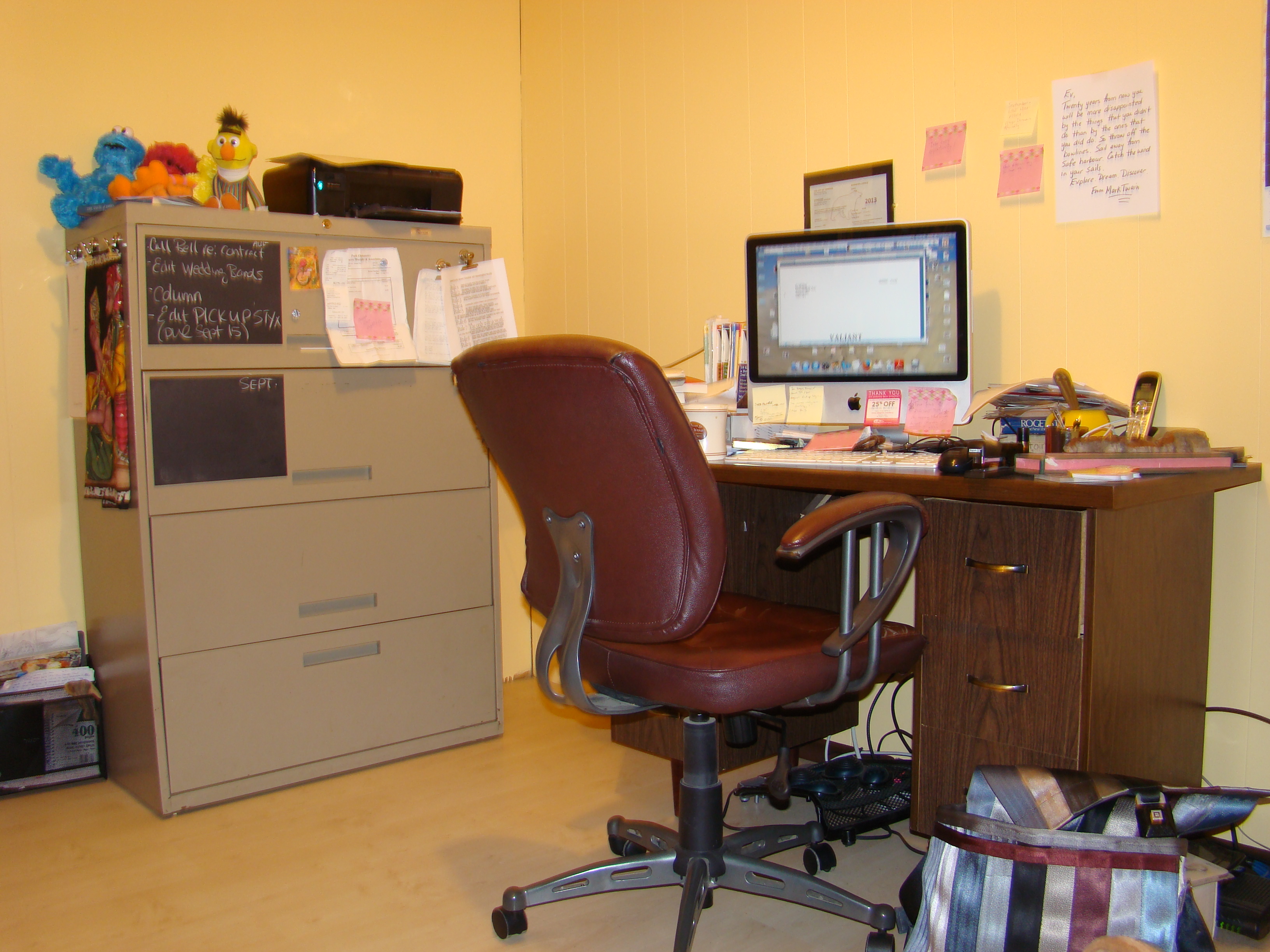
In my head . . . er, office!

In my head . . . er, office!

The other day, in a bit of a funk, I turned to my journal, figuring some random ranting might soothe my itchy impatience, unrest, and sluggishness. This annoying, conflicting state hits me every so often: I want something to happen, to be accomplished, to be different—but I feel too lazy to work or do much of anything.    

Do you relate? Have goals and dreams that you don’t always work toward, that you beat yourself up for not accomplishing, even while you fritter time away time on stupid stuff? (Facebook games, perhaps? Argh, the time suckage!)

Anyway, I opened my spiral bound notebook, a tattered, sadly neglected thing this summer, and what had I scrawled as the last entry?

Not a flowing stream-of-consciousness ramble. Not a to-do list (one of my favourite past-times—creating, not necessarily fulfilling, to-do lists!). Not an idea for a story or an informal essay about something I was thinking on . . .

A quote. And what a quote! So weirdly timely, as if back on June 20th, I knew the glorious sun would leave in mid-August, fall would descend early and heavy with rain . . . and I would be in need of something inspiring, encouraging, motivating.

Twenty years from now you will be more disappointed by the things that you didn’t do than by the ones that you did do. So throw off the bowlines. Sail away from the safe harbour. Catch the wind in your sails. Explore. Dream. Discover. ~ Mark Twain  

I rewrote the words to myself (Ev, twenty years from now . . . ), signed the letter (From, Mark Twain), then stuck it on my wall above my monitor. I smelled salt water, felt the breeze—and thought, Ah, he nailed the cause of my malaise—exactly.

I’m a bit of a psycho about things I’m passionate about, as you may or may not have deduced over the years, but passions go awry if you don’t put your time and heart into them. They don’t leave you altogether; they just nag at your subconscious, causing angst, making you restless until you get back to them.

Busy the past year (with things that, to be fair to myself, legitimately demanded time, burned physical and mental energy, and took an emotional toll), I let myself fall into the trap of putting off things that I know I need to do, desperately want to do, and derive a huge sense of satisfaction and well-being from.   

And for a while that’s fine. Is understandable. Is life. But after a time . . . Well, the conviction I should be working on something but instead I’m playing Bubble Pop Battle ‘til my hand cramp up kind of drives me around the bend.  

So what am I doing about Twain’s friendly warning? I’m remembering that twenty years will fly by—and that at sixty (and at seventy and at eighty—and today!) I want to be able to say that I gave my goals my best shot, that maybe my progress occurred in fits and spurts, but I was steady. I took risks. I tried.   

Years ago, when my children were small, Thomas Moore’s famous line, “The best of all ways to lengthen our days is to steal a few hours from the night,” was my mantra. Later, when I was teaching, I wrote early mornings. And after that, for a few luxurious years, I wrote during regular workday hours.   

And now? In light of my letter from Mark?  I’m back to early mornings. It’s not natural for me. At all. But I’m finding the quiet hours very lovely. And very productive. As with late nights, the world is different when everyone else is asleep. Dreams are closer to consciousness. More seems possible.   

Perhaps pretending Mark Twain penned you a personal note isn’t something you’d find especially motivating, but his message is pertinent for us all.

Time moves quickly. What is it you should be doing now? What trips are you planning? What tasks need tackling, or classes should you register for? Or do you need to steer into something entirely new? So go on, do it. Sail away from safe harbour  . . . Explore. Dream. Discover. 

_ _ _ _ _ _ _ _ _ _ _ _ _ _ _

“A Note From Mark Twain” by me, Ev Bishop, was originally published in the Terrace Standard, August 28, 2013 as my monthly column “Just a Thought.”

Circles

So, after fourteen years or so where we are now, we’re moving. The house we bought used to be my dad’s—well, actually, my whole family’s. And they say you can’t go home again!

My new office is my old bedroom. Bizarre. And as I pulled out its carpet and built-in closet, then proceeded to paint the room a deep golden yellow called Bengalese Cream, I thought about circles—ones I want to continue and bring back to full strength (the gardens and flowerbeds, the yard!), and ones I want to break entirely, once and for all (for example, a genetic propensity for . . . collecting).

Memories crouch in every corner and sit on every shelf in my new-old house, and as in any life, some are wonderful . . . others not so much.

My little nephew visited one day while I was emptying out the kitchen, and found a smiley-faced toy carrot on a coffee table in the living room. “Hey, I remember this!” he exclaimed with delight—then his tone grew suspicious. “Wait, you’re not throwing it away are you?”

I assured him that no, I wasn’t throwing it away. It was a keeper. And it is. I think, literally, every child and grandchild of Simon and Susanne Higginson has chewed on that rubbery, squeaking toy. It’s practically an institution.

But I am recycling, gifting, selling, or scrap-yarding almost everything else. I have my own stuff, literally and metaphorically, to put into the house now.

At first I felt bad clearing things out, but time moves on and life constantly changes, regardless of the physical items we cling on to, trying to pretend nothing’s different. The task then is to carefully choose a few things that have special significance and pass on everything else to people who can use it better than you. Or that’s my aim anyway.

An antique doughboy in the entrance way will take its place in the living room once more. How can it not? Every time I see it, my sister’s a laughing toddler again, magazines strewn about her, waving, wildly proud, from the compartment she’s standing in.

A wardrobe from the 1800s reminds me of times spent in antique shops and second-hand stores with my mom.

A child-sized workbench, handmade by my dad, will remain in the garage. I can’t wait to outfit it with new tools (The labels for what should hang where are still there!) and restock it with miscellaneous lengths of wood for visiting kids to create with.

I’ve found a number of things we’d all thought lost forever, most notably a whole collection of pictures of one of my brothers. They’d been carefully pilfered out of the collection and mounted on poster board for his wedding. We all just forgot. It was profoundly sweet to look at this lifetime of childhood photos, chosen and arranged by my mom’s hand. You can feel the love—and the fun—she had in putting it together.

Other discoveries are as surprising and painful as a slip of a knife. A card from my husband’s mom (now deceased) to my mom when she was dying. Old letters from my parents to each other when they were fighting. Syringes, long outdated prescriptions, and other paraphernalia related to disease.

I wonder sometimes if I’m up to the task of taking on my family home, with all that concept entails—and while the verdict’s not in (It’s sort of a multi-year project), so far I’m pleasantly surprised and get a little more excited, a little more confident, about our decision every day.

The work is cathartic. I feel my parents smile at me occasionally. My mom shakes her head. “You’re not really going to keep that old thing are you, Ev?” My dad’s voice booms as I heft junk down the stairs: “Yep, you’ve always been a big strong girl.” (You can just imagine how I loved hearing that as a teen!) And in the kitchen, memories of my stepmom’s meals and baked treats inspire daydreams about future family events at the home I’ve circled back to . . .

_ _ _ _ _ _ _ _ _ _ _ _ _ _ _

“Circles” by me, Ev Bishop, was originally published in the Terrace Standard, June 26, 2013 as my monthly column “Just a Thought.”

Driving Thoughts

"Driving Thoughts" Photo by Ev Bishop

“Driving Thoughts” Photo by Ev Bishop

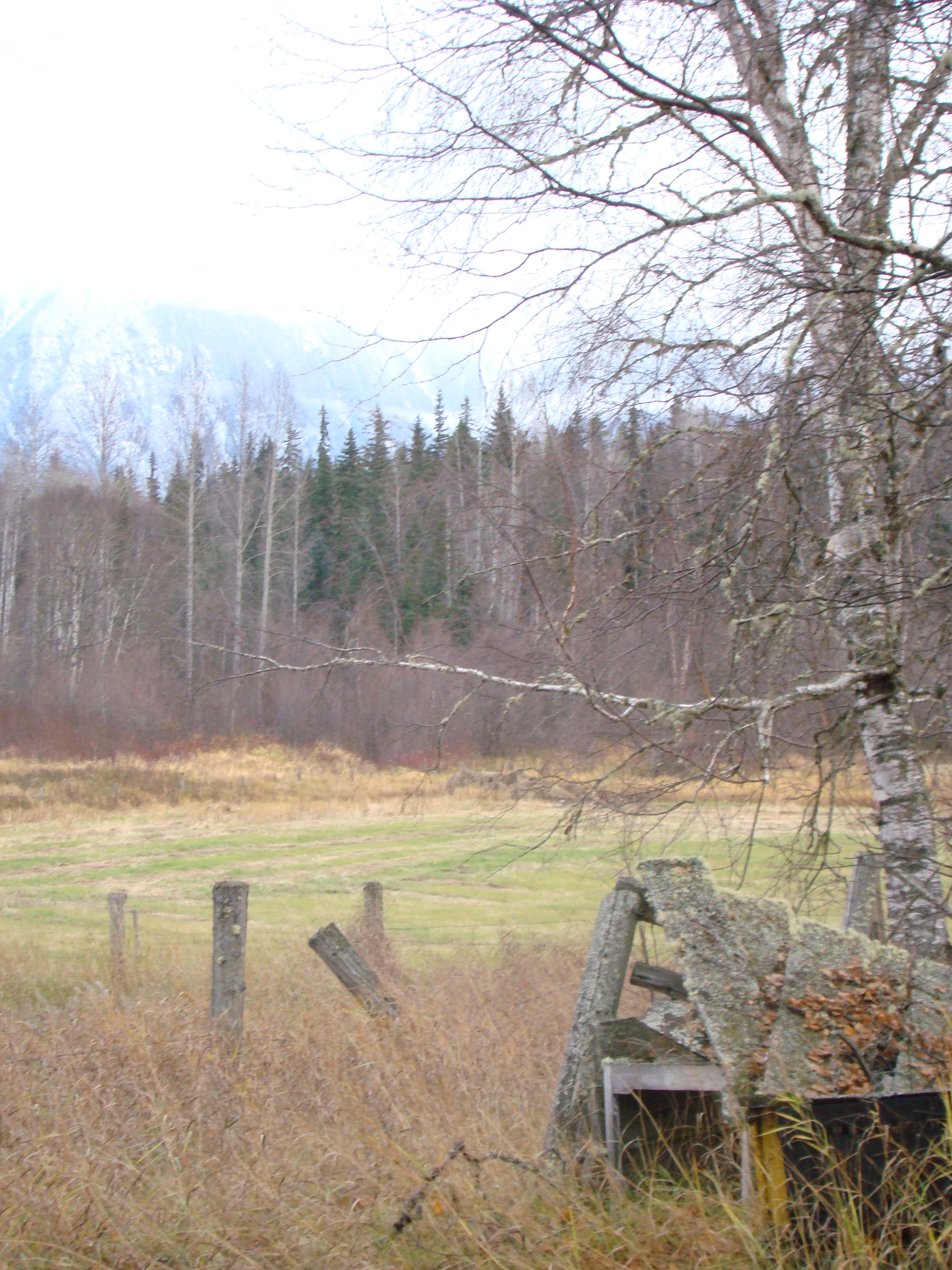
I was driving along today, thinking on this and that, but mostly just enjoying the familiar jaunt from the airport into town, soaking in the sunshine, admiring the gorgeous light and the crazy, brilliant—numerous!— varying shades of green that epitomize spring time in Terrace.

A vehicle behind me approached too fast, started tailgating me on the hill. I hate that feeling—of being pressured on the road (and I was doing the speed limit, maybe even riding a km or two over). A specific thought jumped into my head: Just keep your eyes on where you want to go.

I can sometimes be a bit of a nervous driver. I’m a good driver, and I love to drive—but I never feel invincible anymore. My sense of mortality kicked in about the same time I had children. I became aware (God forbid, please) that they could die young—and so could I. But I digress. As I said, I love to drive. I just, sometimes, am too aware of how many pounds my car weighs as it hurtles itself along the highway. And I’m too conscious of other drivers who are not as conscious of their responsibility and the fact that they too are propelling thousands of pounds of steel in other people’s direction.

I’m also, at times, overly cognisant of the surface of the road—worn ridges that shouldn’t be there. Pits and grooves—sink holes. Worse: angles that aren’t conducive to hugging you to the curve.

Someone once told me that the airport hill is such a road—that its angle is wrong and you’re slightly more prone to going off the road there because of it. I’m occasionally plagued by that fact—or fiction—especially when there’s an idiot behind me.

When my nerves shift into overdrive, however, I recall the sage line I mentioned above—I think it was given by my husband, but don’t tell him I credited him with it. Keep your eyes on where you want to go. Don’t panic.

It’s good advice for nervous drivers, novice drivers, and for people learning to ride bikes. You will over correct and zig and zag on the road until you learn to focus ahead of you, not on the nose of your car. And you’ll wibble and wobble, won’t be able to balance, will fall off your bike if you don’t learn to look ahead at where you want to go instead of staring down at where you are. (How I wish I’d had my husband around when I was eight or so and learning to ride a bike!)

Keep your eyes on where you want to go. Calming, practical advice for drivers and wannabe bicyclists, yes—but also good advice for life.

I’m a bit of a nervous liver (as in one who lives, not the organ responsible for aiding digestion, making proteins, and getting rid of toxins!). Not always, but sometimes, I get hung up in the details of where I am in the moment, the crisis of the instance, the busyness of the immediate.

Whether it’s writing or other work related goals, relationship desires, financial plans, or personal improvement endeavours, I can get mired up in where I’ve been or where I seem to be stuck. It’s good to remember that by looking forward, we move forward—and often just by embracing that truth, anxiety eases.

It was a beautiful drive—vibrantly green, with air so fresh and sweet as it rushed in through the open window that I grinned like mad just because life is good. I drove, and I thought, and I kept my eyes on where I wanted to go.

_ _ _ _ _ _ _ _ _ _ _ _ _ _ _

“Driving Thoughts” by me, Ev Bishop, was originally published in the Terrace Standard, May 29, 2013 as my monthly column “Just a Thought.”
On Journaling

Photo by Puuikibeach

Photo by Puuikibeach

My daughter got me a snazzy new journal recently. Its designers cleverly titled it “My Dysfunctions,” and its funky yellow cover carries further explanation (less we be unable to figure out what it’s for!): “A journal for chronicling my immeasurably fascinating dysfunctions, neuroses, emotions, inner children, moments of shame and doubt, projection, self-loathing, misanthropy, and completely normal insanity, because the only difference between me and the rest of the population is that I acknowledge how crazy I am and they’re all in mind-numbing denial.” Hilarious and so apt!

While I’ve always wanted to create the kind of journals or diaries you can pass on to loved ones after you die (You know the kind I mean—leather bound beauties, filled with perfectly formed lines, a.k.a. legible ones, that share deep thoughts and entertaining tidbits that somehow manage to speak of the “human experience.”), one only has to flip one or two pages into my scrawls to realize my actual journals are the furthest thing from those daydream ones.

They’re completely random, messy, meandering things—half rant, half . . . boring.

Entries are inconsistent blurts of this and that. I do record small stories about my days, but more often I just vent—journaling to get things out of my system and process (deal with!) things that are going on around me-and/or in my head. And all that’s very valuable—just not something you want your family to stumble upon when you’re gone.

Or maybe it is.

I have a couple of my mom’s old notebooks. I was thrilled when my dad gifted them to me. But then I read them. And was . . . disappointed.

Only the beginning few pages in each were filled out. And there wasn’t a personal vignette to be found.

They were sermon notes. Now don’t get me wrong. I respect (and share) my mother’s faith. And I know the value of note taking—how it aids comprehension and retention. But there was nothing of her in the notes.

I poured over each page, hoping for a tiny visit—a whisper of her voice, her opinion, her humour, her angst, her . . . anything. I’d thought there might be snippets about my little toddler brother, tales about her and my dad, thoughts on parenting . . .

But these were not that type of journal.

What her journals aren’t, however, makes me think mine are okay. Maybe more than okay.

What if I’d read some never-before-guessed secret in my mom’s notebooks? I’d have been delighted, intrigued, curious, not incensed. What if I read her no holds barred inner response to a fight she and my dad—or she and I—had had? Would I be devastated? No. I’d grow from it, learn from it . . . And what if I read about unfulfilled dreams or came across scribblings about things she’d like to do in the future? The words might bring some pain, yes, but mostly they’d bring joy.

We often waste time hiding ourselves—or trying to, anyway. We try to disguise the darker sides of our nature, and strive to avoid what we perceive as “burdening” to others—the sharing of any sorrows, or questions, or doubts. Journaling should be an attempt to bust through that self-censor. A fight against the lonely notion that we can’t—or shouldn’t—say what we honestly feel and think, lest we offend, lest we unintentionally wound, lest people, really knowing us, cease to like us.

I’ve read extremely personal things taken from miscellaneous journals, and I’ve never thought less of the author—just the opposite usually. Uncensored details or observations about love, hate, confusion, beauty, ugliness, relationships—heck, about tea and simple pleasures, make me think, Ah, so that’s what it’s like to be him. To be her. And, perhaps ironically, help me understand myself better.

Someone famous once said something like, “I never worry about what someone might think of my diaries after I’m gone. I’ll be dead.”

Wise words. I wish I could fully embrace them—but the idea of someone reading all my journals makes me cringe. After all, I burnt all my childhood diaries when I was 13. I couldn’t bear the idea of someone perusing me. Sometimes I assure myself that’s what I can do with my spiral bound notebooks, too. But I don’t think I will.

While I can’t imagine anyone ever wanting to wade through my impossibly messy, navel-gazing cycle of snooze-inducing blah-blah-blah, my journals are part of me and I’ve made tenuous peace with them. And if someone does page through them when I’m long gone . . . Well, perhaps I should decorate each one with warning labels, similar to the one on my new yellow journal. . . .

– – – – – – – – – – – – – – – – – –

“On Journaling” by me, Ev Bishop, was originally published in the Terrace Standard, April 24, 2013 as my monthly column “Just a Thought.”
Ms. Bishop. In the Library. With the Coffee Mug.

Photo by Ev Bishop

Photo by Ev Bishop

I started to spring clean. I got as far as my library shelves and office cabinet.

I’m prone to flights of daydreaming and distraction at the best of times, but when I’m supposed to be tidying books? Heaven help me! All those ideas, all those adventures, all those life-changing worlds and words . . .

I’ve been known to box up books, only to go back and rescue select titles. I keep doubles of some novels—because they’re that good and because it is a truth universally acknowledged that if you loan books, you rarely get them back. (Of course that fact means I rarely lend in the first place, but I like doubles in case, you know, I start.)

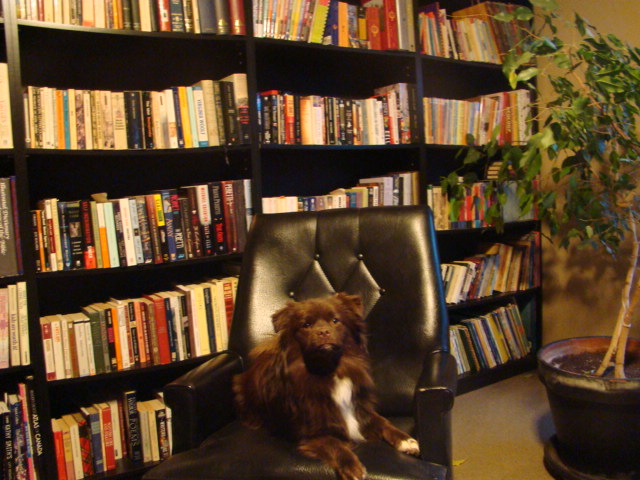
Anyway, armed with fresh coffee, a multitude of multi-sized cardboard boxes, and a belly full of steely resolve, I headed to my miniature library.

I’d just gotten through my writing-related books (mostly keepers), when the biggest killer of productivity, house-cleaning wishes, and de-junking desires hit me: an interesting thought. My brother had been sorting my Dad’s books and commented that you can learn a lot about people from their bookcases.

I found his theory interesting. So interesting that I lost several hours to perusing titles with an eye to what secrets my books might tell about my psyche, obsessions, and beliefs, instead of focussing on whether or not I would ever actually read or refer to them again.

A deer skull (complete with lower jaw and teeth) sits atop one row of books (Christianity and other faith and religion texts). I’m not sure what that says.

A bottle of wine lounges on its side, coming of age in the lofty company of modern literary fiction greats like Joy Kogawa, Barbara Gowdy, Wally Lamb, and Eden Robinson. Why am I storing a bottle of wine there? To make the classic authors a shelf above and a shelf below jealous? Perhaps. Also, it looks kind of pretty.

I have a lot of science fiction—Orwell, Bradbury, H.G.Wells, Asimov and Silverman, Heinlein, Robert J Sawyer. . . .

A full shelf homes titles by authors who are also personal friends. And another carries autographed works. And I have a small (but growing!) section with books that carry stories by me.

I have gads of Stephen King, almost the full Merrily Watkins series by Phil Rickman (highly recommended, by the way), Diana Gabaldon’s wonderful genre-bending Outlander series, and a myriad of other scary or scintillating tales. They hulk in the shadows, balancing the sweetness and light of my Jan Karon and Maeve Binchy books.

As my children grew, I parted with any kids’ books that were lame—but as children and YA writers are top storytellers in my books (Ha ha, pun intended!), I still have one full five-shelf case of “must keeps.”

My collection is roughly 1/5 non-fiction (but within that, a full shelf is devoted to poetry), with a higher concentration of writing craft and religious texts—but lots of history, social sciences, and philosophy, too

What fascinated me most circles back to my original goal of pruning my collection. Weirdly, it’s not the best books I have the hardest time parting with. The story between the covers isn’t my only consideration—nor the information relayed, nor the style, humour, or power with which the author writes. Not even my firm “Will you ever read this again?” question actually determines whether I cull or not. No, what really hampers my ability to part with a book is the story within the story.

I bought this for Marriah and Christopher at that little bookstore when we were on holidays on the Island.

My aunt and I spotted this book at the same time. She let me have it, but I “owed” her.

This was the first book I read after my mom died.

Aw, this is the one Chris read to Christopher all the time!

Breaking Smith’s Quarter Horse! My dad was obsessed with this forever.

And that—the notion that the story within a book is only part of the reason it keeps its spot when another, arguably far superior, might be pulled—was eye opening. I’ve long fought junk collecting because I know what a trap it can become. I had no idea that the psychology behind why I hold onto some books is similar to why some people can’t get rid of broken toys, old clothes, or boxes of knick-knacks they haven’t looked at in years.

I’m happy to say I did complete my library/office weed through. I now have space to justify new books.

The shoe closet and the kitchen cupboards are next. I’m a little scared. If you think I build sentimental, unrelated attachments to books easily, you should see what I can associate with old mixing bowls or a pair of satin slippers!

– – – – – – – – – – – – – – – – – –

“Ms. Bishop. In the Library. With the Coffee Mug” by me, Ev Bishop, was originally published in the Terrace Standard, March 27, 2013 as my monthly column “Just a Thought.”

Spring Stinks

"Early Spring Daze" - Photo by Ev Bishop

“Early Spring Daze” – Photo by Ev Bishop

Spring stinks. No, seriously, it does. All the dead plant life from fall, frozen all winter, finally thawed and rotting. The sopping wet fields and lawns release an icky, sweet, almost manure-like scent as organisms in the dirt decompose. But it’s a stench I love. It smells like possibility.

Like, regardless of whether my new year’s resolutions have already fallen by the wayside or whether I’m already behind in my yearly goals whatever they may be, it’s okay because it’s spring. Time for new growth. For planting. For milder weather and easier times.

And this year, thanks to our gentle winter, the promise of spring has come earlier than usual. (And I say this despite the fact that as I write this, snowflakes as big as my fist are falling from the sky. That’s the kind of optimism spring brings! The kind that makes me smile at the crazy, cold sky and say with great confidence, “Oh, it’s okay. It’s not ‘staying’ snow.”)

I think everyone feels it—or I hope they do: a rush of hopefulness and happiness as plans about what they want to do in the warmer months in beautiful Terrace unfurl in their minds.

I’ve been poking about my perennial beds with glee. Things are going to take off early this year—but not too early. (Nothing’s so developed that I’m worried everything will be killed if we have a late cold snap). I’ve noted that I need a new roof and my house is desperate for a paint job. (The past four or five years it was just in want of a paint job. The desperation is new.) I even contemplated an old-fashioned spring-cleaning as I looked at my walls, but thankfully came to my senses. There’s no need to get too crazy now.

But whether the walls get scrubbed or not, spring always feels like it harkens a new season of industry, one where I’ll get to all my chores—and enjoy doing so.

And this year spring is more exciting than ever because I feel like thrilling new growth abounds beyond my own yard, small gardens and personal aims. Wherever I venture in town, development is afoot.

After years where it seemed like our shops and merchants were just struggling to hold on and keep the rent paid, parking lots are filled with cars. Long empty retail spaces are filling up. And the Skeena Mall . . . well, holy Toledo, it actually looks like a mall. Maybe it’s weird to be grateful to contractors you’ve never met, but every time I look at the lovely Skeena Mall logo with its swirl of green pine, that’s what I feel.

And equally weirdly, I’m thrilled by the big signs on the corners of the mall parking lot that will one day advertise the stores that fill the mall. Finally! I never understood why mall merchants weren’t permitted to have outdoor signs. Kudos to those who enabled the change.

New restaurants have opened up and will hopefully thrive, including our very own sushi bar. Shops and companies that started out small are expanding, buying or renting bigger office spaces, building new, larger shops. Oh, Terrace, after years of dormancy, we’re growing again!

Spring. It’s the perfect time to muck in the mud, figuratively and literally—but it’s also a great time to clean up and go walk about and window shop (and also to shop shop!). In winter, we (or, at least, I) tend to bundle up and run from one place to the next on a mission to do whatever I need to do quickly. In spring, it’s time to meander and daydream.

I hope whatever you’re up to this spring finds you inspired and motivated—and that when you smell that hint of stink under the sweet fresh breeze that’s soon to bring us warmer days, you’re filled with a sense of anticipation and promise. On small and big scales, in personal and public matters, it’s going to be a great growing season.

– – – – – – – – – – – – – – – – – – – – – – –

“Spring Stinks” by me, Ev Bishop, was originally published in the Terrace Standard, February 27, 2013 as my monthly column “Just a Thought.”

A New Year’s Pondering

"Mmmm" - Photo by Ramona Higginson

“Mmmm” – Photo by Ramona Higginson

I was playing on the Internet, avoiding my traditional January look-back/look-ahead (a time I set aside, usually with tea and a journal, to contemplate what I’ve accomplished the past year and make notes about what I’d like to get done in the new one), when I came across the following quote from Ellen Goodman: “We spend January 1 walking through our lives, room by room, drawing up a list of work to be done, cracks to be patched. Maybe this year, to balance the list, we ought to walk through the rooms of our lives . . . not looking for flaws, but for potential.”


It struck me as being both very true and very good advice. My head is usually full of details about things I don’t like about myself and want to change, areas I see myself falling down in that I want to shore up, and aspects of my relationships that need work. And this year (today!) is no different.

If one were to read any or all of my journals (And boy, I pity the poor fool who ever does—how boring and myopic my ramblings are!), he or she would see I’ve been dealing with the same stuff—the same questions, the same passions, the same laments, etc.—my whole life.

I do grow and change (or at least I hope I do!), but no matter what season a tree is in, it is still a tree, and I—much to my frustration at times—am always me.

For almost as long as I can remember, many of my primary goals, plans, and answer seeking have somehow centered around one or more—or some combination of—the following:

Faith. Is there a God? I believe, 100%, unequivocally, yes. What does He want/expect from us? How should I live? That gets trickier and sets the stage for a lot of my quandaries and questions.

Relationships. Why can’t I be all that I want to be for my friends and family—and why can’t they always be what I want/need them to be?

Pain. Personal, but also in the world at large.

My weight. I hate that honesty demands I mention it here. I want to be done having weight/body issues. I have wanted that since I was eleven. I’ll keep you posted if it ever actually comes to pass.

Writing. My grand passion—and the best way of dealing with life I’ve ever found. I always have tons of writing-related hopes and goals.

The point I’m getting to? Well, I’m not exactly sure. Part of me wants to write a ream of resolutions in keeping with my list of obsessions. The other part of me wants to pretend I’ve outgrown my old patterns of constant searching and questions, of discontent and striving.

But that’s why I like the quote. It doesn’t say we should’ve arrived at a place in our lives where we don’t have questions or see what we want to improve—or that there is some magical phase of life where no improvement is needed. It just says we should also look at the good we’ve already accomplished (or, perhaps, that exists without any help from us) and build on it.

And with those thoughts—and a mug of steaming Earl Grey at my side—I’ve decided to look at the rooms of my life with different eyes this year, and to journal about what I notice. I’ll still give time to plans and things I’d like to change, but I’m also aiming to acknowledge what I’ve already started and record things that hopefully I’m doing right, answers I believe I’ve found, areas that have healed, and ways I may have helped others—and can help further. There’s a lot of potential in 2013!

“A New Year’s Pondering” by me, Ev Bishop, was originally published in the Terrace Standard, January 23, 2013 as my monthly column “Just a Thought.”

A New Year’s Pondering

"Mmmm" - Photo by Ramona Higginson

“Mmmm” – Photo by Ramona Higginson

I was playing on the Internet, avoiding my traditional January look-back/look-ahead (a time I set aside, usually with tea and a journal, to contemplate what I’ve accomplished the past year and make notes about what I’d like to get done in the new one), when I came across the following quote from Ellen Goodman: “We spend January 1 walking through our lives, room by room, drawing up a list of work to be done, cracks to be patched. Maybe this year, to balance the list, we ought to walk through the rooms of our lives . . . not looking for flaws, but for potential.”


It struck me as being both very true and very good advice. My head is usually full of details about things I don’t like about myself and want to change, areas I see myself falling down in that I want to shore up, and aspects of my relationships that need work. And this year (today!) is no different.

If one were to read any or all of my journals (And boy, I pity the poor fool who ever does—how boring and myopic my ramblings are!), he or she would see I’ve been dealing with the same stuff—the same questions, the same passions, the same laments, etc.—my whole life.

I do grow and change (or at least I hope I do!), but no matter what season a tree is in, it is still a tree, and I—much to my frustration at times—am always me.

For almost as long as I can remember, many of my primary goals, plans, and answer seeking have somehow centered around one or more—or some combination of—the following:

Faith. Is there a God? I believe, 100%, unequivocally, yes. What does He want/expect from us? How should I live? That gets trickier and sets the stage for a lot of my quandaries and questions.

Relationships. Why can’t I be all that I want to be for my friends and family—and why can’t they always be what I want/need them to be?

Pain. Personal, but also in the world at large.

My weight. I hate that honesty demands I mention it here. I want to be done having weight/body issues. I have wanted that since I was eleven. I’ll keep you posted if it ever actually comes to pass.

Writing. My grand passion—and the best way of dealing with life I’ve ever found. I always have tons of writing-related hopes and goals.

The point I’m getting to? Well, I’m not exactly sure. Part of me wants to write a ream of resolutions in keeping with my list of obsessions. The other part of me wants to pretend I’ve outgrown my old patterns of constant searching and questions, of discontent and striving.

But that’s why I like the quote. It doesn’t say we should’ve arrived at a place in our lives where we don’t have questions or see what we want to improve—or that there is some magical phase of life where no improvement is needed. It just says we should also look at the good we’ve already accomplished (or, perhaps, that exists without any help from us) and build on it.

And with those thoughts—and a mug of steaming Earl Grey at my side—I’ve decided to look at the rooms of my life with different eyes this year, and to journal about what I notice. I’ll still give time to plans and things I’d like to change, but I’m also aiming to acknowledge what I’ve already started and record things that hopefully I’m doing right, answers I believe I’ve found, areas that have healed, and ways I may have helped others—and can help further. There’s a lot of potential in 2013!

“A New Year’s Pondering” by me, Ev Bishop, was originally published in the Terrace Standard, January 23, 2013 as my monthly column “Just a Thought.”

A Quiet Christmas?

Cozy Ginger Bread HomeWhen I was a little kid, Christmas was busy, like, I think, Christmas tends to be for many people. I had a huge extended family that lived nearby—or nearby enough that we could go visit, but not so close that it was a no prep necessary jaunt.

We’d load up whatever vehicle my dad was smitten with at the time with boxes of food to contribute to the feasting, wrapped presents and snow clothes—and changes of clothes—and head down the highway, a fairytale drive of frozen white and blue, to Hazelton and Smithers.

Both sets of grandparents lived on big, out of the way farms, and I can’t remember green Christmases in either place, ever. We’d drive up, inevitably once night had fallen, and at either property, the effect was the same: magic. The long winding road that for the trip had seemed a snowy fantasy-realm—was suddenly transformed by warm yellow lights glowing in the darkness, brightening the snow, beckoning us in cheerily.

And when I was little, Christmas was loud.

From the moment we were out of the truck and the door of the house was thrown open and a din of voices greeted us, the noise never ceased ‘til we left.

And I adored it. I come from a long lineage of arguers, game players, big eaters, big talkers and big jokers. Our gatherings were, at least to me, the epitome of festive. Us kids would, literally, scream ourselves hoarse playing games like Pit and Risk.

I remember the year it changed—or perhaps “changed” is too strong; “developed” is better. My idea of an ideal Christmas developed a quieter side.

I was eleven or twelve and my Grandma Higginson, who owned a floral shop for many years, sent me a pre-Christmas present—a miniature Christmas tree that stood about 2 feet tall and was factory strung with tiny bright multi-coloured lights that twinkled.

I was entering an era (er . . . or, short-lived phase) where I kept my bedroom immaculately tidy, and I don’t think I can adequately convey the pleasure I derived from decorating my room with that little tree. I placed it on an antique wooden desk I used for writing letters and the like (I really haven’t changed that much in 28 years!), and bought little gifts with my babysitting money, which I wrapped and placed beneath the tree. I purchased my first Christmas album (Amy Grant’s cleverly titled “A Christmas Album”—still one of my all-time favourite carol collections).

Thus started my own small tradition. Playing games, eating, laughing and massacring carols were still some of my favourite ways to ring in Christmas—but I decided I should spend time in quiet contemplation, too. I’d hide out in my room after everyone else had gone to bed or was eating yet again, with eggnog and a journal, planning out my new year in advance.

And it’s a tradition I’ve kept. My family is still loud—though not nearly so big as it used to be—and we all love to eat, argue, and play games into the wee hours, but I still sneak away—or stay up for a bit after the others have gone to bed—to dream by the tree and jot down thoughts and plans by the soft twinkling glow of the sparkling Christmas tree.

I’d thought I wasn’t feeling into Christmas this year, and who knows, maybe a noisy one won’t have much appeal, but I am looking forward to the quiet—Ah, who am I kidding? I’ve already told one of my brothers to bring his Just Dance games for the Wii and that him and me, plus siblings, spouses, nieces and nephews will have a dance off party.

So . . . it will be loud and crazy and my family and I will miss the people we miss and celebrate the ones we’re with—but I’ll seek out my quiet corner eventually, to think and pray and just to be. I hope you find a peaceful spot to be this holiday, too.

Merry Christmas!


“Quiet Christmas” by me, Ev Bishop, was originally published in the Terrace Standard, December 19, 2012 as my monthly column “Just a Thought.”