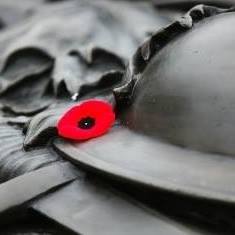
 It’s an especially hard or poignant or painful Remembrance Day for me, as I’ve always been someone who wishes she could identify as a Pacifist, but who is all too aware that throughout human history, there have been times when pacifism couldn’t work (though arguably many things—impossible seeming things—have been achieved through non-violence and acts of peaceful protest). There is a certain kind of person, of evil, that will not be deterred or stopped by anything other than brute force—no appeal to a greater good, to wisdom, to mercy, to conscience, to human decency because there is nothing decent in them. Hitler is the primary example of that, of course.
He could not have been, would not have been, put down by anything other than military defeat—although, that wouldn’t have been the case if he had never been allowed to rise to power in the first place.
And I’m always beyond grateful to live in the country and time that I do (although the random, undeserved good fortune of it stirs up a lot of existential questions—but those are for some other time)—and I do not take the freedom I enjoy because of the sacrifice of so many brave souls for granted. I am very conscious of the gift they gave.
But why is this year’s Remembrance Day harder than others? Because I look to our southern neighbors and I feel afraid—for them and for us. What have we done? What have we allowed?
After every “great” war, there’s always been a pervasive hope that it was, finally, the war to end all wars. Yet that was never the case.
Einstein once said, “I know not with what World War 3 will be fought, but World War 4 will be fought with sticks and stones.”
I hated (still hate!) that he acted as if a third World War was inevitable, like we collectively, as citizens of earth, would continue to fail to learn to put hatred, racism, greed, selfishness and entitlement away. Or maybe what I hated was that I feared he was right.
Some people criticize Remembrance Day as “glorifying” war—and too many times in history, our soldiers have returned from atrocious battles, only to be shunned, marginalized, ignored or mistreated by the very governments who sent them out in the first place—as if the soldiers are somehow the ones to blame when a war becomes politically unpopular (Vietnam vets, anyone?). But it is the veterans—and the world’s current soldiers—who most fully understand the true horror and cost of battle—and I’m afraid that the sheer inability we people seem to have to grow in our ideas of how we treat and respect and even see other people as equally human will doom us to repeat our history’s darkest times.
“Lest we forget” gets chanted so often we almost don’t remember what it means: Lest we forget and thus repeat the same mistakes and horrors—and have another war. Lest we forget the massive casualties and stupid, horrific, meaningless deaths and get complacent, not remembering (or caring!) to extend the principles of human decency, respect and freedom that people died to provide for us—and condemn ourselves to another war.
There is this idea that floats around about “holy wars” or “just wars.” There is no holy war. There is no just war. And may there not be another unavoidable one. Please.
My thanks and deep gratitude to all those who fought to protect us from the worst elements of ourselves—those who gave their literal lives and those who came back, forever changed. My thanks also to the people whose lives were (and are) forever changed by living with the fallout from war, not just the death of loved ones, but the return of loved ones who were (or are) altered or damaged by what they saw, had to do, or had done to them.
Let us not forget. And please, please, let us not repeat. Perhaps, in fact, we should change the motto to, “We need to remember and be vigilant.” Hatred, conflict, and war don’t start in some far off, separate from us place. They start in our hearts and homes—in what we let ourselves overlook or justify, what we joke about, what we condone by our failure to speak out against—and they spread.
As Gandhi encouraged, we can be the change we want to see in the world. I truly believe it. For all our sakes, let’s do it.
Peace out,
Ev
p.s. I’m aware that my writing might sound as if I thought the last “real” war was Vietnam. I don’t mean to ignore the military conflicts, genocides, wars, struggles and “presences” that have gone on (and are still going), or to negate their impact. It’s just a massive topic and it’s hard to narrow it down.

 If you’re one of my Ev’s News subscribers or you’ve popped by my Facebook page recently, you may have already heard about this giveaway, but I just had to put the offer on my website too. It’s too good to not yell about, and I’d hate for someone to miss it!
 Author Ev Bishop: page-turning stories about family, friends, and finding your true home.