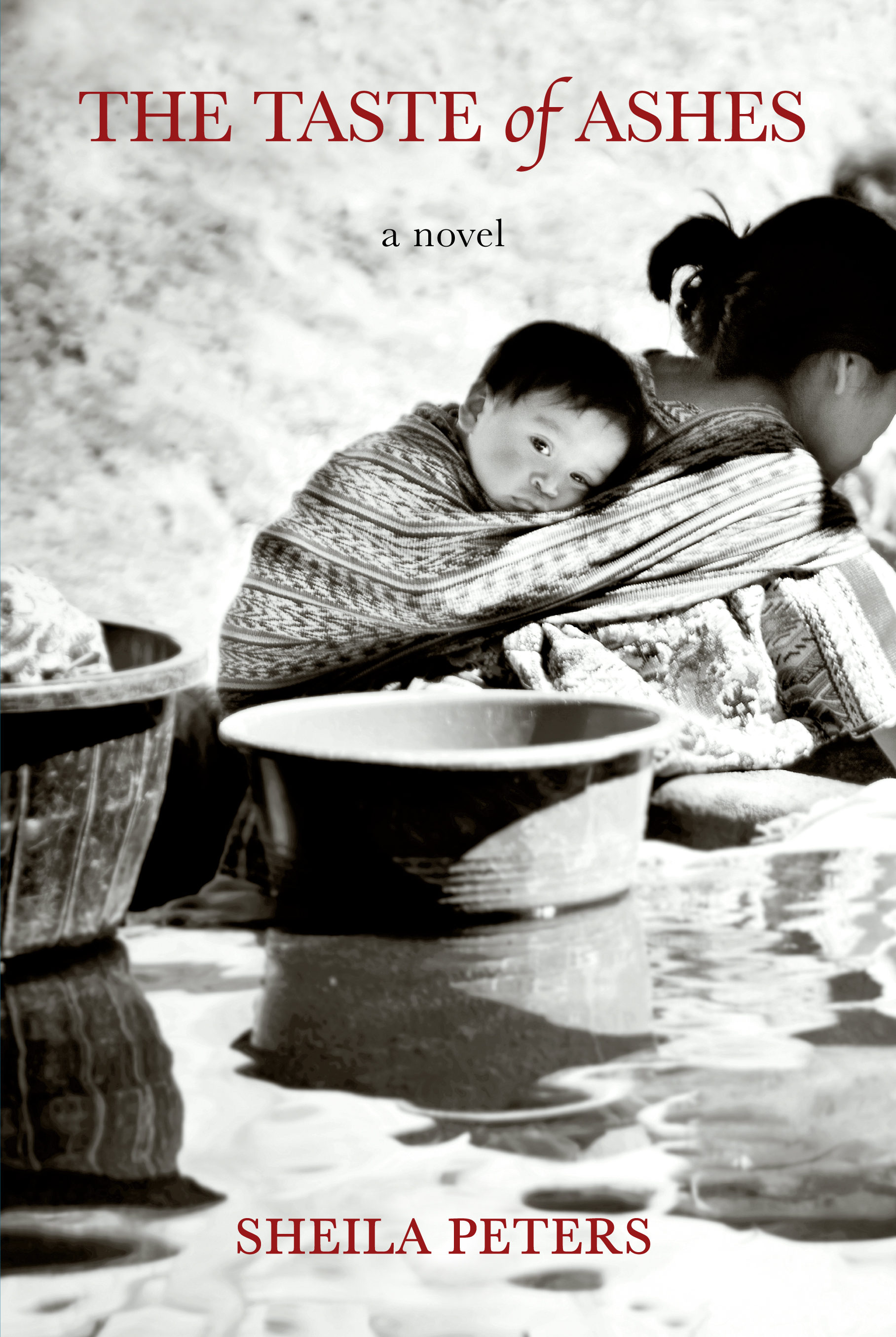
Book Review – The Taste of Ashes by Sheila Peters

Taste of Ashes The Taste of Ashes by Sheila Peters reads more like non-fiction about actual living, breathing individuals and literally true events, than well-researched fiction that’s “merely” emotionally true. By praising it or raving about how much I enjoyed it, I feel I’m making light of real people’s very difficult, hard circumstances. Likewise, if I criticize any part, I feel I’m somehow slamming real people—and how dare I do that?

But I did enjoy it. Identified with it. Laughed out loud in places. The story’s written in a braided narrative, with three main point-of-view characters: Isabel Lee, one-time wild child, now recovering alcoholic and fodder for the small town rumour mill, Father Álvaro Ruiz, a priest seeking respite in Canada after enduring mind, body and spirit breaking torture in Guatemala, and Janna—Isabel and Álvaro’s daughter, born out of an intense affair the first time Álvaro was in Canada as a young Oblate priest—a child Álvaro knows nothing about. Once their voices were established and I knew who was who, I could hardly put the book down—though at times, out of stress, outrage and empathy, I wanted to throw it across the room.

Peters is incredibly skilled at showing the many-layered ways we hurt the people we love unintentionally (through ignorance and indifference—or just misunderstanding what they actually need from us)—and worse, the ways some people intentionally set out to damage and destroy others. She’s equally adept, however, at showing that healing also exists (if at a price), that love (in the furthest thing from a mushy, romantic sense of the word) endures, and grace—in sharp splinters of pain and light—can eventually pierce and change even the bleakest reality. She also shows and celebrates the power of beauty and nature.

Disturbing, challenging content adds depth to the pure pleasure of a well told, absorbing story and provokes thought. Like Isabel, I have lived in northern BC my whole life (I was born in Smithers and actually lived on Railway Avenue for most of my early childhood—the same street Isabel lives on), and any pain and personal hardship I’ve experienced has been on a small town scale. I don’t fear authorities. I have the luxury of “rights.” Torture at the hands of the government (shameful for me to admit) is the stuff of movie plots or awful newscast footage. I am moved and horrified by it, but in the detached way of one who is safe from such things. To explore the darkness and seeming randomness of that type of evil was very difficult and, I think, beneficial (though even that word—beneficial—reeks of privilege). I was shamed by my insulated safety, and by my lack of knowledge about South America, particularly Guatemala.

As all the best novels do, the ones that are read for generations because of the glimpse they provide into specific times and histories, The Taste of Ashes broadened my view of our world, and opened my eyes to aspects of human experience that shouldn’t be ignored.

I was driving to work in May, listening to the radio, and CBC happened to be interviewing a Forensic investigator about the trial of Guatemalan general Efrain Rios Montt (found guilty of genocide and crimes against humanity, he was sentenced to 80 years in jail—a historic, and long overdue, achievement for the people of Guatemala), and I started to shake a bit. Not only did I recognize the name, I had personal reaction to the type of atrocities he was directly responsible for.

The Taste of Ashes can simply be read as an interesting story of a passionate, illicit love affair, its fallout and the subsequent lives of those involved, but for me it’s more—the type of tale that makes me consider the kind of person I am, the sort of life I am privileged to live—and what, if any, responsibilities come with that privilege.

Peters’ beautiful, strong writing and vivid, put-you-there descriptions made it easy to forgive the (very few) instances where I stumbled over a slightly awkward phrase or transition into a different point-of-view or time period that could have been smoother.

My only real “complaint” about the book is not about the story at all; it’s about its cover. While I know one can’t (or shouldn’t!) judge a book by the cover, I’m confused by its plain garb. I don’t see how the sedate, black and white photo of a babe in a blanket-sling on his faceless mother’s back fits specifically to the story or speaks to its themes. Nothing hints of the exposure (and exposé) the story provides of northern BC living. Nothing shows of the complexity of the cross-cultural, cross-generational relationships it delves into.

Don’t let the slightly boring cover put you off. The Taste of Ashes is well worth your investment of time and money. If you give it a go, let me know. I’d love to hear your thoughts on it.

North Words Creative Writers Retreat

North Words Creative Writers 2013 Retreat is running August 10 – 11 in Terrace, BC this year. As ever, it promises to be an inspiring, motivating time, filled with craft discussion and writing exercises, and I was thrilled to be asked to be a guest presenter. Maybe I’ll see you there? I look forward to it!

p.s. If you have any questions about the event, I’ll either answer them for you or find someone who can. 🙂

NorthWords Adult Poster 2013

Return to sender . . .

"Returned Manuscript" Photo by Ev Bishop

“Returned Manuscript” Photo by Ev Bishop

My recent weeks have been full of emptying—first one house, then another. As I sorted through closets and cupboards, some of which, honestly, that hadn’t been gone through in 20 odd years, quite a few items gave me pause. Why on earth had he (my dad) kept that? Or, conversely, at my old house, why on earth did I hold onto that?

One such item, tucked away in the back of a cupboard above my bedroom closet, was a sealed box. A manuscript box. Marked “Requested Material.” Besmirched with a black X through the intended recipient’s address and a sticker instructing you to turn the box over.

Doing as bidden, another sticker greets you, one with five options: Insufficient address, Attempted not known (whatever that means!), No such number/street, Not deliverable as addressed – unable to forward, and Other. “Other” is selected with another X and a red, slightly smeary stamped imprint shouts “Unclaimed.”

More injuriously, another stamped mark says 1st Notice, 2nd Notice, Return—and there are handwritten month and day notes beside category.

I remembered, only upon seeing the box again, the initial request for the full manuscript—how excited I’d been.

I also remembered how disappointed, and irritated, I’d been when it came back. I carefully follow all submission guidelines. In this instance, I’d spoken with the agent in person, received the request to submit in person, been given the address to send to in her handwriting.

I didn’t send the parcel priority post, or in some other manner that requires a signature or a special trip into a postal outlet for pick up. It should’ve been delivered right to their office . . . so maybe they don’t have a big enough mailbox for manuscript boxes? (If that’s the case, how bizarre!) Or maybe she’d never really wanted to consider my novel in the first place? (Ouch, but please, I’d rather she’d just said so!)

I suspect the reality is nothing like any of my above suppositions. It’s just something that occasionally happens with mail. And when you’re busy, and the object you’re receiving notices about is off your radar, you don’t get around to picking it up. Nothing personal. No big deal.

But what is a big deal: Why didn’t I follow up, or resend it, or . . . do something? Why did I tuck it away, out of sight, out of mind . . . Imagine if I didn’t move for another 20 years or more, what a find it would be then!

I haven’t decided what to do with the unopened box. But I am taking it to heart, as it strikes me as a powerful (if painful!) message about my writing in general.

This novel, packaged up with such care, only to be stuck away, hidden from all, is symbolic of what I do with a lot of my writing.

I love to write (as I think any of you who read my blog know!); I don’t love the submission process. I would like to share my stories, perhaps connect with someone out there, make them laugh, or cry or just . . . relate—but that desire is always a bit peripheral to the actual act of writing.

The result of this . . . laziness, fear, slight disinterest, whatever . . . is that I have many stories and quite a few novels that have yet to see the light of day.

I don’t want to become one of those writers for whom publishing is the primary goal and content is secondary—but I also know that if I don’t start to put out a body of work fairly soon, my years to be able to do so will diminish, my chance to share my stories will shrink, and my hope to someday support myself with my words will become a more and more unlikely daydream.

And so, for now at least, the box sits on the floor by my desk, in a terribly inconvenient spot, where I keep tripping over it—a constant reminder that I need to be bolder, to more actively seek to share my words (and worlds!) with others. Wish me luck!

And tell me, what would you do with the unopened manuscript box?

Circles

So, after fourteen years or so where we are now, we’re moving. The house we bought used to be my dad’s—well, actually, my whole family’s. And they say you can’t go home again!

My new office is my old bedroom. Bizarre. And as I pulled out its carpet and built-in closet, then proceeded to paint the room a deep golden yellow called Bengalese Cream, I thought about circles—ones I want to continue and bring back to full strength (the gardens and flowerbeds, the yard!), and ones I want to break entirely, once and for all (for example, a genetic propensity for . . . collecting).

Memories crouch in every corner and sit on every shelf in my new-old house, and as in any life, some are wonderful . . . others not so much.

My little nephew visited one day while I was emptying out the kitchen, and found a smiley-faced toy carrot on a coffee table in the living room. “Hey, I remember this!” he exclaimed with delight—then his tone grew suspicious. “Wait, you’re not throwing it away are you?”

I assured him that no, I wasn’t throwing it away. It was a keeper. And it is. I think, literally, every child and grandchild of Simon and Susanne Higginson has chewed on that rubbery, squeaking toy. It’s practically an institution.

But I am recycling, gifting, selling, or scrap-yarding almost everything else. I have my own stuff, literally and metaphorically, to put into the house now.

At first I felt bad clearing things out, but time moves on and life constantly changes, regardless of the physical items we cling on to, trying to pretend nothing’s different. The task then is to carefully choose a few things that have special significance and pass on everything else to people who can use it better than you. Or that’s my aim anyway.

An antique doughboy in the entrance way will take its place in the living room once more. How can it not? Every time I see it, my sister’s a laughing toddler again, magazines strewn about her, waving, wildly proud, from the compartment she’s standing in.

A wardrobe from the 1800s reminds me of times spent in antique shops and second-hand stores with my mom.

A child-sized workbench, handmade by my dad, will remain in the garage. I can’t wait to outfit it with new tools (The labels for what should hang where are still there!) and restock it with miscellaneous lengths of wood for visiting kids to create with.

I’ve found a number of things we’d all thought lost forever, most notably a whole collection of pictures of one of my brothers. They’d been carefully pilfered out of the collection and mounted on poster board for his wedding. We all just forgot. It was profoundly sweet to look at this lifetime of childhood photos, chosen and arranged by my mom’s hand. You can feel the love—and the fun—she had in putting it together.

Other discoveries are as surprising and painful as a slip of a knife. A card from my husband’s mom (now deceased) to my mom when she was dying. Old letters from my parents to each other when they were fighting. Syringes, long outdated prescriptions, and other paraphernalia related to disease.

I wonder sometimes if I’m up to the task of taking on my family home, with all that concept entails—and while the verdict’s not in (It’s sort of a multi-year project), so far I’m pleasantly surprised and get a little more excited, a little more confident, about our decision every day.

The work is cathartic. I feel my parents smile at me occasionally. My mom shakes her head. “You’re not really going to keep that old thing are you, Ev?” My dad’s voice booms as I heft junk down the stairs: “Yep, you’ve always been a big strong girl.” (You can just imagine how I loved hearing that as a teen!) And in the kitchen, memories of my stepmom’s meals and baked treats inspire daydreams about future family events at the home I’ve circled back to . . .

_ _ _ _ _ _ _ _ _ _ _ _ _ _ _

“Circles” by me, Ev Bishop, was originally published in the Terrace Standard, June 26, 2013 as my monthly column “Just a Thought.”