Wherever you go, there you are . . .

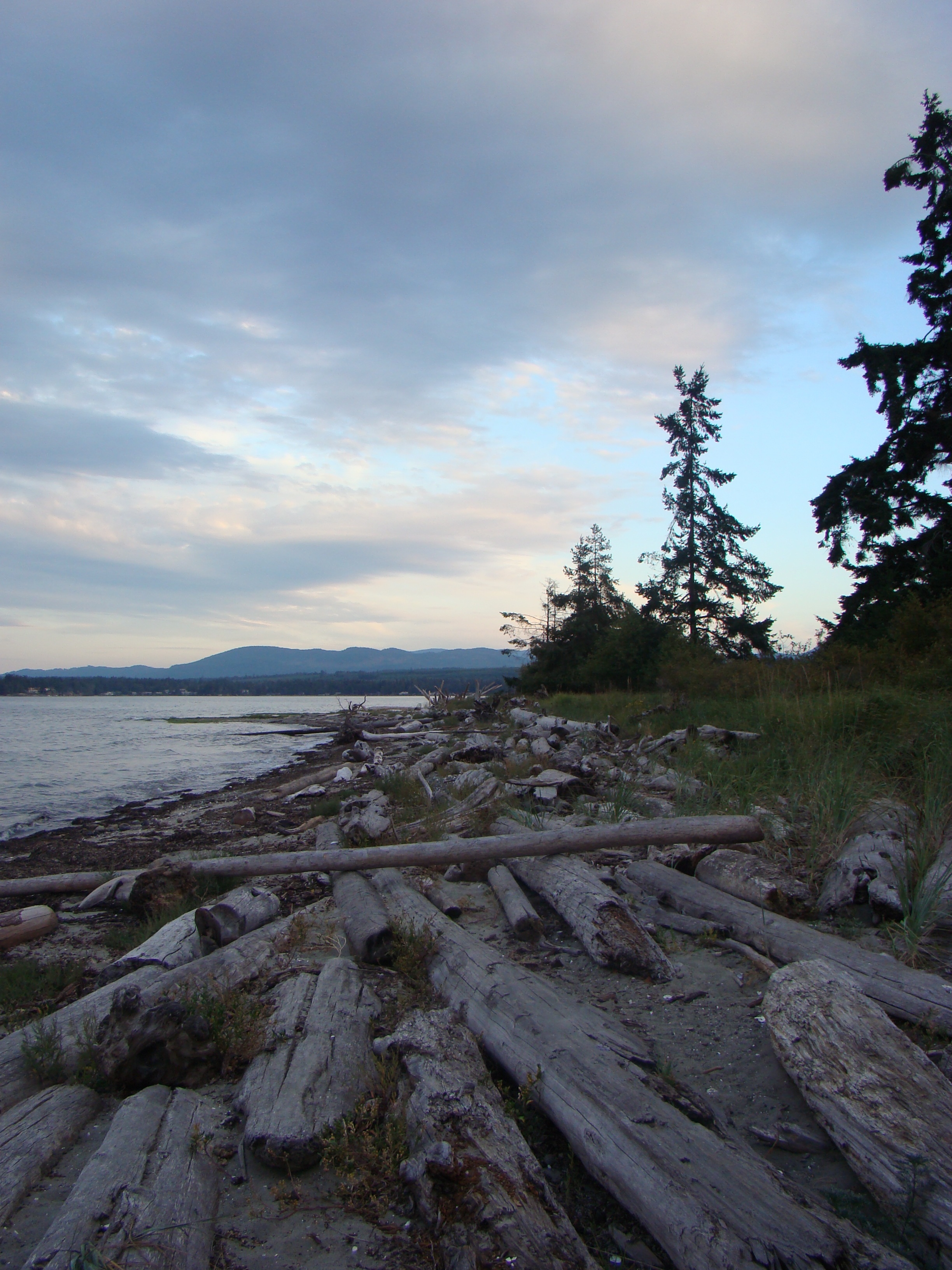
Photo by Ev BishopOnce upon a time, a long time ago, I was sitting at the end of a wooden dock in the purple-not-quite-dark haze of a warm northern summer night with a dear friend. We were discussing places we’d been (or he was) and places we hadn’t (me, everywhere; him, it seemed then, nowhere). I confess I was expressing a bit of jealousy and at one point he looked out over the shimmering dark mass of the tiny isolated lake we visited, and his side profile was a perfect black shadow.

“Nah, you don’t get it,” he said. “Wherever you go, you bring yourself. After about two weeks in any place, you stop being a visitor and they’re just the same as anywhere else, because you’re the same person. So if you enjoy where you are in general, you enjoy the place. If you aren’t happy in general, you aren’t happy in a new place.”

It was a life changing moment, though I didn’t realize it then; it grew on me over the years as the wisdom in his casual words came back to me time and again, applying aptly to so many facets of life.

And just recently, a variation of its truth struck me in how it relates to reading and story. I was commenting on a short exercise one of my friends did called *The Iceburg. In her reply to my comments, it became obviously, embarrassingly clear that I had completely missed her intended “understory” and put my own feelings and sentiments and past onto the character and his motivations/feelings.

I felt kind of stupid, but then I didn’t, because I realized that’s what readers do. They bring themselves to the book. To the short story. To the poem. Despite our best and most skilled writing, despite our subtle pointers and sometimes even didactic scenes meant to reveal something specific, readers will immerse themselves, with their personal histories, their guilts, their persuasions, in your story.

So can you challenge readers whom I’ve basically just said come into your story with preconceptions, prejudices, set ideas, notions, etc? Absolutely. The power and joy of reading—and its value—is that through story, you experience a new or different world and can add others’ experiences to your own, enlarging your thinking and ways of seeing/perceiving the world.

But equally absolutely, you will sometimes be surprised by what conclusions a reader arrives at about your story . . . hopefully not in too negative a way—my friend wasn’t offended—I hadn’t said anything offensive—she was just curious about how I’d gotten what I had from my read . . . and quite simply this was how: her character reminded me of someone I knew and I put all my “stuff” with that person on to her character.

So what does this fact that the reader brings him/herself to the story, thus colouring its reading, mean for us as writers? At least two things: 1) We should write our stories putting as much personal heart, care, and detail as possible. They are ours. 2) We should share our stories, knowing that once we do, they are ours no longer—or, at very least, not in the way they were, because now they are the reader’s. Precious and loved—or hated and scorned—perhaps for reasons we skilfully intended, perhaps for reasons that have nothing to do at all with what was actually in the story we wrote.

For me, it takes a bit of the pressure off—yes, I want to write stories that people love, relate to in some way, “get” . . . But if they don’t, perhaps it’s not me. It’s them. 🙂


* The Iceberg comes from a book of writing exercises that I recommend you buy: The 3 am Epiphany by Brian Kiteley.

If you’d like to try the exercise yourself—it’s a great one—here you go: “Write a small story or storylet that works with the idea of an iceberg, whose great mass is mostly below the water and therefore unseeable. Write a scene in which much of the actual story is not told. Let us feel the rest of the story that bobs quietly underwater, but don’t let us see it concretely. 500 words.”

If you do the exercise, I’d love to hear how it went, or better yet, let me read your resulting short story.

Where my head is at these days

Do you ever feel like a character in one of your own stories?

Ilene never regretted marrying young, choosing family over further formal education, and writing over a “real” job—until 2012 when colossal world ending shifts in the earth’s tectonic plates forces her to consider the path she chose. If she could do it all over again, would she change a thing?

Okay . . . my life is not exactly like Ilene’s or at all (hopefully!) like the theme of a certain year-titled film, but I have been doing some thinking on the choices I’ve made and will make in the future about my writing.

It’s not a case for panic—I go through these reassessment times fairly frequently, finding them invigorating and affirming (and sometimes a necessary correction: “Hey, you took a wrong turn back there, get back on the road.”) In fact, this current bout of reflection has me bouncing off walls and just feeling plain old excited about what’s ahead, because so far I’ve made almost all of my self-imposed goals.

I’ve been writing “seriously” for just over ten years. My non-fiction tends to sell when I submit it (if I keep it out there enough, anyway ;-). I’ve started to sell short stories. I have one standalone novel or (maybe) two ready for publication and a Book 1 ready to go, plus half of Book 2 of what I see being a three-book series.

By many writers’ measure, the above paragraph of accomplishments might seem scant, but to me it’s wonderful success: I have kept on keeping on. I have continued writing even when everyone around me (and a loud voice in my own head) says, “Why? Isn’t there something more worthwhile, more practical, more something you could do?”—And now my writing really is entrenched, accepted, and nary receives a condescending smile!

I don’t know what exactly is ahead in my writing life, but it feels like there is “something,” and I’m excited about it—or then again, maybe I do have a small notion, but I’m holding it back for a bit.

Thankfully the end-of-the-world shtick was just a plot device, but Ilene can’t be too angry. She’s relieved to embrace the life she’s leading and accepts that while she can’t know what the future holds, looking forward to good things rather than worrying about possible bad things is way more beneficial to every part of her life (and is way more fun!). She would not change a thing.

So that’s me, looking back at the past years of my writing life and looking ahead to possibility . . . What’s your writing head like these days?

How many drafts?

Earlier today on Twitter, my friend Jen Brubacher retweeted about Anne Rice and how she only writes one draft: Doing drafts.

I watched/listened to the short blip with great interest. Anne Rice’s process supports some thinking I’ve been doing since I started perusing Dean Wesley Smith’s Killing the Sacred Cows of Publishing, especially his ideas on Speed and ReWriting. (Okay, I’ve been pretty obsessed with his pontifications about agents too, but the thoughts sparked there are beyond the scope of this post!)

I don’t think I will ever get to a place where I do only one draft, and I’m not sure I want to. There’s huge value in going through work with the purpose of getting it to say what you want it to say, how you want it said . . . And there’s equally huge value in having that “Don’t worry” card to hand your nasty inner editor (presuming you have one of those too): Just let me fly through my story–it’s wonderful fun. And if I’ve screwed something up? Don’t worry. I’ll fix it when I’m done. (A cheerful rhyme infuriates my I.E. to no end!)

Most writing I do (and most writing I edit for others) needs at least one thorough self-edit, one more edit after trusted reader response, plus a proofing. But even that — for me to say, maybe things only need four drafts, total — well, that’s an enormous change in my approach to craft and process.

I didn’t rewrite my first novel; I just wanted to know I could write one. And I did it — 86K, with a solid beginning, middle, and end . . . What a rush!

I rewrote my second novel, literally, about 20 times. And tried to sell it. Sort of. I sent it out to about 30 people at various stages of its 20 drafts. But I knew as I edited, I wasn’t really so much editing as I was teaching myself how to write.

My last novel was stronger at the end of its first draft than that second one was at its 18th. And these days I rarely put things through more than four edits. I felt incredibly intimidated by that. Maybe I’m fooling myself? I wondered. Maybe I’m embracing mediocrity. Maybe . . . ARGH.

Lately my maybes have changed. Maybe, just maybe, I show a story better on the first wonderful spill . . . and again, just maybe, I see better _exactly_ what needs to be added, chopped, refined, respun, deleted on my first read . . .

I don’t think how many drafts a writer does actually matters. We all have our own processes and methods for getting stories out on the page, and so long as we’re finishing things, sending them out, and starting new stories at pretty regular intervals, our differing systems are perfect.

It’s been really motivating to have my current way of doing things affirmed by pros, however, even if it’s also a bit scary (in a delicious, wonderful way). I have quite a body of work. It’s time to stop stop hacking at it and starting sending it out with greater focus and energy (and less fear!) than I have before.

Wish me luck!

And now it’s your turn. Weigh in, please. 🙂 How many times do you work through a story (short or novel length)? Do you have an overarching system and rules, or is your approach to editing more piece-by-piece?

Happy writing (and editing),
Ev